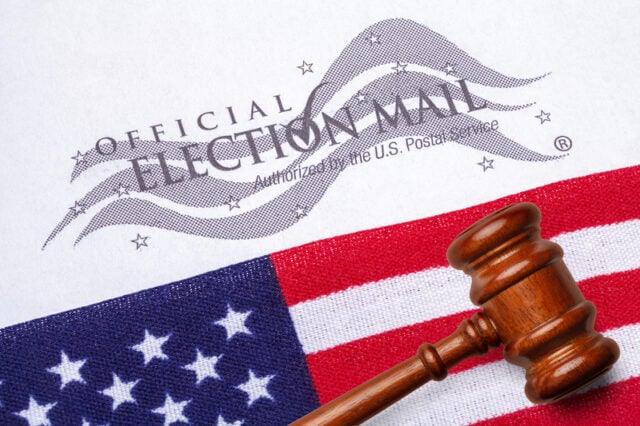
The Supreme Court handed Donald Trump a major legal setback on Monday. The justices refused to reinstate sweeping restrictions on mail-in voting. Their decision preserves current mail ballot procedures nationwide. Election administrators had warned that sudden policy shifts would trigger widespread chaos. Tens of millions of voters can now cast their ballots under familiar rules.
The fierce legal battle centered on an executive order issued in March. That presidential directive instructed the United States Postal Service to enforce rigid new procedures. Under the plan, states would have had to submit complete voter rolls. Those voter names had to be entered into an untested federal verification database. The agency also created strict new requirements for mail ballot envelopes. Postal officials warned that noncompliant election mail would be turned away. A whistleblower later told Congress the software remained deeply flawed.
Civil rights groups and twenty-four state attorneys general quickly sued the administration. U.S. District Judge Indira Talwani in Boston issued an initial injunction halting the mandate. She concluded that the executive branch lacked constitutional authority to dictate state voting rules. Shortly after, U.S. District Judge Carl Nichols in Washington issued a matching injunction. Nichols ruled that federal postal statutes do not authorize postal leaders to police voting. Facing twin defeats, the administration petitioned the Supreme Court for emergency intervention.
The high court decisively turned down the administration’s emergency application on Monday night. Justice Brett Kavanaugh concurred with the majority’s conclusion in a brief opinion. He noted that changing election machinery right now would be arbitrary and profoundly disruptive. Local election workers need operational stability while balloting is actively taking place. Justices Clarence Thomas and Samuel Alito dissented from the unsigned order. The final decision ensures postal workers can handle election mail as usual.

Although this emergency order resolves the current election season, Trump still has distinct options. First, his administration can continue litigating the lawsuit on its merits. The case will proceed through lower appeals courts in the coming months. A complete review could ultimately bring the issue back before the Supreme Court. That avenue seeks to affirm broader executive control over federal mail standards for future cycles. Second, Trump can pressure Congress to pass national legislation curbing mail ballots. Republican leaders previously introduced bills mandating strict photo identification and citizenship documentation. However, passing sweeping voting measures requires overcoming steep opposition in the Senate.
Third, Trump can urge Republican-led state legislatures to revise their local election codes. The United States Constitution grants individual states primary power over voting logistics. State lawmakers can independently limit mail ballot access by modifying state statutes. Several jurisdictions have previously restricted unattended ballot drop boxes and shortened application periods. Fourth, the Trump campaign can launch targeted post-election challenges in battleground precincts. Campaign legal teams routinely challenge signature verification standards and late-ballot deadlines. These localized court fights provide an established avenue for disputing individual ballot tallies.
Voting rights organizations celebrated the ruling as a crucial win for civic participation. Legal representatives from the American Civil Liberties Union commended the high court’s restraint. They emphasized that mail balloting is secure, well-tested, and trusted by voters. Nearly one-third of the national electorate cast mail ballots in recent elections. Overseas military personnel and disabled voters depend heavily on reliable postal deliveries. The ruling ensures that no legitimate voter faces unexpected postal barriers this autumn.
Meanwhile, conservative leaders and White House officials expressed deep frustration with the outcome. Donald Trump reiterated his claim that mail voting invites widespread administrative irregularity. Administration allies argued that uniform federal postal standards would strengthen public confidence. Nevertheless, federal courts remain extremely skeptical of eleventh-hour rule changes. The judiciary generally avoids altering voting mechanics once election cycles are already running. For now, election administrators nationwide can operate under stable, pre-existing guidelines.
The Supreme Court’s decision closes the door on federal postal limits for this cycle. Yet the heated political clash over mail balloting is far from settled. Both political parties are shifting their focus back toward turn-out campaigns. Voters seeking specifics about their local ballots can verify details through the official Vote.gov Voter Portal. The ongoing legal debate over election authority will likely resurface in coming years.
Sources Used
- The Associated Press
- CBS News
- The Washington Post
- Democracy Docket
- Votebeat
- ACLU of Massachusetts
- Vote.gov
Disclaimer
Artificial Intelligence Disclosure & Legal Disclaimer
AI Content Policy.
To provide our readers with timely and comprehensive coverage, South Florida Reporter uses artificial intelligence (AI) to assist in producing certain articles and visual content.
Articles: AI may be used to assist in research, structural drafting, or data analysis. All AI-assisted text is reviewed and edited by our team to ensure accuracy and adherence to our editorial standards.
Images: Any imagery generated or significantly altered by AI is clearly marked with a disclaimer or watermark to distinguish it from traditional photography or editorial illustrations.
General Disclaimer
The information contained in South Florida Reporter is for general information purposes only.
South Florida Reporter assumes no responsibility for errors or omissions in the contents of the Service. In no event shall South Florida Reporter be liable for any special, direct, indirect, consequential, or incidental damages or any damages whatsoever, whether in an action of contract, negligence or other tort, arising out of or in connection with the use of the Service or the contents of the Service.
The Company reserves the right to make additions, deletions, or modifications to the contents of the Service at any time without prior notice. The Company does not warrant that the Service is free of viruses or other harmful components.