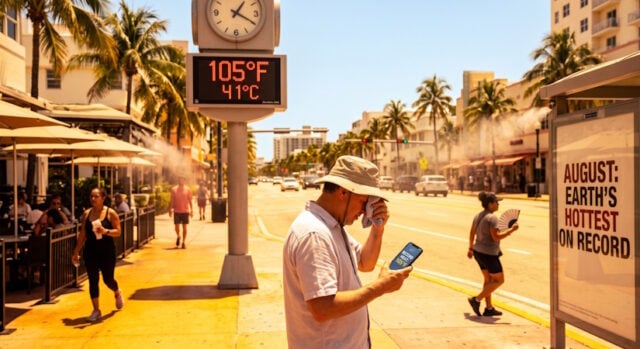
The Heat Broke Every Chart
If you felt like you were melting last month, you were not alone.
Climate scientists have confirmed our collective dread. August officially went down as the hottest August ever measured globally. In fact, it tied July 2023 for the warmest month across all history.
The European Union’s Copernicus Climate Change Service reported global surface air temperatures reached 16.96°C. That is roughly 62.5°F across the entire planet’s surface.

More alarming, temperatures sat 1.65°C above pre-industrial levels. It marks another month crossing the symbolic 1.5°C threshold.
Oceans Are Simmering
The land was scorching, but the world’s oceans were practically boiling over.
Average sea surface temperatures over extra-polar oceans reached 21.07°C. That beat the previous August benchmark set in 2023. At one point, daily global ocean marks peaked at 21.11°C.
Warmer waters do not just disrupt marine ecosystems. They act like high-octane fuel for tropical storms. They also make cooling breezes along coastal cities almost impossible to find.
What Drove the Searing Spike?
Two main culprits drove this unprecedented spike.
First, greenhouse gas pollution continues to trap heat in our atmosphere. That creates a steadily rising baseline for global temperatures.
Second, a powerful El Niño cycle gained momentum across the Pacific. This natural climate phenomenon releases vast amounts of stored oceanic warmth.
When human warming meets a strong natural warming cycle, records tumble fast. Western Europe, central Africa, and parts of Asia saw massive anomalies.
The Human Toll
Numbers only tell part of the story.
Cities struggled to keep power grids humming under surging air-conditioning demands. Major European rivers dwindled to historic lows. Farmers faced ruined crops and hardened topsoil.
Wildfires erupted across parched landscapes. For millions of people, overnight temperatures stayed dangerously high. Without cool nights, the body never gets a chance to recover.
Outlook
Do not expect an immediate cooldown as fall arrives.
Forecasters warn that El Niño conditions will likely strengthen further through early next year. That means ocean heat and erratic weather will persist into 2027.
Expect an active tropical storm season and lingering regional droughts. Winter may bring unusual warmth to many northern regions. August set a terrifying benchmark. Yet, it may soon just feel like an ordinary summer.
Sources Used
- Copernicus Climate Change Service (C3S): https://climate.copernicus.eu/climate-bulletin
- World Meteorological Organization (WMO): https://wmo.int/media/news/earth-has-hottest-august-record
- National Oceanic and Atmospheric Administration (NOAA): https://www.ncei.noaa.gov/access/monitoring/monthly-report/global/
Disclaimer
Artificial Intelligence Disclosure & Legal Disclaimer
AI Content Policy.
To provide our readers with timely and comprehensive coverage, South Florida Reporter uses artificial intelligence (AI) to assist in producing certain articles and visual content.
Articles: AI may be used to assist in research, structural drafting, or data analysis. All AI-assisted text is reviewed and edited by our team to ensure accuracy and adherence to our editorial standards.
Images: Any imagery generated or significantly altered by AI is clearly marked with a disclaimer or watermark to distinguish it from traditional photography or editorial illustrations.
General Disclaimer
The information contained in South Florida Reporter is for general information purposes only.
South Florida Reporter assumes no responsibility for errors or omissions in the contents of the Service. In no event shall South Florida Reporter be liable for any special, direct, indirect, consequential, or incidental damages or any damages whatsoever, whether in an action of contract, negligence or other tort, arising out of or in connection with the use of the Service or the contents of the Service.
The Company reserves the right to make additions, deletions, or modifications to the contents of the Service at any time without prior notice. The Company does not warrant that the Service is free of viruses or other harmful components.