
A Florida driver can carry the required $10,000 in Personal Injury Protection coverage and still receive only a fraction of a crash-related medical bill. The policy limit is one part of the calculation.
Direct answer: Florida PIP benefits may come in under $10,000 because that figure is a maximum policy limit, not a guaranteed reimbursement. Treatment generally must begin within 14 days. Access to the higher medical-benefit tier depends on a qualifying emergency medical condition determination, and PIP generally pays 80% of covered medical expenses subject to statutory limits.
Verify the current official text before relying on any figure, because the legislature can amend these provisions and courts continue to interpret them.
How Much Does PIP Actually Pay in Florida?
Florida PIP provides up to $10,000 in combined medical and disability benefits. But the amount available for medical expenses depends on statutory conditions and on whether other covered benefits draw from the same limit. PIP is first-party coverage, meaning an eligible insured seeks benefits under the applicable policy without first proving another driver caused the crash.


Under Fla. Stat. § 627.736(1), the standard limit covers combined medical and disability benefits. Medical expenses are generally reimbursed at 80%. Disability benefits are generally paid at 60% of lost income and earning capacity, and the statute addresses death benefits separately.
Readers often confuse three figures here: the coverage limit, the allowable charge, and the amount actually paid. The limit is the ceiling. The allowable charge is what the statute and fee schedules permit for a given service. The payment is what the insurer issues after applying both.
What Does PIP Cover Under Florida Law?
PIP covers reasonable and necessary medical services related to the crash, along with qualifying disability losses and the statutory death benefit. The statute also excludes certain services. Under Fla. Stat. § 627.736(1)(a)5, medical benefits exclude massage therapy as defined in § 480.033 or acupuncture as defined in § 457.102, and a licensed massage therapist or acupuncturist may not be reimbursed regardless of who ordered the service.
How an EMC Changes the Available Benefit Tier
A qualifying emergency medical condition determination can provide access to medical and disability benefits up to the full $10,000 limit. When the statute’s lower tier applies instead, medical benefits are capped at $2,500. The same crash and the same bill can therefore produce sharply different payments, depending on the medical documentation.

Under Fla. Stat. § 627.732(16), an emergency medical condition is a sudden, severe health crisis—such as intense pain—that requires immediate medical attention to prevent serious health risks, organ dysfunction, or long-term bodily impairment. Who makes that call matters. Florida law uses a specific standard for a Florida emergency medical condition (EMC), and the documentation can decide which benefit tier applies to your claim.
Who May Make the Affirmative EMC Determination?
Physicians, osteopathic physicians, and dentists fall within the categories listed in Fla. Stat. § 627.736(1)(a)3. An authorized provider must make an affirmative determination to establish eligibility for the higher tier.
Chiropractors are not on that list. A chiropractor cannot make the affirmative EMC determination for the higher tier, although that limitation does not by itself determine whether chiropractic treatment otherwise qualifies for reimbursement.
What If the Records Do Not Establish an EMC?
Under Fla. Stat. § 627.736(1)(a)4, reimbursement is limited to $2,500 if a qualifying provider determines that no emergency medical condition existed. That cap applies when a provider makes a no-EMC determination; it is not a penalty.
If the records contain no determination at all, do not treat silence as an affirmative EMC finding. The effect of incomplete or unclear records can depend on the documentation and current Florida appellate authority, so the file may require case-specific review.
What Happens If Treatment Does Not Begin Within 14 Days?
Under the Florida PIP 14-day rule, medical benefits are generally unavailable unless initial services and care are received within 14 days after the accident from a provider recognized by the statute, as provided in Fla. Stat. § 627.736(1)(a). The deadline concerns initial services, not the completion of all treatment.
Reporting symptoms to an insurer does not satisfy the treatment requirement. Qualifying care from a qualifying provider must begin within the statutory window. Waiting because the pain seems manageable can create a coverage problem even if symptoms worsen later, so prompt evaluation matters.
Records to Keep After Initial Treatment
- The date of treatment and identity of the first treating provider
- Medical records and referrals
- Itemized bills and insurer explanations of benefits
- Written requests, decisions, or denials concerning EMC status
Why PIP Usually Does Not Pay 100% of a Medical Bill
Florida PIP generally pays 80% of a covered, reasonable, and necessary medical expense, subject to the applicable benefit ceiling and statutory reimbursement rules under Fla. Stat. § 627.736. The patient, a health insurer, or another source may remain responsible for the balance.
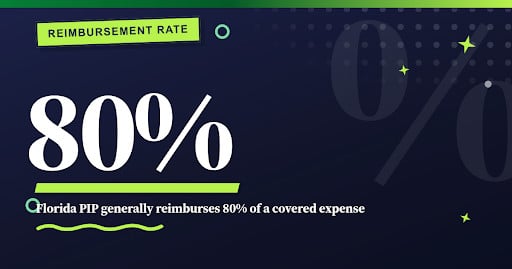
The 80% calculation is not always based on the provider’s full billed amount. The statute includes reimbursement and fee-schedule provisions that can reduce the allowable charge before applying the percentage, so the payment calculation may begin with an allowable charge rather than the invoice total.
Florida PIP Medical Bill Calculation
The table below provides simplified illustrations. Each example assumes the full bill is covered, reasonable, necessary, timely, and not reduced by a fee schedule.
| Simplified scenario | Covered medical bill | 80% calculation | Benefit-tier effect | Illustrative PIP payment | Unpaid bill balance
|
|---|---|---|---|---|---|
| Qualifying EMC documented | $8,000 | $6,400 | Within $10,000 tier | $6,400 | $1,600 |
| Lower $2,500 tier applies | $8,000 | $6,400 | Capped at $2,500 | $2,500 | $5,500 |
| Qualifying EMC and larger bill | $15,000 | $12,000 | Capped at $10,000 | $10,000 | $5,000 |
These examples do not account for deductibles, fee-schedule reductions, policy exclusions, prior benefit payments, or disputes over medical necessity. They illustrate the basic mechanics and do not predict what an insurer owes in a particular case.
Is PIP Still Required, and Is There a New Florida PIP Law?
Is PIP Coverage Still Mandatory for Florida Drivers?
Yes, generally. Under Fla. Stat. § 627.733, owners or registrants of qualifying Florida motor vehicles must maintain the security required by law, which includes PIP coverage. The statute includes exceptions, and not every vehicle or person is treated the same, so check the current text for your situation.
What Is the “New” Florida PIP Law?
The term “new law” can be misleading. Fla. Stat. § 627.736 includes the 14-day treatment requirement and EMC-linked medical-benefit tiers. Because insurance statutes and court interpretations can change, verify the law applicable on the accident date rather than relying on an undated summary.
Other Questions About Florida Crash Claims
Does Florida’s 51% Rule Reduce PIP Benefits?
No. The comparative-fault rule in Fla. Stat. § 768.81 generally concerns negligence claims, not the calculation of first-party PIP benefits. A claimant found more than 50% at fault may be barred from recovering damages in an affected negligence action, subject to statutory exceptions, but that analysis is separate from PIP’s no-fault structure.
How Much Time Do You Have to Pursue a PIP Claim?
Several deadlines may apply. You generally must receive initial medical services within 14 days under Fla. Stat. § 627.736. An action seeking unpaid PIP benefits under a written insurance policy is generally subject to Florida’s five-year limitation period for claims founded on a written instrument under Fla. Stat. § 95.11(2)(b). The accrual date, policy terms, notice requirements, billing rules, and statutory presuit procedures may all affect the actual deadline in a particular case.
Act promptly and obtain case-specific guidance rather than waiting until the general limitation period is close to expiring.
What to Check When the Payment Is Lower Than Expected
Compare the insurer’s explanation of benefits with the treatment date, the provider’s credentials, the EMC documentation, the allowable-charge calculation, any deductible, and benefits already paid from the same limit. An unexpectedly low payment usually traces back to one of those entries, and each should appear in the claim records.
A policy limit states the most a policy may provide under covered conditions. The actual payment depends on Florida law, the policy terms, and the individual medical and billing records, so disputed benefits may require a case-specific review.
Disclaimer
Artificial Intelligence Disclosure & Legal Disclaimer
AI Content Policy.
To provide our readers with timely and comprehensive coverage, South Florida Reporter uses artificial intelligence (AI) to assist in producing certain articles and visual content.
Articles: AI may be used to assist in research, structural drafting, or data analysis. All AI-assisted text is reviewed and edited by our team to ensure accuracy and adherence to our editorial standards.
Images: Any imagery generated or significantly altered by AI is clearly marked with a disclaimer or watermark to distinguish it from traditional photography or editorial illustrations.
General Disclaimer
The information contained in South Florida Reporter is for general information purposes only.
South Florida Reporter assumes no responsibility for errors or omissions in the contents of the Service. In no event shall South Florida Reporter be liable for any special, direct, indirect, consequential, or incidental damages or any damages whatsoever, whether in an action of contract, negligence or other tort, arising out of or in connection with the use of the Service or the contents of the Service.
The Company reserves the right to make additions, deletions, or modifications to the contents of the Service at any time without prior notice. The Company does not warrant that the Service is free of viruses or other harmful components.