The waters in the Middle East just became a lot more dangerous. On Tuesday, the United States military destroyed five Iranian crude oil tankers. The strikes came as direct retaliation for repeated Iranian aggression at sea. According to U.S. Central Command, Iranian forces targeted an American Navy warship twice this week. The Islamic Revolutionary Guard Corps fired multiple ballistic missiles at the vessel over two days.
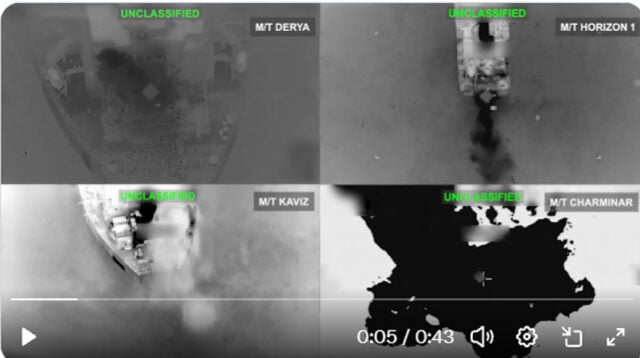
CENTCOM forces destroyed five Iranian crude oil carriers, Sept. 8, after the Islamic Revolutionary Guard Corps (IRGC) targeted a U.S. Navy warship with ballistic missiles twice over the past two days. The U.S. warship successfully evaded the attempted Iranian attacks and… pic.twitter.com/Gi8a2tloN1
— U.S. Central Command (@CENTCOM) September 8, 2026
M/T Riesco sinks in the Gulf of Oman, Sept. 8, after being destroyed by CENTCOM forces in response to attempted IRGC attacks on a U.S. Navy warship. pic.twitter.com/EkmG8uyMT9
— U.S. Central Command (@CENTCOM) September 9, 2026
CENTCOM confirmed that the targeted American warship avoided every single incoming missile. The ship stayed completely unharmed and continued its scheduled patrols in regional waters. No American service members were injured during either of the missile attacks. However, Washington made sure Tehran felt an immediate and heavy economic price. American forces launched swift retaliatory airstrikes against Iran’s commercial fleet.

Military officials identified all five of the Iranian vessels struck during the operation. Four crude carriers were hit directly in the Gulf of Oman. Those ships were the Kaviz, the Charminar, the Horizon 1, and the Riesco. A fifth tanker, named the Derya, was destroyed near Kharg Island. Kharg Island serves as Tehran’s most vital terminal for global crude oil exports.
Before dropping any ordnance, American forces took crucial steps to protect civilian mariners. The military explicitly ordered the foreign crews on board each vessel to abandon ship. Once crews cleared the decks safely, precision strikes rendered all five tankers completely inoperable. CENTCOM emphasized that these vessels belonged to Iran’s state-backed shadow shipping network. The IRGC routinely relies on this shadow fleet to fund regional military operations.
This massive strike was not an isolated incident in the region. Just days earlier, American jets blasted three other Iranian oil tankers into scrap metal. Those previous hits also answered IRGC missile launches aimed at an aircraft carrier and destroyer. U.S. commanders have warned that further Iranian strikes will trigger even harsher retaliation. Military leaders pledged to dismantle Tehran’s exposed commercial tanker fleet ship by ship.
The broader conflict between the United States and Iran has lasted over six months. Diplomatic negotiations have stalled, leaving both militaries locked in continuous maritime confrontations. The U.S. Navy continues to enforce a strict naval blockade around major Iranian ports. Meanwhile, Iran has tried repeatedly to strangle traffic near the critical Strait of Hormuz. Nearly a fifth of the world’s daily oil supply passes through that narrow waterway.
Energy markets are watching the unfolding situation with intense anxiety. Strikes near Kharg Island hit at the very core of Iran’s oil revenue. Roughly ninety percent of all Iranian crude exports flow directly through Kharg facilities. Tehran quickly vowed to respond by striking maritime assets near Kuwait and Bahrain. Iranian political leaders insisted that recent salvos represent only a fraction of their firepower.
Neither side shows any willingness to back down in this high-stakes maritime standoff. American commanders remain committed to protecting commercial shipping lanes and naval assets. At the same time, each new attack pushes the region closer to an all-out war. For now, five more tankers sit dead in the water, sending a loud message to Tehran.
Sources
- The Washington Post: https://www.washingtonpost.com/national-security/2026/09/08/us-launches-strikes-5-iranian-oil-tankers-after-latest-attacks-warships/
- Washington Examiner: https://www.washingtonexaminer.com/news/world/4717252/us-hits-iranian-tankers-response-to-missile-attacks/
- Times of Israel: https://www.timesofisrael.com/liveblog_entry/us-says-it-destroyed-5-iranian-oil-tankers-after-ballistic-missiles-fired-at-warship/
- CBC News: https://www.cbc.ca/news/world/us-military-5-oil-tankers-iran-strikes-jordan-9.7336574
Disclaimer
Artificial Intelligence Disclosure & Legal Disclaimer
AI Content Policy.
To provide our readers with timely and comprehensive coverage, South Florida Reporter uses artificial intelligence (AI) to assist in producing certain articles and visual content.
Articles: AI may be used to assist in research, structural drafting, or data analysis. All AI-assisted text is reviewed and edited by our team to ensure accuracy and adherence to our editorial standards.
Images: Any imagery generated or significantly altered by AI is clearly marked with a disclaimer or watermark to distinguish it from traditional photography or editorial illustrations.
General Disclaimer
The information contained in South Florida Reporter is for general information purposes only.
South Florida Reporter assumes no responsibility for errors or omissions in the contents of the Service. In no event shall South Florida Reporter be liable for any special, direct, indirect, consequential, or incidental damages or any damages whatsoever, whether in an action of contract, negligence or other tort, arising out of or in connection with the use of the Service or the contents of the Service.
The Company reserves the right to make additions, deletions, or modifications to the contents of the Service at any time without prior notice. The Company does not warrant that the Service is free of viruses or other harmful components.