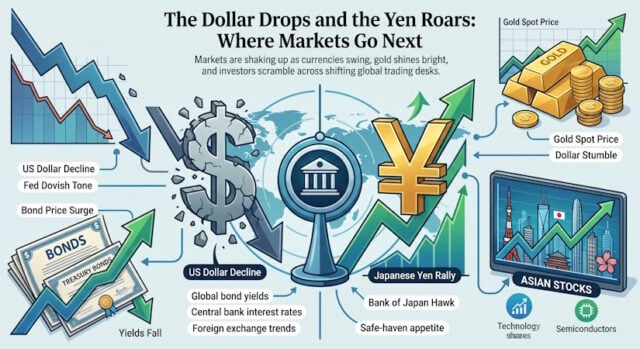
The Dollar Dips as Global Markets Pivot
Global financial markets just threw a wrench into the prevailing economic playbook. The mighty greenback stumbled sharply across international trading desks today. At the same time, the Japanese yen staged a ferocious and sudden comeback. Investors scrambled to adjust their books across several major asset classes. The ripples spread straight through Asian shares, precious metals, and sovereign bonds.
For months, dollar dominance felt like an unstoppable financial freight train. Yet the dollar index slid down toward the 99 handle this week. Dovish comments from Federal Reserve officials cooled expectations for aggressive rate hikes. Meanwhile, Tokyo delivered an entirely different message to global currency desks. Bank of Japan officials dropped heavy hints about another interest rate hike. Speculation swirled that Japanese policymakers might raise borrowing costs again soon. That dynamic sent the yen surging past key resistance barriers against the greenback. Traders holding short yen positions quickly rushed toward the emergency exits. Currency volatility reminded everyone that foreign exchange trends can flip very rapidly.
Bond traders also enjoyed a dramatic change in sentiment. Benchmark sovereign debt yields retreated from recent multi-month peaks. Because bond prices rise when yields fall, fixed-income portfolios caught welcome relief. The ten-year Treasury yield dropped back down toward 4.75 percent. Buyers emerged after a punishing multi-week bond selloff rattled market confidence. Cooler economic numbers eased worries about runaway inflation pressures. For now, fixed-income buyers seem happy to lock in juicy payouts.

Asian equities reacted to these shifting financial winds with notable resilience. Lower bond yields usually take pressure off corporate borrowing and company balance sheets. Regional benchmarks like the MSCI Asia Pacific index posted solid intraday advances. Technology shares led the regional rebound with strong optimism around semiconductors. South Korean and Taiwanese chip stocks drew steady buying appetite from funds. A firmer yen created brief headwinds for Japan’s export-heavy Nikkei index. However, broader domestic Japanese shares still managed to hold onto green territory. Investors seemed relieved that geopolitical risks and energy costs took a breather.
Gold bullion took full advantage of the dollar’s sudden stumble. Spot gold pushed higher, trading firmly above 4,400 dollars per ounce. A weaker greenback makes bullion much cheaper for overseas investors to purchase. Falling bond yields also reduce the opportunity cost of holding non-yielding bullion. Safe-haven appetite remained healthy amid ongoing regional tensions abroad. Central banks also continue to stack physical bullion in their reserve vaults. Retail buyers and institutional managers both added to their gold allocations. Gold looks poised to maintain its status as an essential portfolio hedge.
Market moves rarely happen in isolated silos across modern electronic trading. When the dollar wobbles, international capital quickly moves looking for bargains. A stronger yen recalibrates global carry trades that funded foreign speculative bets. Lower yields offer stocks breathing room after weeks of intense market volatility. Meanwhile, gold collects gains whenever monetary and geopolitical uncertainty simmers.
Will this shift become a lasting trend or just a fleeting bounce? Upcoming employment data and inflation prints will dictate the next big chapters. Central bankers hold the steering wheel as fall policy meetings draw closer. Keeping a close eye on global central banks is smarter than ever. For now, market participants are bracing for plenty of choppy waters ahead. Watching currency crosses, bond yields, and commodity trends remains essential homework. Flexibility will likely remain every savvy trader’s best defensive weapon.
Sources Used
- Investing.com – USD/JPY Falls as JGB Yields Rewrite the Yen’s Long-Term Case
- Investing.com – Yen Extends Surge, Oil Slips Despite Tensions, Stocks Rebound
- Investing.com – Asian Currencies Rise as Yen Surges Toward 158
- Kontan / Reuters – Bond Yields Fall, Stocks Rally as Fed’s Waller Comments Curb Rate Hike Bets
- BigGo Finance – Asian Stocks Rebound as Bond Yields Stabilize; Yen Surge Fuels Intervention Speculation
- BeInCrypto – Asian Stocks Slide on Bond Stress: Will Safe Havens BTC and Gold Keep Rallying?
Disclaimer
Artificial Intelligence Disclosure & Legal Disclaimer
AI Content Policy.
To provide our readers with timely and comprehensive coverage, South Florida Reporter uses artificial intelligence (AI) to assist in producing certain articles and visual content.
Articles: AI may be used to assist in research, structural drafting, or data analysis. All AI-assisted text is reviewed and edited by our team to ensure accuracy and adherence to our editorial standards.
Images: Any imagery generated or significantly altered by AI is clearly marked with a disclaimer or watermark to distinguish it from traditional photography or editorial illustrations.
General Disclaimer
The information contained in South Florida Reporter is for general information purposes only.
South Florida Reporter assumes no responsibility for errors or omissions in the contents of the Service. In no event shall South Florida Reporter be liable for any special, direct, indirect, consequential, or incidental damages or any damages whatsoever, whether in an action of contract, negligence or other tort, arising out of or in connection with the use of the Service or the contents of the Service.
The Company reserves the right to make additions, deletions, or modifications to the contents of the Service at any time without prior notice. The Company does not warrant that the Service is free of viruses or other harmful components.