The Devastating Toll
Nepal is enduring a catastrophic natural disaster following sudden glacial floods. Authorities report that over 380 people have died across the Himalayan region. At least 353 bodies have been recovered in Nepal’s hardest-hit mountain valleys. Three additional deaths were confirmed across the northern border in Tibet. Officials fear the final death toll will climb much higher in coming days. Nearly 1,400 people remain officially missing following the catastrophic deluge. Swollen rivers and deep mud continue to complicate ongoing recovery operations.
Foreign Nationals and Americans Missing
Hundreds of foreign nationals and international tourists are among the missing. Nepal’s tourism board confirmed that 65 American travelers remain unaccounted for. The U.S. State Department is actively monitoring approximately 90 impacted Americans. Emergency rescue teams have safely evacuated three U.S. citizens so far. Over 170 missing foreign travelers are Hindu pilgrims from neighboring India. Dozens of tourists from Australia, Britain, and Canada are also missing. Many victims were trekking along mountain trails toward sacred Mount Kailash. Others were celebrating the local Janai Purnima festival near Gosaikunda Lake.

Glacial Collapse and Debris Flow
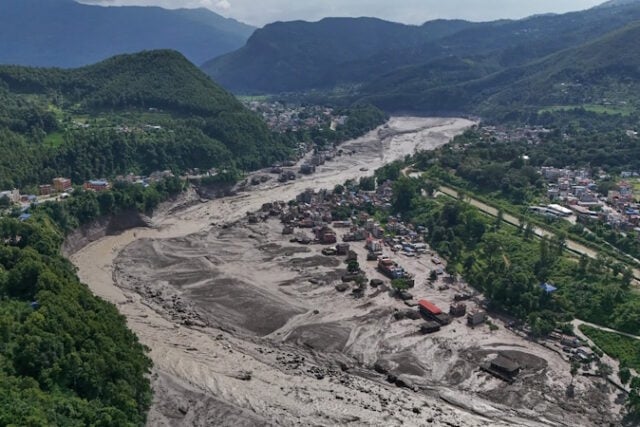
A massive collapse of high-altitude glacial ice triggered the destructive torrent. The tumbling glacier crashed into the Lhende River near the Nepal-China border. This massive impact generated seismic tremors equivalent to a 5.2-magnitude earthquake. Debris formed a temporary dam that quickly breached under immense water pressure. A violent surge of water and rock roared down the Bhotekoshi valley. Entire residential settlements, market squares, and trekking lodges were wiped out. Witnesses described a terrifying wall of black mud engulfing riverside homes.
Search and Rescue Operations
Over 4,300 police officers and military personnel have joined rescue operations. Helicopters have airlifted dozens of critically injured survivors to Kathmandu hospitals. However, 25 miles of wiped-out roads have severed access to remote hamlets. At least 19 bridges were completely destroyed by the violent river currents. Heavy excavation equipment cannot cross the heavily fractured mountain paths. Dozens of Nepali security personnel are also among the missing victims. Rescuers must dig through deep mud deposits using simple hand tools.
Looming Weather Concerns
Severe weather approaching poses a major threat to ongoing rescue efforts. Nepal’s Department of Hydrology and Meteorology forecasts relentless heavy monsoon rains. Steep Himalayan mountain slopes are already heavily saturated with water. Even moderate rainfall could easily trigger devastating secondary landslides across valleys. Authorities discovered fresh river blockages upstream that could unleash further flash floods. Thick fog and heavy cloud cover threaten to ground rescue helicopters. Officials are urging downstream communities to evacuate riverbanks immediately during storms.
Humanitarian and Health Crisis
Thousands of displaced survivors are now sheltering in temporary relief camps. Floodwaters have heavily contaminated local water supplies with thick mud and bacteria. Health workers are warning of dangerous outbreaks of waterborne infectious diseases. There is an urgent shortage of clean drinking water and medical supplies. Stagnant pools of floodwater also heighten the risk of mosquito-borne dengue fever. Aid workers struggle to deliver emergency rations to completely isolated villages.
Economic Damage and Infrastructure Fallouts
The floods dealt a severe blow to Nepal’s critical hydropower sector. Six major hydroelectric stations suffered extensive turbine damage from abrasive debris. Power outages continue to disrupt hospitals and emergency centers across multiple districts. Farming communities lost vital livestock and vast terraces of seasonal crops. Small business owners along popular trekking routes saw their livelihoods destroyed. Rebuilding collapsed infrastructure will cost hundreds of millions of dollars.
Regional Climate Vulnerability and Aid
The Hindu Kush Himalaya region is warming rapidly due to climate change. Melting mountain glaciers create thousands of unstable high-altitude moraine lakes. The United States has pledged emergency funding to support local relief organizations. Neighboring nations and United Nations teams are deploying critical humanitarian resources. Authorities stress that real-time early warning systems must be expanded immediately. For now, rescue crews are racing against incoming storms to save lives.
Sources Used
- Time: https://time.com/article/2026/08/26/hundreds-feared-dead-including-foreign-tourists-after-flash-floods-in-nepal/
- CBS News: https://www.cbsnews.com/news/nepal-tibet-missing-flash-flooding-mud-flow-glacier-collapse/
- The Guardian: https://www.theguardian.com/world/2026/aug/27/what-caused-nepal-flash-flood-glacial-collapse-tibet-border
- Associated Press: https://apnews.com/article/climate-change-nepal-flash-floods-7262dac22e31258955efa5c28c8fe917
- The Washington Post: https://www.washingtonpost.com/world/2026/08/26/least-22-dead-hundreds-missing-flash-floods-nepal-china-border/
Disclaimer
Artificial Intelligence Disclosure & Legal Disclaimer
AI Content Policy.
To provide our readers with timely and comprehensive coverage, South Florida Reporter uses artificial intelligence (AI) to assist in producing certain articles and visual content.
Articles: AI may be used to assist in research, structural drafting, or data analysis. All AI-assisted text is reviewed and edited by our team to ensure accuracy and adherence to our editorial standards.
Images: Any imagery generated or significantly altered by AI is clearly marked with a disclaimer or watermark to distinguish it from traditional photography or editorial illustrations.
General Disclaimer
The information contained in South Florida Reporter is for general information purposes only.
South Florida Reporter assumes no responsibility for errors or omissions in the contents of the Service. In no event shall South Florida Reporter be liable for any special, direct, indirect, consequential, or incidental damages or any damages whatsoever, whether in an action of contract, negligence or other tort, arising out of or in connection with the use of the Service or the contents of the Service.
The Company reserves the right to make additions, deletions, or modifications to the contents of the Service at any time without prior notice. The Company does not warrant that the Service is free of viruses or other harmful components.