The Interconnected Vision of Tech, Energy, and Trade
When Donald Trump sits down to talk policy these days, the conversation rarely stays inside traditional political lanes. Instead, his discussions weave together silicon chips, cryptocurrency mining, geopolitical adversaries, and cross-border trade disputes into a unified doctrine. To understand his current platform, you have to look at how domestic technological leadership and aggressive economic leverage are pitched as two sides of the same coin.
Whether addressing business executives, podcast hosts, or technology summits, Trump consistently returns to a central thesis: the United States must dominate the industries that will define the 21st century while aggressively protecting domestic markets from both foreign adversaries and traditional trading partners.
Artificial Intelligence and the Great Energy Squeeze
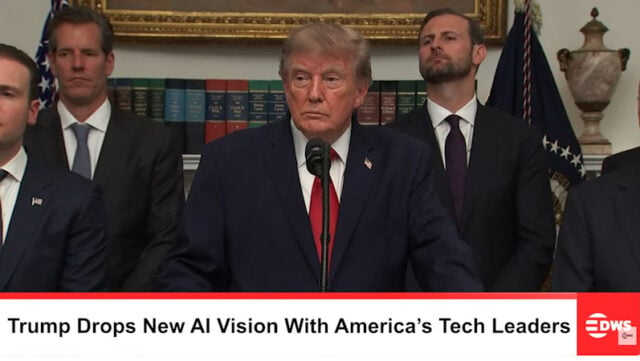
Trump’s framing of artificial intelligence centers on national security and global supremacy. Rather than focusing primarily on ethical guardrails or safety frameworks, he approaches AI as an existential technological race that the U.S. cannot afford to lose. In interviews reported by outlets like Yeni Şafak English, Trump has described AI as a transformative force far larger than the original rise of the internet.

Winning that race, however, comes down to raw infrastructure. Trump frequently highlights the massive electrical grid requirements needed to power modern AI data centers. His proposed solution combines aggressive domestic energy expansion—often summarized under his “drill, baby, drill” mantra—with slashing bureaucratic delays for new energy generation and grid expansion. By cutting red tape, the goal is to supply the immense kilowatt-hours needed to out-compute foreign competitors.
A Complete Pivot to Digital Assets and Crypto
Trump has undergone a major shift regarding digital assets. Once skeptical of decentralized tokens, he now pitches the United States as the undisputed future crypto capital of the world. In discussions covering regulatory reform covered by Bitcoin News and industry analysis on CoinGape, he argues that heavy-handed domestic regulation simply pushes innovators and capital straight into the hands of rival economies.
Trump’s digital asset platform emphasizes:
- Providing transparent regulatory frameworks for stablecoin issuers and builders, as detailed in recent remarks highlighted by Bloomberg Technology.
- Establishing a national strategic Bitcoin stockpile from existing government holdings.
- Protecting domestic Bitcoin mining operations to bolster energy grid resilience and keep computational power on American soil.
China: Tech Competition and the 60% Tariff Threat
China remains the primary focal point of Trump’s economic and national security strategy. In every discussion about AI or digital finance, Beijing is cast as the primary competitor waiting to seize any technological ground America surrenders.
To counter this, Trump advocates for aggressive economic decoupling, centering his trade strategy on proposed universal baseline tariffs and levies of up to 60% or higher on Chinese imports. During appearances covered by PBS NewsHour, he defended tariffs not merely as revenue generators, but as essential negotiation tools to force concessions, reshore critical manufacturing, and restrict intellectual property transfers.
Maximum Pressure on Iran
On Middle Eastern policy, Trump consistently returns to his “maximum pressure” doctrine regarding Iran. His core argument is that economic deterrence provides regional stability. He frequently points to the enforcement of strict oil sanctions during his first term as the benchmark, arguing that starving the Iranian government of export revenue directly curtails funding for regional proxy groups.
In recent discussions, he has emphasized tightening maritime monitoring around critical shipping lanes like the Strait of Hormuz and ramping up economic sanctions to prevent Tehran from acquiring nuclear capabilities.
Canada: Border Security and USMCA Friction
Even close allies and neighbors are not exempt from Trump’s transactional trade philosophy. When discussing Canada, Trump often blends trade balance concerns with border security.
Trump points to recurring bilateral flashpoints:
- Strict enforcement of the United States-Mexico-Canada Agreement (USMCA) rules of origin.
- Long-standing disputes over Canadian dairy supply management quotas and softwood lumber imports.
- Proposed tariff threats to ensure bilateral cooperation on supply chains and border logistics.
The Bottom-Line Strategy
Trump’s commentary across these diverse subjects reveals a consistent overarching worldview. Whether negotiating trade terms with Ottawa, imposing tariffs on Beijing, squeezing financial flows to Tehran, or deregulating domestic AI and cryptocurrency industries, the strategy relies on using American market power as leverage. By pairing aggressive domestic industrial deregulation with assertive economic nationalism abroad, the objective is straightforward: maximize American leverage across every negotiating table in the world.
Sources Used
Disclaimer
Artificial Intelligence Disclosure & Legal Disclaimer
AI Content Policy.
To provide our readers with timely and comprehensive coverage, South Florida Reporter uses artificial intelligence (AI) to assist in producing certain articles and visual content.
Articles: AI may be used to assist in research, structural drafting, or data analysis. All AI-assisted text is reviewed and edited by our team to ensure accuracy and adherence to our editorial standards.
Images: Any imagery generated or significantly altered by AI is clearly marked with a disclaimer or watermark to distinguish it from traditional photography or editorial illustrations.
General Disclaimer
The information contained in South Florida Reporter is for general information purposes only.
South Florida Reporter assumes no responsibility for errors or omissions in the contents of the Service. In no event shall South Florida Reporter be liable for any special, direct, indirect, consequential, or incidental damages or any damages whatsoever, whether in an action of contract, negligence or other tort, arising out of or in connection with the use of the Service or the contents of the Service.
The Company reserves the right to make additions, deletions, or modifications to the contents of the Service at any time without prior notice. The Company does not warrant that the Service is free of viruses or other harmful components.