Home Accuweather.com AccuWeather Lowers 2026 Atlantic Hurricane Season Forecast as Historic Super El Niño...

AccuWeather Lowers 2026 Atlantic Hurricane Season Forecast as Historic Super El Niño Takes Hold

After a slow start to the 2026 Atlantic hurricane season, AccuWeather hurricane experts are reducing the number of named total storms, hurricanes and major hurricanes expected.

The biggest driver for this change is the increasing likelihood of historic El Niño conditions and the near 100% confidence in a Super El Niño by the end of hurricane season, which lasts through November.

AccuWeather experts are near certain the conditions in the measured region of the Pacific Ocean will meet the threshold for Super El Niño for the first time since 2015. The strongest Super El Niño on record was 1982-83, and this year’s event could challenge that record.

The Latest Hurricane Forecast from AccuWeather

Faith Based Events

As a result of the Super El Niño and its impacts suppressing the development of the Atlantic Hurricane season, AccuWeather now forecasts 8-11 named storms, 3-4 hurricanes and 1-2 major hurricanes during the 2026 Atlantic hurricane season.


image-Aug-19-2026-02-09-32-8660-PM

Most likely outcome:

  • Named Storms: 9 (previous July updated forecast called for 11)
  • Hurricanes: 3 (previous July updated forecast called for 5)
  • Major Hurricanes: 1 (previous July updated forecast called for 2)
  • Direct U.S. Impacts: 4 (same as previous July updated forecast)

 “The strengthening El Niño is changing the outlook for the rest of this hurricane season,” said AccuWeather Lead Hurricane Expert Alex DaSilva. “We expect more frequent periods of disruptive wind shear that can make it difficult for tropical systems to develop and strengthen. That gives us greater confidence in lowering the total number of named storms, but it does not eliminate the risk of a damaging hurricane strike in the United States. It only takes one storm to define a hurricane season.”

Despite the lower seasonal forecast, the expected number of direct U.S. impacts remains unchanged at three to five, with four considered the most likely number.

The Historical Perspective of Landfalling U.S. Atlantic Hurricanes Since 1851

The potential milestone follows an unusual 2025 Atlantic hurricane season, when several powerful storms developed, but no Atlantic hurricanes made landfall in the United States.

  • Only three named storms have developed in the Atlantic so far this season, and none have strengthened into hurricanes. By comparison, the 2025 season had already produced five named storms by Aug. 19, including Category 5 Hurricane Erin.
  • In the 2025 Atlantic Hurricane season, there were no hurricanes that made landfall in the United States; the first time this occurred in a decade, with the last instance dating back to 2015.
  • Since Atlantic hurricane records began in 1851, only seven times has there been at least 2 consecutive years in which the U.S. did not experience a landfalling hurricane. If no Atlantic hurricanes make landfall this season, it would become the eighth time this occurs.
  • Two of the previous multi-year stretches without a continental U.S. hurricane landfall have occurred since the turn of the century: 2000–2001 and 2009–2010.
  • The longest stretch in the historical record lasted three consecutive years, from 1862 through 1864.

A Slow Start to the Atlantic Hurricane Season as El Niño Strengthens

Tropical storms Arthur and Bertha developed closer to the United States earlier this summer, while Tropical Storm Cristobal formed over the open Atlantic this month.

atl_tracks_2026_720

The 2026 hurricane season is trailing key historical benchmarks. On average, the first Atlantic hurricane develops by Aug. 11, while the fourth named storm develops by Aug. 15. The historical average date for the season’s first major hurricane is Sept. 1

AccuWeather hurricane experts now have very high confidence that Super El Niño conditions will be present during the second half of the hurricane season. It is becoming increasingly likely that this could be the strongest El Niño on record since at least 1950, which is as far back as record-keeping goes.

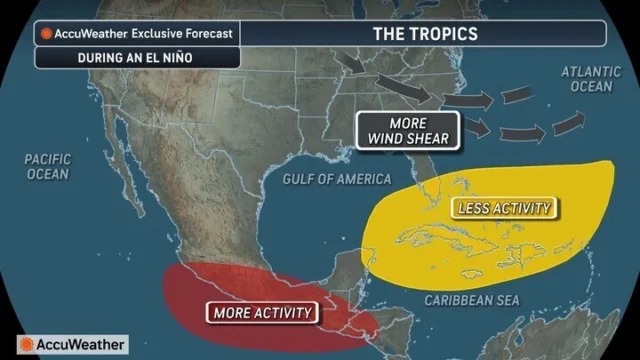
El Niño typically increases disruptive wind shear over parts of the Atlantic. Strong wind shear can make it more difficult for tropical systems to organize, strengthen, and maintain their structure.

“While those atmospheric conditions can reduce the overall number of tropical storms and hurricanes, they do not eliminate the threat to the United States,” DaSilva added. “Exceptionally warm waters near part of the U.S. coastline can provide fuel for tropical systems that develop close to land, raising concerns about rapid intensification and leaving people and businesses with less time to prepare.”

the_tropics_during_an_el_nino_720-1

U.S. Impact Risk Remains Unchanged in Latest Forecast Update

Two direct U.S. impacts have already occurred this season. Tropical Storm Arthur brough significant flooding to the northern Gulf Coast in June, with more than 30 inches of rain reported in parts of Louisiana. AccuWeather estimates $4 billion to $6 billion in total damage and economic loss from Arthur in the United States.

Tropical Storm Bertha also brought rain, gusty winds and storm surge to parts of the Gulf Coast in July.

AccuWeather experts continue to forecast one to three additional direct U.S. impacts through the remainder of the season, for a total of three to five direct U.S. impacts as initially forecasted in March.

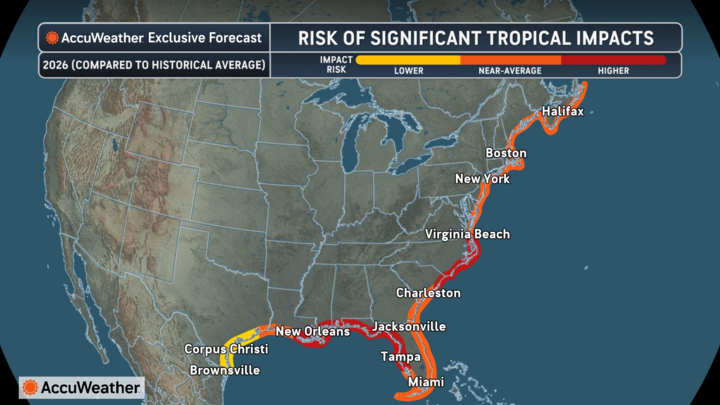
The likely impacted areas have also remained the same:

  • Higher-than-historical-average risk: Northern and eastern Gulf Coast and the Carolinas
  • Increased risk: Northeastern Caribbean
  • Lower-than-historical-average risk: Central and lower Texas coast

It Only Takes One Storm

AccuWeather expert meteorologists stress that the total number of storms during the season does not determine how destructive or costly the season will be.

“The 1992 Atlantic hurricane season is one of the most dramatic examples,” said DaSilva. “Only seven named storms developed, but Hurricane Andrew became a Category 5 hurricane and devastated South Florida.”

The climatological peak of the Atlantic hurricane season is around Sept. 10, with significant tropical development and U.S. impacts possible well into the fall. The historical average first major hurricane in the Atlantic is Sept. 1. With an average of 14 named storms per year, there is 70% of the hurricane season left to go, based on historical storm development.

image_720-4

Some of the most destructive hurricanes in recent history have struck after the climatological peak of the season. Hurricane Helene made landfall in Florida’s Big Bend as a Category 4 hurricane on Sept. 26, 2024, causing catastrophic flooding and devastation across parts of the Southeast and southern Appalachians. Less than two weeks later, Hurricane Milton made landfall near Siesta Key, Florida, as a Category 3 hurricane on Oct. 9.

AccuWeather initially forecast 11-16 named storms for the 2026 Atlantic Hurricane Season in March and reduced that range to 8-14 in early July.


Disclaimer

Artificial Intelligence Disclosure & Legal Disclaimer

AI Content Policy.

To provide our readers with timely and comprehensive coverage, South Florida Reporter uses artificial intelligence (AI) to assist in producing certain articles and visual content.

Articles: AI may be used to assist in research, structural drafting, or data analysis. All AI-assisted text is reviewed and edited by our team to ensure accuracy and adherence to our editorial standards.

Images: Any imagery generated or significantly altered by AI is clearly marked with a disclaimer or watermark to distinguish it from traditional photography or editorial illustrations.

General Disclaimer

The information contained in South Florida Reporter is for general information purposes only.

South Florida Reporter assumes no responsibility for errors or omissions in the contents of the Service. In no event shall South Florida Reporter be liable for any special, direct, indirect, consequential, or incidental damages or any damages whatsoever, whether in an action of contract, negligence or other tort, arising out of or in connection with the use of the Service or the contents of the Service.

The Company reserves the right to make additions, deletions, or modifications to the contents of the Service at any time without prior notice. The Company does not warrant that the Service is free of viruses or other harmful components.