Projecting Strength Across the Waterways
Speaking before an energetic crowd in Garden City, New York, Donald Trump delivered a sweeping foreign policy address that quickly transformed into a masterclass in political rhetoric. With tensions in the Middle East running hot, Trump leaned heavily into his signature brand of unapologetic power projection, declaring that American military resolve would reshape global commerce and bring Tehran to heel.

Yet, rather than keeping the focus exclusively on naval maneuvers and international treaties, Trump did what he does best: he dragged the geopolitical crisis straight into the American living room, connecting warships thousands of miles away to the weekly trip to the supermarket and the price of filling up the tank.
The Carrier Swap: Lincoln Gives Way to Washington
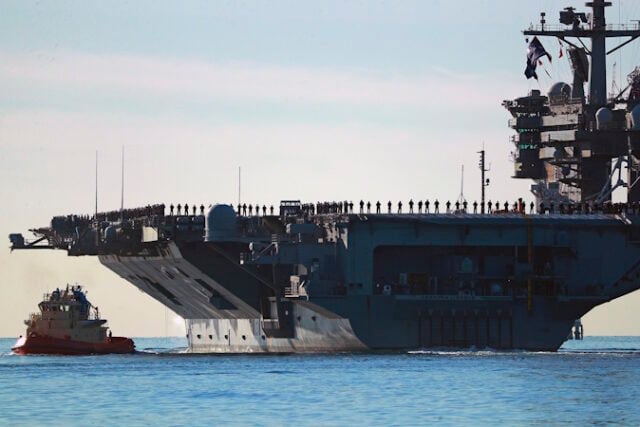
Central to Trump’s address was the state of American naval operations in the Middle East, specifically the status of the USS Abraham Lincoln. The Nimitz-class aircraft carrier and its roughly 5,000 sailors and Marines have been on a grueling, record-setting deployment spanning nearly nine months. Despite growing scrutiny from military families and Capitol Hill regarding crew exhaustion, extended sea duty, and mental health support, Trump brushed aside the pushback with characteristic bluntness.
Trump claimed the nine-month stretch was “not nearly long enough,” dismissing reports of widespread family anxiety by stating simply, “No, they’re not”. He assured the crowd that naval relief was already underway. The Lincoln is in the process of rotating out, handing over its blockade duties to another heavy hitter: the USS George Washington, which recently sailed from Southeast Asia to take up position in the contested waters. For Trump, the seamless swap of two multi-billion-dollar floating airfields was proof of unmatched American endurance and logistical superiority.
“We’ll Declare the Strait a U.S. Territory”
From the logistics of carrier rotations, Trump escalated to one of his most audacious foreign policy assertions to date. Focusing on the Strait of Hormuz—the vital maritime artery through which roughly one-fifth of the world’s petroleum moves—Trump claimed that America’s endgame involved total dominion.
“After we finish defeating Iran,” Trump announced to roars from the audience, “pretty soon I’ll be declaring the Hormuz Strait a territory of the United States”.
The remark set off immediate ripples across international diplomatic circles. In Tehran, Iranian Deputy Foreign Minister Kazem Gharibabadi fired back on social media, declaring that the critical waterway could never be seized “by tweet, nor by aircraft carrier, nor by issuing an order, nor by an election speech”. But for Trump’s domestic base, the line was classic bravado, framing a complex maritime standoff as an inevitable American victory where the U.S. Navy sets the rules of global passage.
Trump to Sign Spending Deal, Declare National Emergency (Video)
The Pivot: From Foreign Conflicts to Gas and Groceries
What began as a military briefing quickly pivoted to kitchen-table economics. Recognizing that voters feel foreign policy through their wallets, Trump directly addressed the elephant in the room: rising energy prices.
With the national average for regular unleaded gasoline hovering around $4.08 per gallon—up nearly 30% from the previous year—Trump asked Americans to view pump prices through a strategic lens. He told the audience that paying “a tiny little bit more for your gasoline” was a modest and necessary price to pay to stop “a very evil country” from securing a nuclear weapon. “I’ll never apologize,” he added, arguing that military deterrence now prevents catastrophic economic collapse later.
From gas pumps, Trump seamlessly shifted the conversation to food costs and grocery bills. Energy, he noted, is the fundamental baseline of the entire economy: diesel powers the tractors, fuels the freight trucks, and keeps cold-storage supply chains running. By linking energy shocks directly to the price of milk, bread, and eggs, Trump sought to turn an economic vulnerability into an argument for decisive victory. In his telling, inflation is not a systemic domestic failure, but a temporary wartime friction that will evaporate the moment the Middle East is secured and energy corridors are cleared.
A High-Stakes Gamble for the Heartland
By interweaving aircraft carrier deployments, territorial claims over global straits, and grocery store receipts, Trump presented a unified worldview to his supporters. He framed the conflict not as an endless foreign entanglement, but as a direct defense of American security and future economic prosperity. Whether voters will continue to accept higher prices at the checkout counter and the gas pump while waiting for the geopolitical dust to settle remains one of the defining questions of this political season.
Disclaimer
Artificial Intelligence Disclosure & Legal Disclaimer
AI Content Policy.
To provide our readers with timely and comprehensive coverage, South Florida Reporter uses artificial intelligence (AI) to assist in producing certain articles and visual content.
Articles: AI may be used to assist in research, structural drafting, or data analysis. All AI-assisted text is reviewed and edited by our team to ensure accuracy and adherence to our editorial standards.
Images: Any imagery generated or significantly altered by AI is clearly marked with a disclaimer or watermark to distinguish it from traditional photography or editorial illustrations.
General Disclaimer
The information contained in South Florida Reporter is for general information purposes only.
South Florida Reporter assumes no responsibility for errors or omissions in the contents of the Service. In no event shall South Florida Reporter be liable for any special, direct, indirect, consequential, or incidental damages or any damages whatsoever, whether in an action of contract, negligence or other tort, arising out of or in connection with the use of the Service or the contents of the Service.
The Company reserves the right to make additions, deletions, or modifications to the contents of the Service at any time without prior notice. The Company does not warrant that the Service is free of viruses or other harmful components.