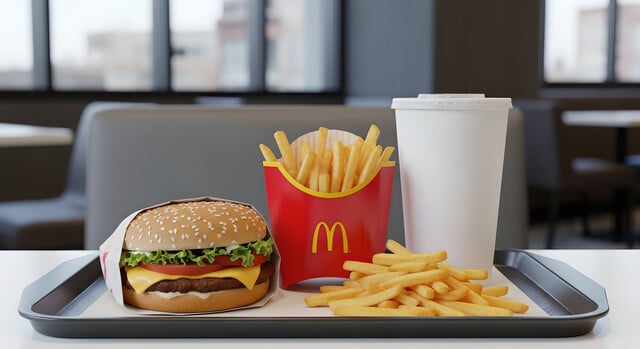
Have you ever wondered what is actually happening behind the scenes when you tap your smartphone screen to order a quick bite? Most of us view fast-food loyalty apps as simple, convenient tools designed to save a few dollars, earn free fries, or skip the line. However, a fascinating new report has revealed that fast-food giant McDonald’s is quietly keeping far more detailed tabs on your personal profile than you might ever imagine. When a tech journalist requested his personal data file under consumer privacy regulations, the company handed over a staggering 515-page dossier outlining his habits.
This massive digital file went well beyond a basic list of past burger receipts. The record meticulously logged every single interaction with the mobile app over several years—including exact purchase timestamps, precise restaurant locations, personalized offers viewed, loyalty points accumulated, and even individual Monopoly sweepstakes codes scanned. But the real surprise lay in the computational predictions hidden inside the file. McDonald’s systems weren’t just storing past behavior; they were using artificial intelligence to forecast his exact future eating habits, predicting precise visit counts, expected dollar spending, and even assigning an “attrition likelihood” rating.
Consumer advocates describe this level of data collection as commercial surveillance disguised as customer convenience. Rather than using basic marketing tricks, corporate leaders are feeding these user profiles into centralized data repositories. In a recent earnings call, McDonald’s executive leadership disclosed that the company is consolidating behavioral purchase data from roughly 220 million consumers worldwide into a single global data lake. By analyzing these massive data sets, the company can power advanced artificial intelligence platforms designed to predict consumer cravings, personalize promotions, and maximize customer retention.
For everyday diners, this situation highlights the hidden costs of modern digital convenience. Privacy legislation, such as the California Consumer Privacy Act (CCPA), gives consumers the legal right to request copies of their saved profiles, lifting the veil on how major corporations harvest personal data. While free food rewards are certainly appealing, your digital footprint provides valuable ammunition in the battle for fast-food dominance. Every tapped coupon, saved favorite item, or scanned barcode directly feeds a sophisticated mathematical engine designed to ensure you never stop returning.

Ultimately, the next time you open a fast-food app on your phone, remember that you aren’t just placing an order for lunch—you are actively feeding an algorithm. As global brands lean heavily into machine learning and predictive data, our casual daily routines are transformed into highly lucrative intelligence. Whether you find this degree of customization helpful or a bit unnerving, one thing is undeniable: behind those famous Golden Arches sits a sprawling digital vault that knows your appetite better than you do.
Sources Used
- Kursiv Media – McDonald’s built 515-page dossier on US journalist and predicted his next meal
- BroBible – Journalist Shocked To Learn The McDonald’s Loyalty App Had Created A 515-Page Data File On Him
- McDonald’s Careers Privacy – Applicant Privacy Statement – McDonald’s
Disclaimer
Artificial Intelligence Disclosure & Legal Disclaimer
AI Content Policy.
To provide our readers with timely and comprehensive coverage, South Florida Reporter uses artificial intelligence (AI) to assist in producing certain articles and visual content.
Articles: AI may be used to assist in research, structural drafting, or data analysis. All AI-assisted text is reviewed and edited by our team to ensure accuracy and adherence to our editorial standards.
Images: Any imagery generated or significantly altered by AI is clearly marked with a disclaimer or watermark to distinguish it from traditional photography or editorial illustrations.
General Disclaimer
The information contained in South Florida Reporter is for general information purposes only.
South Florida Reporter assumes no responsibility for errors or omissions in the contents of the Service. In no event shall South Florida Reporter be liable for any special, direct, indirect, consequential, or incidental damages or any damages whatsoever, whether in an action of contract, negligence or other tort, arising out of or in connection with the use of the Service or the contents of the Service.
The Company reserves the right to make additions, deletions, or modifications to the contents of the Service at any time without prior notice. The Company does not warrant that the Service is free of viruses or other harmful components.