By Alison Purvis, Sheffield Hallam University
With temperatures forecast to climb to 36°C in parts of the UK, heat health alerts are once again in place – and for many people it will mean more than an uncomfortable few days.
The human body normally keeps its core temperature at around 37°C, and when the air around us heats up, it has to work harder to hold that line. Heat stress occurs when the body gains heat faster than it can lose it.
Its main defence is sweating and sending more blood to the skin, where the heat can be released into the environment, but that system has limits. When the heat becomes too much, or hot, humid air stops sweat evaporating, or dehydration leaves too little fluid for the body to sweat and circulate blood properly, these cooling mechanisms start to fail. That’s what leads to heat exhaustion and, in more serious cases, heatstroke.

The two conditions are often used interchangeably, but the difference between them matters. Knowing which one you’re looking at could save a life.
Some are more vulnerable
Anyone can develop heat-related illness, but some people are far more at risk than others.
Older adults and young children are less efficient at regulating their body temperature, and that vulnerability can be compounded by underlying health: heart, kidney and respiratory disease all reduce the body’s ability to cope with heat, as can medications that affect sweating, hydration or blood flow.
Enclosed spaces such as parked cars and poorly ventilated rooms can heat up rapidly, causing body temperature to rise quickly, particularly in children, older adults and people with underlying health conditions.
People who work or exercise outdoors face additional risks. Physical activity generates extra heat within the body, which, along with the burden of environmental heat and humidity, causes further rises in core temperature.
Heat exhaustion
Heat exhaustion is what happens when the body is struggling to cope but still just about managing to keep its core temperature below dangerous levels – you might notice heavy sweating, dizziness, headache, nausea, fatigue, cramps or simply feeling wiped out.
Heat exhaustion is often accompanied by dehydration because large amounts of fluid and salts are lost through sweat.
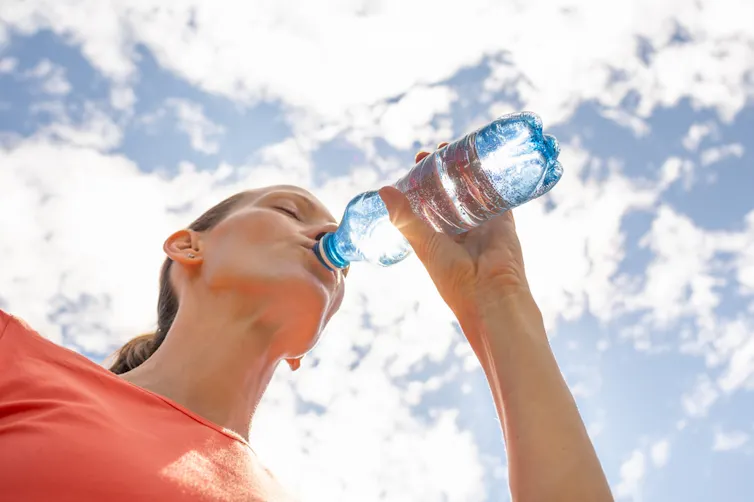
Staying hydrated helps reduce risk, but drinking water alone is not always enough. Even a well-hydrated person can develop heat illness if temperatures are very high, humidity prevents sweat evaporating, or activity continues without adequate cooling and rest.
However, heat exhaustion does not inevitably progress to heatstroke. Most people recover fully if they are cooled down and rehydrated promptly.
KieferPix/Shutterstock.com
Heatstroke
Heatstroke occurs when the body’s temperature regulation system begins to fail and core temperature rises to dangerous levels, typically above 40°C. The most important difference between heat exhaustion and heatstroke is the effect on the nervous system.
Heatstroke looks different: confusion, disorientation, behaving strangely, collapse, seizures – the nervous system itself starts to fail.
Heatstroke can damage the brain and other organs and can be fatal without urgent treatment. It can strike during heatwaves or during intense physical activity when the body generates more heat than it can lose.
Temperature readings can be helpful, but they should not be relied upon in isolation. Measurements taken on the skin, forehead, or in the ear may not accurately reflect true core temperature. Look at the whole picture rather than relying on a temperature measurement.
If someone develops these symptoms, act quickly: get them somewhere cool, loosen their clothing, encourage cool fluids, and cool them down with whatever is to hand — a fan, damp towels, even a cold shower. Most people should improve within about 30 minutes.
If the person becomes confused, behaves unusually, collapses, has a seizure or loses consciousness, assume they have heatstroke and don’t delay in calling the emergency services.
Alison Purvis, Associate Dean, Sheffield Hallam University
This article is republished from The Conversation under a Creative Commons license. Read the original article.
Disclaimer
Artificial Intelligence Disclosure & Legal Disclaimer
AI Content Policy.
To provide our readers with timely and comprehensive coverage, South Florida Reporter uses artificial intelligence (AI) to assist in producing certain articles and visual content.
Articles: AI may be used to assist in research, structural drafting, or data analysis. All AI-assisted text is reviewed and edited by our team to ensure accuracy and adherence to our editorial standards.
Images: Any imagery generated or significantly altered by AI is clearly marked with a disclaimer or watermark to distinguish it from traditional photography or editorial illustrations.
General Disclaimer
The information contained in South Florida Reporter is for general information purposes only.
South Florida Reporter assumes no responsibility for errors or omissions in the contents of the Service. In no event shall South Florida Reporter be liable for any special, direct, indirect, consequential, or incidental damages or any damages whatsoever, whether in an action of contract, negligence or other tort, arising out of or in connection with the use of the Service or the contents of the Service.
The Company reserves the right to make additions, deletions, or modifications to the contents of the Service at any time without prior notice. The Company does not warrant that the Service is free of viruses or other harmful components.