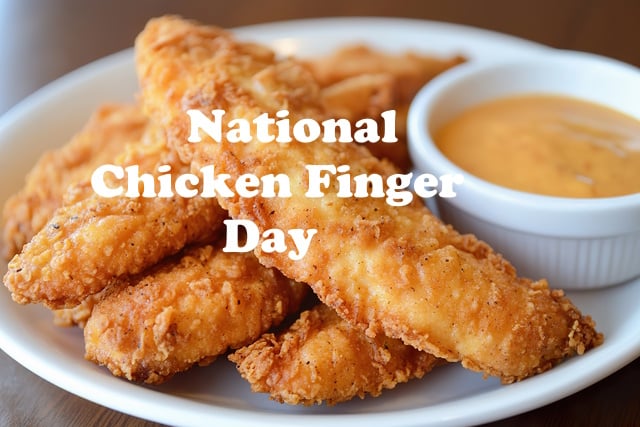
Chicken Finger Day was launched by Raising Cane’s, a Louisiana-based fast food chain that produces southern chicken fingers. Raising Cane’s, founded in 1996, has over 385 restaurants in over 24 states as well as international countries such as Bahrain, Kuwait, Lebanon and Saudi Arabia.
- 1960s – The inventor of the chicken nugget was Robert C. Baker, a Cornell University food science professor, who published the recipe in an academic paper in the early 1960s.
- 1974 – Chicken fingers first appeared in Manchester, New Hampshire. The Puritan Backroom in Manchester, N.H., claims to have done just that in 1974, writes USA Today. Three friends (Alben Yarborough, Ansley Williams, and Dusty Yarborough) began construction on Spanky’s down on River Street in Savannah. Originally, they planned on opening a pizza and burger joint. Alben, on the other hand, wouldn’t print a menu without some chicken on it.
- 1980s – Chicken fingers gain popularity as the meatier substitute for chicken nuggets.
- 1980 – Chicken nuggets have been highly popularised in takeaway restaurants, especially the symbolic Chicken McNuggets of McDonald’s, and the first nuggets to be sold by McDonald’s were in 1980.
- 1990 – In Statesboro, Georgia, Zaxby’s is a fast-casual restaurant chain known for its chicken fingers, wings, and unique sauces.
- 1996 – Todd Graves establishes a chicken finger restaurant called Raising Cane’s. d Graves was originally told by both his college professors and banks that the idea wouldn’t work.
- 2010 – Chicken Finger Day is established on July 27 by Raising Cane’s.
- He saved his own money, working 90-hour shifts as a boilermaker and fishing commercially in Alaska. After finally being able to get an SBA loan, he began construction on the first Raising Cane’s in Baton Rouge. Once it opened, the business became a huge success!
- Chicken tenders are actually parts of a chicken. They are the little strips of meat that are tenuously attached to the underside of each breast (and thus sometimes called “hanging tenders”), so every chicken has two tenders.
- Chicken tenders dish, sometimes also called chicken fingers or chicken strips, are chicken tenders that are breaded and deep fried, which explains why the two are synonymously named.
- No one knows how the term chicken fingers came to be. The most logical answer points to its form or the way it’s eaten. Chicken fingers are roughly shaped like human fingers, although bigger, and are generally finger food. These could be the reasons why the term ‘chicken fingers’ was coined.
- The original name for this dish is chicken tenders, however, chicken fingers originated as a slang term for the word
- The restaurant’s use of the “chicken tenders” name reportedly was a first, but chicken fingers were already in existence
- Poultry are domesticated birds kept by humans for the purpose of producing eggs, meat, and/or feathers. Poultry comes from the French/Norman word, poule, itself derived from the Latin word Pullus, which means small animal.
- Poultry is the second most widely eaten meat in the world, accounting for about 30% of meat production worldwide, after pork at 38%.
- With 25 billion chickens in the world, there are more of them than any other bird species
- This bird was probably first domesticated for the purpose of cockfights, not as food.
- Roosters perform a little dance called ‘tidbitting’ in which they make sounds (food calls) and move their head up and down, picking up and dropping a bit of food. Researchers have found that females prefer males that often perform tidbitting and have larger, brighter combs on top of their heads.
- A female chicken will mate with many different males but if she decides, after the deed is done, that she doesn’t want a particular rooster’s offspring and can eject his sperm. This occurs most often when the male is lower in the pecking order.
- In England, chicken fingers are known as chicken goujons, and could also be called chicken fillets or strips.
Sources:

Disclaimer
Artificial Intelligence Disclosure & Legal Disclaimer
AI Content Policy.
To provide our readers with timely and comprehensive coverage, South Florida Reporter uses artificial intelligence (AI) to assist in producing certain articles and visual content.
Articles: AI may be used to assist in research, structural drafting, or data analysis. All AI-assisted text is reviewed and edited by our team to ensure accuracy and adherence to our editorial standards.
Images: Any imagery generated or significantly altered by AI is clearly marked with a disclaimer or watermark to distinguish it from traditional photography or editorial illustrations.
General Disclaimer
The information contained in South Florida Reporter is for general information purposes only.
South Florida Reporter assumes no responsibility for errors or omissions in the contents of the Service. In no event shall South Florida Reporter be liable for any special, direct, indirect, consequential, or incidental damages or any damages whatsoever, whether in an action of contract, negligence or other tort, arising out of or in connection with the use of the Service or the contents of the Service.
The Company reserves the right to make additions, deletions, or modifications to the contents of the Service at any time without prior notice. The Company does not warrant that the Service is free of viruses or other harmful components.