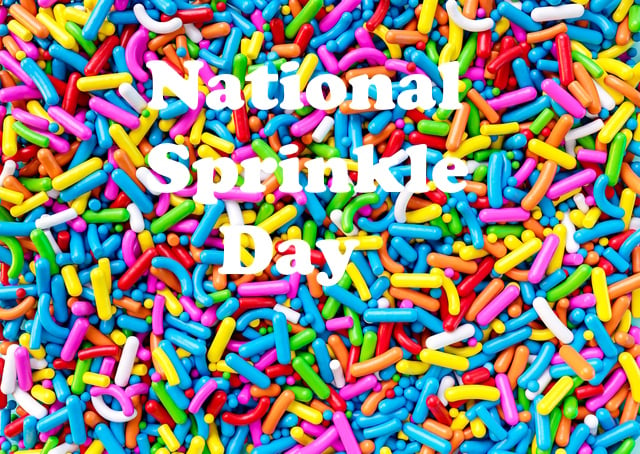
National Sprinkle Day is celebrated on July 23 every year. As the name suggests, the day was indeed designed to celebrate the delight brought on by the existence of sprinkles, the colorful flecks of sugar we all know and love. Sprinkles are used for many things across the world, the most common of which is probably topping ice cream.
It is a widely accepted fact that, no matter the hardships, sprinkles make everyone’s day just a little better, even if it’s only a little. This day is all about learning about different variations of sprinkles and trying them out for yourself.
- 18th Century – First evidence of Nonpareils.
- 1896 – The German version of nonpareils is popularly known in Germany as Liebesperlen (love pearls). Invented by confectioner Rudolf Hoinkis, the name derives from a conversation Hoinkis had with his wife, proclaiming he loved her like these “pearls”, the nonpareil. The factory where he first manufactured the treat, was founded in 1896.
- 1913 – Dutch confectionaire Erven H. de Jong invents the hagelslag.
- 1930 – The origin of the name “Jimmies” is still unclear, but it was first published in 1930 as a cake topping reference.
- 1930s – Jimmies are used as a cake topping.
- 1940s – Sprinkles are used as ice cream toppings.
- Nonpareils, these tasty decorations are known by different names all over the world.
- In Holland they’re known as hagelslag,
- in Philadelphia and Boston they’re known as Jimmies
- Jimmies, also called Sugar Strands or Rainbow Cake Sprinkles, look like broken pieces of spaghetti and you can get them in all kinds of colours. You can sprinkle them on everything from ice cream to cupcakes, doughnuts, cakes, and cookies.
- “Shots” is a special term for sprinkles in Connecticut and other parts of the United States
- Nonpareils are tiny, crunchy, and sweet dots that can look elegant or fun. You also get them in different colours. In Australia, they are also called “Hundreds and thousands”. They are great for a gentle sprinkle effect.
- Confetti or Quins can be found in various shapes, such as hearts, stars, circles, etc. In some cases, the shape is not defined. You can sprinkle them on cupcakes or the sides of cakes or mix them with other cake sprinkles for an interesting combination.
- Dragees or Sugar Pearls are larger than nonpareils, very hard, smooth, and round. In the US some of them are considered inedible, while in Europe, Canada, and Australia their consumption is pretty standard. In any case, we suggest that you use them sparingly and that larger dragees should be scrapped before eating, due to the danger they present to the teeth.
- Sanding Sugar is pearl coloured and shiny. Perfect for sprinkling desserts and for edging a glass of champagne or a cocktail.
- In Indonesia, they’re known as meses
- in Belgium, they’re known by the somewhat whimsical muizenstrontjes or mouse droppings.
- In the UK, sprinkles are known as “hundreds and thousands.”
- Another UK variant of the term is vermicelli, especially when said of chocolate sprinkles.
- In the Netherlands, chocolate sprinkles are used as a sandwich topping.
- In Australia and New Zealand, there’s a special treat called fairy bread, made with buttered white bread topped with sugar sprinkles!
- Fairy Bread is a children’s dessert with cake sprinkles or nonpareils on buttered white bread, commonly served at children’s parties in Australia and New Zealand.
- Sprinkles have a coating of shellac, which is something extracted from insects.
- Sprinkles are made of sugar, corn syrup, cornstarch, shortening, wax, and coloring.
- Sprinkles are not vegan.
- A dessert called confetti cake has sprinkles mixed with the batter, where they slowly dissolve and form little colored spots, giving the appearance of confetti. Confetti cakes are popular for children’s birthdays in the United States.
- The Pillsbury Company sells its variation known as “Funfetti” cake, incorporating a sprinkle-like substance into the mix.
Sources:

Just Fun Facts
Disclaimer
Artificial Intelligence Disclosure & Legal Disclaimer
AI Content Policy.
To provide our readers with timely and comprehensive coverage, South Florida Reporter uses artificial intelligence (AI) to assist in producing certain articles and visual content.
Articles: AI may be used to assist in research, structural drafting, or data analysis. All AI-assisted text is reviewed and edited by our team to ensure accuracy and adherence to our editorial standards.
Images: Any imagery generated or significantly altered by AI is clearly marked with a disclaimer or watermark to distinguish it from traditional photography or editorial illustrations.
General Disclaimer
The information contained in South Florida Reporter is for general information purposes only.
South Florida Reporter assumes no responsibility for errors or omissions in the contents of the Service. In no event shall South Florida Reporter be liable for any special, direct, indirect, consequential, or incidental damages or any damages whatsoever, whether in an action of contract, negligence or other tort, arising out of or in connection with the use of the Service or the contents of the Service.
The Company reserves the right to make additions, deletions, or modifications to the contents of the Service at any time without prior notice. The Company does not warrant that the Service is free of viruses or other harmful components.