The conflict between Washington and Tehran reached a devastating boiling point on Wednesday, July 15, 2026, as United States forces conducted three separate waves of intense airstrikes against Iranian military targets in a single day. Ordered by President Donald Trump, this rapid sequence of bombardments marks the most severe escalation since regional hostilities erupted, specifically focusing on completely eliminating Iran’s capability to threaten vital, critical international shipping networks.
Video of U.S. Central Command forces attacking a military target, released
July 15, 2026. (U.S. Central Command Video)
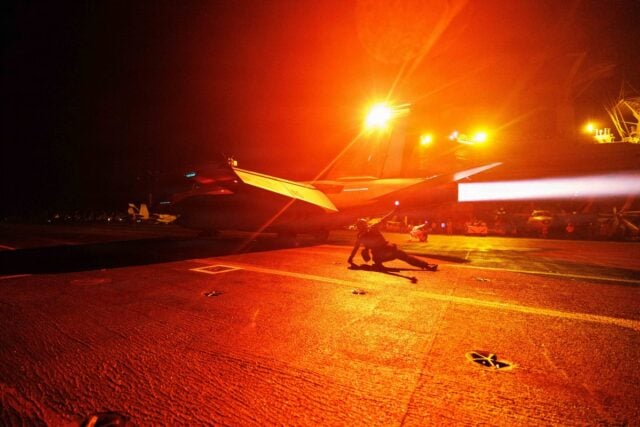
The relentless day of operations commenced overnight with a sweeping seven-hour bombardment. According to U.S. Central Command (CENTCOM), this initial wave heavily pounded coastal defense installations, communication hubs, and drone storage infrastructure. Before daybreak, American forces unleashed a second, ninety-minute precision wave on Wednesday morning. This daylight strike utilized advanced munitions to dismantle cruise missile launchers and coastal radar systems on Greater Tunb Island. By late afternoon, the military officially confirmed a third wave of strikes, deploying navy ships and fighter jets to enforce an absolute maritime blockade on all major Iranian ports.
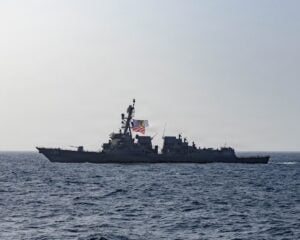
The Pentagon explicitly emphasized that Wednesday’s defensive operations are narrowly tailored to degrade the Islamic Revolutionary Guard Corps’ (IRGC) offensive capacity without provoking an all-out regional war. Intelligence officials noted that while American forces are heavily bombarding frontline maritime assets, they have carefully avoided hitting inland urban centers, major command headquarters, or senior Iranian leadership. This intentional tactical constraint indicates that Washington is attempting to maximize military and economic leverage while deliberately keeping a narrow diplomatic window open to pressure Tehran back to the international negotiating table.

Tehran has reacted with immense defiance to the ongoing American campaign. Following the third wave of U.S. airstrikes, the Islamic Revolutionary Guard Corps launched a highly coordinated retaliatory response codenamed “Operation Nasr 2,” firing a massive barrage of ballistic missiles and suicide drones at regional American assets. Exploded projectiles heavily impacted key U.S. logistical installations, communications centers, and Patriot air defense systems situated across Kuwait, Bahrain, and Jordan. Iranian military command warned that if Washington’s aggressive actions persist, they will permanently shutter every critical alternative oil and gas export route throughout the Persian Gulf. This severe threat immediately sent shockwaves through global markets, driving global crude oil prices well past eighty-five dollars per barrel on Wednesday afternoon. With international commercial maritime transit at a complete standstill and both heavily armed adversaries actively trading massive barrages of fire, the entire Middle East now stands on the precipice of a full-scale war as anxious global powers brace for a prolonged military escalation.
Sources and Links:
- Fox News: US resumes blockade on Iran, launches strikes after attacks in Strait of Hormuz
- The Washington Post: U.S. launches fresh wave of attacks on Iran after Trump threatens wider strikes
- Saudi Gazette: Iran threatens to block more trade routes as US launches fresh strikes
- The Jerusalem Post: CENTCOM strikes targets in Iran as US reinstates Hormuz blockade
- IRNA (Islamic Republic News Agency): IRGC declares strikes on US military facilities in Kuwait during Operation Nasr-2
- The Guardian: US launches third night of strikes on Iran as Trump announces Hormuz blockade
- U.S. Central Command (CENTCOM): U.S. Forces Complete Another Round of Strikes Against Iran
- Nepal News: Iran’s IRGC attacks on US military assets in Bahrain, Kuwait in ‘Operation Nasr 2’
Disclaimer
Artificial Intelligence Disclosure & Legal Disclaimer
AI Content Policy.
To provide our readers with timely and comprehensive coverage, South Florida Reporter uses artificial intelligence (AI) to assist in producing certain articles and visual content.
Articles: AI may be used to assist in research, structural drafting, or data analysis. All AI-assisted text is reviewed and edited by our team to ensure accuracy and adherence to our editorial standards.
Images: Any imagery generated or significantly altered by AI is clearly marked with a disclaimer or watermark to distinguish it from traditional photography or editorial illustrations.
General Disclaimer
The information contained in South Florida Reporter is for general information purposes only.
South Florida Reporter assumes no responsibility for errors or omissions in the contents of the Service. In no event shall South Florida Reporter be liable for any special, direct, indirect, consequential, or incidental damages or any damages whatsoever, whether in an action of contract, negligence or other tort, arising out of or in connection with the use of the Service or the contents of the Service.
The Company reserves the right to make additions, deletions, or modifications to the contents of the Service at any time without prior notice. The Company does not warrant that the Service is free of viruses or other harmful components.