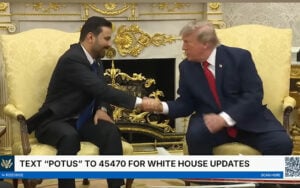
 In the picture, notice the firm handshake between President Donald Trump and the newly appointed Iraqi Prime Minister, Ali al-Zaidi, set against the traditional backdrop of the Oval Office. This symbolic display of diplomacy comes at a moment of extreme geopolitical friction, underscored by the model of Air Force One positioned prominently in the foreground—signaling the heavy projection of American executive and military power that defined their high-stakes discussions.
On Tuesday, July 14, 2026, President Donald Trump welcomed Iraq’s newly appointed Prime Minister, Ali al-Zaidi, to the Oval Office for a high-stakes diplomatic summit. The meeting occurred at a moment of intense regional volatility, arriving just hours after the United States launched a fresh salvo of military strikes against Iranian targets and officially reinstated a sweeping naval blockade in the Strait of Hormuz. Al-Zaidi, a political neophyte and prominent businessman who emerged as a consensus leader in April following months of parliamentary deadlock in Baghdad, found himself navigating a delicate diplomatic tightrope. While the primary objective of the bilateral session was to solidify the future of U.S.-Iraqi relations, the discussion was rapidly overshadowed by the escalating conflict with Tehran and Trump’s looming domestic political agenda, including a highly anticipated prime-time address scheduled for Thursday night.
The Shadow of Iran: Reinstated Blockade and Renewed Strikes
The geopolitical backdrop of Tuesday’s meeting was defined by a major escalation in the 2026 U.S.-Iran war, which initially erupted on February 28 following a joint U.S.-Israeli operation. Although a temporary Memorandum of Understanding (MoU) was signed in mid-June in an attempt to stabilize the region, that fragile peace completely collapsed after repeated maritime skirmishes and attacks on commercial tankers in the Strait of Hormuz.

Sunday, using multiple one-way attack surface drones, CENTCOM forces successfully struck a submarine and ship maintenance facility in Iran. Three Corsair unmanned surface vessels hit the port at Bandar Abbas Naval Base, marking the first time American forces have employed sea… pic.twitter.com/bOM2kmgRxz
— U.S. Central Command (@CENTCOM) July 13, 2026
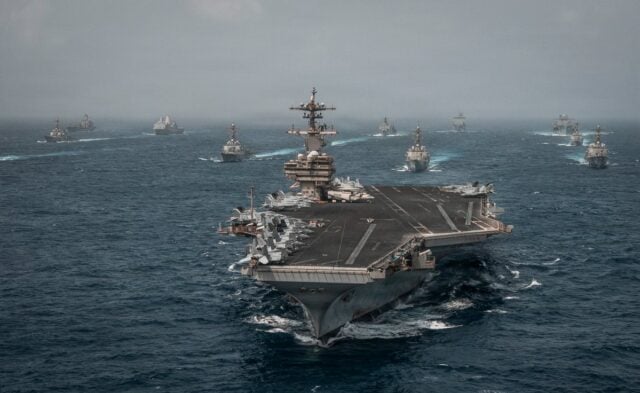
Early Tuesday morning, U.S. Central Command (CENTCOM) announced a new round of air and missile strikes designed to degrade Iran’s offensive military capabilities. Concurrently, the Trump administration officially reinstated a strict naval blockade to cut off Tehran’s maritime transit lines and weapons shipments. Speaking to conservative radio host Hugh Hewitt ahead of the strikes, Trump delivered a blunt warning, asserting, “We’re going to hit them very hard tonight and we’re going to hit them hard tomorrow—and there’s not a damn thing they can do about it”.
Trump reiterated this hardline stance during his joint appearance with al-Zaidi, confirming to reporters that the U.S. military is actively imposing a heavy cost on Iranian forces while taking total control of the strategic waterways. Furthermore, Trump signaled an explicit pivot in global navigation policy, indicating that the U.S. intends to demand financial reimbursement from foreign nations for protecting shipping lanes in the Gulf, upending decades of traditional maritime freedom of navigation doctrines.
Iraq’s Geopolitical Tightrope and the Energy Influx
For Prime Minister al-Zaidi, the renewed hostilities place Baghdad in a profoundly compromised position. Iraq has long served as a geopolitical battleground for influence between Washington and Tehran, and the presence of heavily armed, Iran-backed Shiite militias within Iraqi borders remains a major flashpoint. While the official Iraqi government has given non-state armed groups a firm deadline to completely disarm by the end of September, several prominent militias within the Popular Mobilization Forces have flatly refused to comply.
During the Oval Office briefing, Trump asserted that Iran has been “very much destabilized” by recent military actions, describing the neighboring regime as a historical “big burden on Iraq”. Trump suggested that the degradation of Iranian influence would pave the way for a more stable, secure, and autonomous Iraqi state.
Central to this vision of a reshaped Middle East is a massive influx of Western commercial interest. Trump highlighted a burgeoning economic partnership, proclaiming that American oil and gas companies are currently entering Iraq at “levels that have never been seen before”. The administration views this commercial expansion as an essential step toward locking in long-term Iraqi stability, though critics warn it could further enmesh the country in the crossfire of the broader regional war.
Domestic Waves: The Thursday Night Address and Midterm Teases
Beyond the immediate theater of war in West Asia, President Trump utilized the press availability alongside Prime Minister al-Zaidi to pivot toward his domestic political operations. With the 2026 midterm elections fast approaching this November, Trump teased that a monumental announcement is on the horizon. He confirmed that he will deliver a prime-time national address on Thursday evening, promising that it will contain “really big news” that will shake up the political landscape.
According to administration insiders, the Thursday night speech is expected to center heavily on sweeping claims regarding election infrastructure and voting machine vulnerabilities. Trump hinted to reporters that the presentation will draw from recently reexamined government files and FBI archives, potentially revisiting allegations of foreign interference from previous cycles while setting a highly contentious tone for the upcoming midterms. By linking these domestic security themes with the unfolding military crisis abroad, Trump is clearly positioning himself as a wartime leader fighting adversaries on both foreign and domestic fronts, ensuring maximum public anticipation for his upcoming broadcast.
Sources and Links:
- Associated Press / WSLS: Trump welcomes new Iraqi Prime Minister Ali al-Zaidi to the White House
- The Times of Israel: Trump to host Iraqi PM at White House in mid-July
- Fox News: US launches fresh Iran strikes as CENTCOM resumes naval blockade
- PBS NewsHour: Iran attacks on tankers in Strait of Hormuz kill and injure crewmembers, UAE says
- The Washington Post: Trump plans prime-time speech on 2020 election allegations
- Encyclopædia Britannica: 2026 Iran war overview and timeline
- Jacobin: Unable to Accept Defeat, Donald Trump Presses On in Iran
- Wikipedia: Detailed breakdown of the 2026 Iran war dynamics
Disclaimer
Artificial Intelligence Disclosure & Legal Disclaimer
AI Content Policy.
To provide our readers with timely and comprehensive coverage, South Florida Reporter uses artificial intelligence (AI) to assist in producing certain articles and visual content.
Articles: AI may be used to assist in research, structural drafting, or data analysis. All AI-assisted text is reviewed and edited by our team to ensure accuracy and adherence to our editorial standards.
Images: Any imagery generated or significantly altered by AI is clearly marked with a disclaimer or watermark to distinguish it from traditional photography or editorial illustrations.
General Disclaimer
The information contained in South Florida Reporter is for general information purposes only.
South Florida Reporter assumes no responsibility for errors or omissions in the contents of the Service. In no event shall South Florida Reporter be liable for any special, direct, indirect, consequential, or incidental damages or any damages whatsoever, whether in an action of contract, negligence or other tort, arising out of or in connection with the use of the Service or the contents of the Service.
The Company reserves the right to make additions, deletions, or modifications to the contents of the Service at any time without prior notice. The Company does not warrant that the Service is free of viruses or other harmful components.