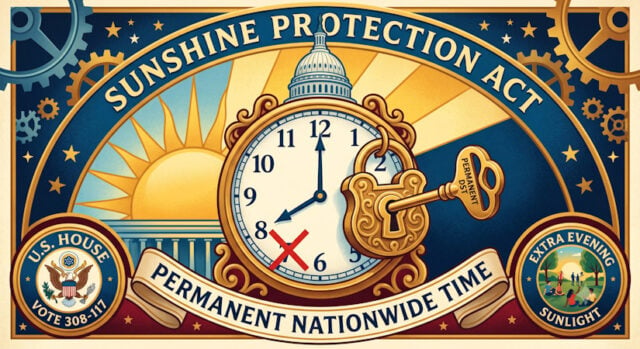
In a decisive legislative move, the United States House of Representatives approved a major bill on Tuesday to establish permanent daylight saving time nationwide, bringing the country one step closer to ending the long standing practice of shifting clocks twice a year. The bipartisan legislation, formally known as the Sunshine Protection Act, passed with a lopsided vote of 308 to 117. Strongly supported by President Donald Trump and championed by Republican Representative Vern Buchanan of Florida, the bill reflects deep public frustration with changing clocks. Proponents argue that locking the clock will reduce traffic accidents, minimize energy consumption, lower evening crime rates, and provide families with more usable daylight for outdoor activities and economic commerce after work.
However, the proposal has sparked an unusual and intense divide that transcends typical partisan boundaries. While coastal and southern lawmakers strongly support the extra evening sunlight to boost local tourism and retail, representatives from Midwestern states and various medical groups have voiced sharp concerns. Detractors, including sleep medicine specialists, emphasize that year round daylight saving time disrupts natural human circadian rhythms by delaying morning light. Critics warn that during peak winter months, sunrises could be delayed until after eight thirty in the morning in several major regions, forcing young children to commute to school and parents to drive to work in total darkness. Representative Mary Gay Scanlon noted that Congress briefly attempted to enact permanent daylight saving time in 1973, only to repeal it within months due to immediate public backlash over safety concerns.
Despite these safety concerns, public opinion appears to heavily favor the change. A recent Associated Press poll revealed that fifty-six percent of American adults prefer year-round daylight saving time compared to standard time. To accommodate differing regional preferences, the newly passed House bill contains a critical compromise: individual states retain the option to opt out and remain on permanent standard time, provided their respective state legislatures enact the necessary laws before the federal mandate takes effect. Currently, 19 states have passed legislation to adopt permanent daylight saving time if authorized by federal law, while Hawaii and parts of Arizona already observe standard time year-round.
The successful House vote marks a monumental shift for a piece of legislation that has repeatedly stalled in recent years. While the United States Senate previously approved a similar version of the Sunshine Protection Act unanimously back in twenty twenty two, that momentum quickly died when the House failed to take it up. Now, the political dynamic has flipped completely. The bill faces an uncertain path forward in the Senate, where lawmakers must decide whether to embrace the popular reform or heed the warnings of health experts. Supporters have already called upon Senate Majority Leader John Thune to bring the legislation to the floor for a vote as soon as possible, hoping to secure a historic victory and finally fix the American clocks permanently. This landmark legislative effort represents a massive, hard-fought victory for all passionate clock change advocates who want long-term consistency across the nation.

Sources and Links:
- The Washington Post: House passes Trump’s plan to make daylight saving time permanent
- The Guardian: US House passes bill to make daylight saving time permanent
- CBS News: House passes bill to make daylight saving time permanent
- Associated Press: House passes bill to ‘ditch the switch’ and make daylight saving time permanent
- Anadolu Ajansı: US House passes bill to make daylight saving time permanent
- Fort Worth Star-Telegram: U.S. House passes bill that will make Daylight Saving Time year round
- House of Representatives Committee on Rules: H.R. 139 – Sunshine Protection Act of 2025
- WRAL News: U.S. House to vote on bill that would make daylight saving time permanent
- WSB-TV Channel 2 Atlanta: Daylight Saving Time year-round? US House to vote on bill to lock the clock
- Texas Farm Bureau: Daylight Saving Time bill passes House committee
Disclaimer
Artificial Intelligence Disclosure & Legal Disclaimer
AI Content Policy.
To provide our readers with timely and comprehensive coverage, South Florida Reporter uses artificial intelligence (AI) to assist in producing certain articles and visual content.
Articles: AI may be used to assist in research, structural drafting, or data analysis. All AI-assisted text is reviewed and edited by our team to ensure accuracy and adherence to our editorial standards.
Images: Any imagery generated or significantly altered by AI is clearly marked with a disclaimer or watermark to distinguish it from traditional photography or editorial illustrations.
General Disclaimer
The information contained in South Florida Reporter is for general information purposes only.
South Florida Reporter assumes no responsibility for errors or omissions in the contents of the Service. In no event shall South Florida Reporter be liable for any special, direct, indirect, consequential, or incidental damages or any damages whatsoever, whether in an action of contract, negligence or other tort, arising out of or in connection with the use of the Service or the contents of the Service.
The Company reserves the right to make additions, deletions, or modifications to the contents of the Service at any time without prior notice. The Company does not warrant that the Service is free of viruses or other harmful components.