If there is one thing the volatile landscape of the Middle East has proven, it is that a peace agreement can evaporate faster than morning mist in the Persian Gulf. Just a few weeks ago, global markets breathed a collective sigh of relief when Washington and Tehran put pen to paper in Pakistan, signaling a potential end to the devastating regional war. Fast forward to today, and the skies over the Middle East are once again illuminated by anti-aircraft fire, cruise missiles, and the heavy thud of carrier-launched airstrikes.
President Donald Trump took to his Truth Social platform to make the administration’s position blindingly clear: while the United States is willing to keep diplomatic channels cracked open, the formal truce is officially history.
“The Islamic Republic of Iran has asked us to continue ‘talks.’ We have agreed to do so, but the United States has stated to them, in no uncertain terms, that the ceasefire is OVER!” Trump declared.
This sudden pivot has left the international community caught in a bizarre, high-stakes limbo—a state of “negotiation under fire” where diplomats are trading proposals in quiet backrooms while military forces trade live ammunition in the shipping lanes. To understand how we slid back to the edge of the abyss so quickly, we have to look at the explosive chain of events that defined the first half of this year.
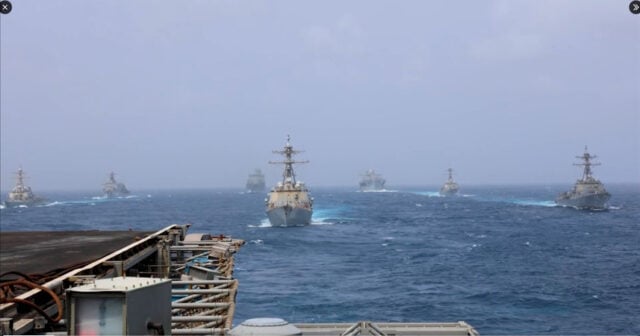
U.S. Sailors conduct nighttime flight operations aboard USS George H.W. Bush (CVN 77) as the aircraft carrier sails in regional waters. pic.twitter.com/kILYbeysj1
— U.S. Central Command (@CENTCOM) July 10, 2026

🚨 BREAKING:
🇮🇷 IRAN:
The Strait of Hormuz belongs to Iran. We will never lose it.
Iran won and the US lost… pic.twitter.com/XSPT9k007n
— IRGC NEWS (@IRGC_IRAN_News) July 10, 2026
How We Got Here: The Shadow of Operation Epic Fury
The current war did not start with a slow burn; it began with a massive explosion. On February 28, U.S. and Israeli forces executed a high-stakes, joint military campaign codenamed Operation Epic Fury. In a stunning 12-hour window, coalition forces launched nearly 900 precision strikes across Iran, targeting command hubs, air defense infrastructure, and top-tier leadership.
The opening salvo fundamentally reshaped the Iranian regime by eliminating its long-standing Supreme Leader, Ayatollah Ali Khamenei. The regime responded by launching hundreds of retaliatory ballistic missiles and thousands of suicide drones across the Middle East, striking U.S. allied military bases in Bahrain, Kuwait, and Qatar. The sheer scale of the conflict left thousands dead, millions displaced, and global energy supply chains deeply fractured.
By April, both sides had reached a bloody stalemate, prompting Pakistan to step in as an intermediary. After weeks of tense, low-intensity friction and brinkmanship, a breakthrough finally arrived in mid-June. Trump and Iranian President Masoud Pezeshkian remotely signed the Islamabad Memorandum of Understanding (MoU). The agreement established a 60-day diplomatic runway intended to freeze hostilities, address nuclear enrichment boundaries, and unfreeze select Iranian assets. Trump famously celebrated the signing during a high-profile dinner with French President Emmanuel Macron at the Palace of Versailles.
Unfortunately, the Islamabad MoU’s foundational flaw was exposed almost immediately: it was dangerously vague about the world’s most critical economic chokepoint.
The Strait of Hormuz: A Multi-Billion Dollar Bottleneck
The strategic center of gravity for this entire conflict is not a desert battlefield or a hidden nuclear facility; it is a narrow strip of water separating Iran from the Arabian Peninsula.
Facing a severely degraded conventional military after months of American bombing, Tehran fell back on its ultimate asymmetric economic lever: the Strait of Hormuz. The Iranian regime began asserting aggressive control over the channel, demanding that international cargo vessels follow pre-approved routes dictated by Tehran and pay steep transit fees.
When shipping intelligence groups and Western naval forces resisted these protocols, hardline factions within the Islamic Revolutionary Guard Corps (IRGC) took matters into their own hands. On July 6 and 7, maritime security reported direct, violent attacks on three separate commercial vessels transiting the strait:
- The Marshall Islands-flagged M/T Al Rekayyat
- The Saudi Arabia-flagged M/T Wedyan
- The Liberian-flagged M/T Cyprus Prosperity
Trump’s reaction was immediate and fierce. Labeling Iran’s leadership as “vicious, violent people,” he authorized two consecutive nights of heavy, offensive airstrikes. U.S. Central Command confirmed that American forces hammered coastal radar stations, air defense batteries, and systematically destroyed more than 60 IRGC fast-attack small boats operating within the waterway. Iran hit back by targeting regional American outposts, and the hard-won June ceasefire collapsed in a matter of hours.
The Anatomy of the 2026 Conflict
To see how rapidly the pendulum has swung between diplomacy and total warfare this year, look at how the key phases played out:
| Conflict Phase | Timeframe (2026) | Primary Actions & Strategic Outcomes |
| Operation Epic Fury | Feb 28 – May 5 | Massive U.S./Israeli air campaign; Supreme Leader Ali Khamenei killed; heavy regional infrastructure damage. |
| The Islamabad MoU | June 17 | Signed by Trump and Pezeshkian; designed as a 60-day window to negotiate a permanent peace accord. |
| The Waterway Crisis | July 6 – 7 | Iran attacks three global merchant ships to enforce transit tolls; U.S. strikes 60+ IRGC targets. |
| The Ceasefire Collapse | July 10 | Trump publicly declares the ceasefire is over, yet authorizes continued backchannel talks. |
Why Both Sides Are Still Talking Through the Smoke
Given the venomous rhetoric and the fresh wreckage of military hardware, you might wonder why the two nations haven’t descended into an unrestricted, catastrophic regional war. The answer lies in the intense internal domestic pressures weighing on both leaders.
For Donald Trump, the primary metric is economic. Despite his aggressive “big stick” foreign policy, the White House has no appetite for a prolonged, multi-year occupation of the Iranian mainland. Trump remains fiercely committed to keeping global oil and energy prices low ahead of the upcoming U.S. midterm Congressional elections. A total closure of the Strait of Hormuz would send crude oil prices sky-high, threatening the domestic economy. Trump directly told reporters at the NATO summit in Turkey that any flare-up would be handled quickly and would not lead to a full-scale ground invasion.
On the other side of the Gulf, Iran is navigating an intensely fragile internal transition. The new Supreme Leader, Mojtaba Khamenei, was himself wounded in the opening February strikes and has spent months operating almost entirely through written decrees. He faces a population drained by economic sanctions and high casualties, yet he must project absolute strength to hold onto power.
Senior U.S. officials revealed a fascinating twist behind the scenes: Iranian representatives privately communicated to Trump’s team that the recent maritime attacks were carried out by an “errant” faction of hardliners intentionally trying to sabotage the diplomatic framework. While Washington is skeptical, the administration is giving the diplomatic track one more chance. Trump has dispatched a high-level negotiation team—led by Vice President JD Vance, Jared Kushner, Secretary of State Marco Rubio, and Special Envoy Steve Witkoff—to Oman for emergency, backchannel talks.
The U.S. baseline requirement is simple but non-negotiable: Iran must publicly state it will halt all hostilities, and every channel in the Strait of Hormuz must remain free, open, and clear of arbitrary tolls. Until that happens, the ceasefire remains dead, the military remains on high alert, and the entire world is left watching the Persian Gulf with bated breath.
Sources and Links:
- The Times of Israel: Trump: We’ll continue holding talks with Iran, but ceasefire is over
- The Washington Post: Trump says U.S. and Iran will keep talking but declares ceasefire ‘OVER!’
- Hindustan Times: Ceasefire with Iran over, says Trump in big declaration at NATO Summit after U.S. strikes
- CBS News: U.S.-Iran Latest: Trump reiterates that ceasefire is over, but says U.S. to continue negotiating
- Financial Times: Donald Trump says U.S. has agreed to continue talks with Iran
- The Guardian: US and Iran trade escalating strikes as supreme leader is buried after days-long funeral
- Encyclopedia Britannica: 2026 Iran War Overview and Dynamic Analysis
Disclaimer
Artificial Intelligence Disclosure & Legal Disclaimer
AI Content Policy.
To provide our readers with timely and comprehensive coverage, South Florida Reporter uses artificial intelligence (AI) to assist in producing certain articles and visual content.
Articles: AI may be used to assist in research, structural drafting, or data analysis. All AI-assisted text is reviewed and edited by our team to ensure accuracy and adherence to our editorial standards.
Images: Any imagery generated or significantly altered by AI is clearly marked with a disclaimer or watermark to distinguish it from traditional photography or editorial illustrations.
General Disclaimer
The information contained in South Florida Reporter is for general information purposes only.
South Florida Reporter assumes no responsibility for errors or omissions in the contents of the Service. In no event shall South Florida Reporter be liable for any special, direct, indirect, consequential, or incidental damages or any damages whatsoever, whether in an action of contract, negligence or other tort, arising out of or in connection with the use of the Service or the contents of the Service.
The Company reserves the right to make additions, deletions, or modifications to the contents of the Service at any time without prior notice. The Company does not warrant that the Service is free of viruses or other harmful components.