Summer is usually the season for fresh, crisp salads, backyard barbecues, and bowls of ripe berries. But right now, health departments across the country are tracking a less-than-welcome summer guest. A massive spike in cyclosporiasis cases is sweeping through multiple states, turning seasonal produce into a major gastrointestinal gamble.
A Growing National Problem
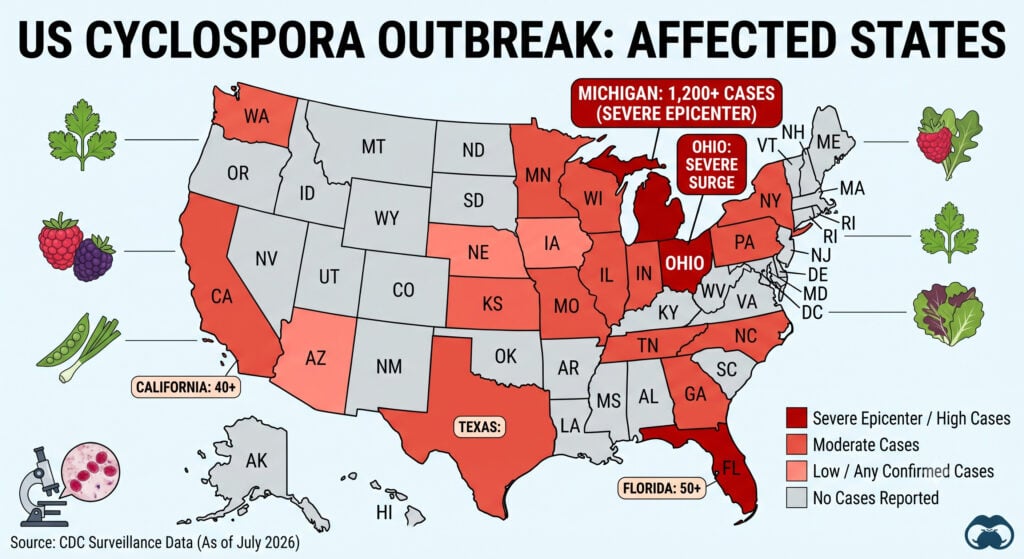
As of July 2026, the CDC is monitoring more than 843 confirmed domestic cases across 31 states, alongside 1,500 suspected cases. This is not just a localized issue; the reach of this parasitic infection is extensive. Epicenters like Michigan have seen numbers skyrocket to over 1,200 cases—a massive departure from their typical annual baseline of 40 to 50 infections. Neighboring Ohio is experiencing a parallel surge.
To better understand the scope of the problem, here is a visual representation of where these infections have been confirmed.
If you are living in one of the states highlighted above and have been feeling unusually fatigued or suffering from persistent stomach issues lately, you are not alone.

Meet the Parasite
So, what exactly is causing all this chaos? The culprit isn’t a virus or a classic food-poisoning bacterium like Salmonella. Instead, it is a microscopic, single-celled parasite called Cyclospora cayetanensis.
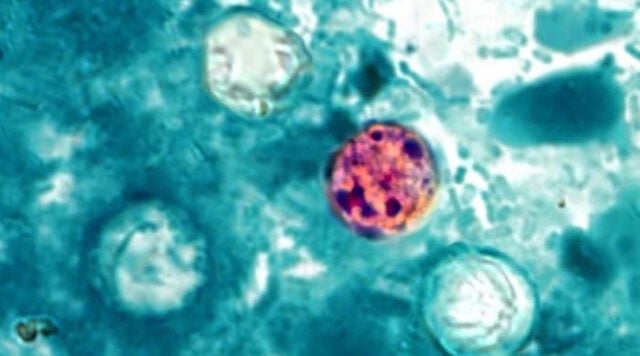
When doctors examine a stool sample under a microscope, they look for circular structures known as oocysts—the parasite’s eggs. As seen in the microscopic imagery included in the infographic, these oocysts stain a distinctive bright red, standing out from cellular debris. These tiny spheres are incredibly durable, shielded by a tough outer wall that lets them survive harsh conditions outside a host.
The Unconventional Way Cyclospora Spreads
When we think of stomach bugs, we usually worry about catching something from a family member or a coworker who forgot to wash their hands. But Cyclospora plays by an entirely different set of rules. It is virtually impossible to catch cyclosporiasis directly from another person.
The parasite spreads via the fecal-oral route, meaning we consume food or water contaminated with microscopic traces of human waste. However, when first passed in stool, the oocysts are completely non-infectious. They require one to two weeks in warm, damp, tropical, or subtropical environments to mature into an infectious state.
What this means for transmission: Because of this built-in delay, a food handler cannot directly pass the active infection to your plate. Instead, the root of the problem almost always traces back to the agricultural level, where contaminated irrigation water or poor sanitation infrastructure in growing fields allows the parasite to take hold on crops.
The Food Culprits and Your Symptoms
Because Cyclospora loves warm, humid weather, outbreaks peak like clockwork between May and August. The parasite binds tightly to the nooks and crannies of raw, fresh produce. In past outbreaks, and during the current 2026 surge, health officials repeatedly point the finger at a specific list of fresh, uncooked ingredients:
| Common Vector Foods | Classic Cyclosporiasis Symptoms |
| • Fresh cilantro and basil | • Profuse, watery diarrhea |
| • Mesclun and romaine lettuce blends | • Severe abdominal cramps and bloating |
| • Fresh raspberries and blackberries | • Intense fatigue and muscle aches |
| • Snow peas and green onions | • Loss of appetite and unexpected weight loss |
Once you accidentally ingest the mature parasite, it travels to your small intestine, embeds itself in the lining, and begins to replicate. The incubation period takes roughly one week before the symptoms hit. And when they do, they hit hard. This isn’t a quick 24-hour bug; untreated cyclosporiasis can trigger explosive diarrhea that lasts from several days to well over a month. A particularly frustrating hallmark of the infection is its cyclic nature: you might feel completely fine for a couple of days, thinking you’ve beaten it, only for the symptoms to return with full force.
Protecting Yourself and Finding Relief
Cyclospora is notoriously chemical-resistant. Standard kitchen sanitizers and chlorinated water washes do not reliably kill or remove the parasite once it has attached itself to the textured surfaces of herbs or leafy greens.
To minimize your risk, make sure to thoroughly rinse firm fruits and vegetables under high-pressure running water while vigorously scrubbing the skins. For delicate items like cilantro or raspberries, commercial kitchens are currently being advised to employ enhanced, meticulous multi-step washing protocols.
If you find yourself facing relentless digestive issues this summer, do not just try to wait it out. Because standard hospital stool cultures frequently miss this specific parasite, you should explicitly ask your healthcare provider for a dedicated Cyclospora test. The good news is that once identified, the infection is highly treatable with a routine course of trimethoprim-sulfamethoxazole, a common sulfa-based antibiotic. Stay informed, rinse your produce well, and don’t hesitate to seek targeted medical care if your summer salads start pushing back.
Sources and Links:
- U.S. Centers for Disease Control and Prevention (CDC) – Surveillance of Cyclosporiasis: https://www.cdc.gov/cyclosporiasis/php/surveillance/index.html
- U.S. Centers for Disease Control and Prevention (CDC) – Preventing Cyclosporiasis: https://www.cdc.gov/cyclosporiasis/prevention/index.html
- U.S. Centers for Disease Control and Prevention (CDC) – About Cyclosporiasis: https://www.cdc.gov/cyclosporiasis/about/index.html
- Pharmacy Times – Cyclosporiasis On the Rise in the United States, Exceeding 450 Cases: https://www.pharmacytimes.com/view/cyclosporiasis-on-the-rise-in-the-united-states-exceeding-450-cases
- TIME – What to Know About the Diarrhea Outbreak Tied to Fresh Produce: https://time.com/article/2026/07/08/cyclosporiasis-outbreak-diarrhea-produce/
- Infection Control Today – Cyclosporiasis Outbreak 2026: 145 Cases Across 17 States, CDC Alert for Health Care Workers: https://www.infectioncontroltoday.com/view/cyclosporiasis-outbreak-2026-145-cases-17-states-cdc-alert-health-care-workers
- Center for Infectious Disease Research and Policy (CIDRAP) – US Cyclospora cases mount as CDC lags on tracking: https://www.cidrap.umn.edu/cyclospora/us-cyclospora-cases-mount-cdc-lags-tracking
- U.S. Food and Drug Administration (FDA) – Cyclospora: https://www.fda.gov/food/foodborne-pathogens/cyclospora
Disclaimer
Artificial Intelligence Disclosure & Legal Disclaimer
AI Content Policy.
To provide our readers with timely and comprehensive coverage, South Florida Reporter uses artificial intelligence (AI) to assist in producing certain articles and visual content.
Articles: AI may be used to assist in research, structural drafting, or data analysis. All AI-assisted text is reviewed and edited by our team to ensure accuracy and adherence to our editorial standards.
Images: Any imagery generated or significantly altered by AI is clearly marked with a disclaimer or watermark to distinguish it from traditional photography or editorial illustrations.
General Disclaimer
The information contained in South Florida Reporter is for general information purposes only.
South Florida Reporter assumes no responsibility for errors or omissions in the contents of the Service. In no event shall South Florida Reporter be liable for any special, direct, indirect, consequential, or incidental damages or any damages whatsoever, whether in an action of contract, negligence or other tort, arising out of or in connection with the use of the Service or the contents of the Service.
The Company reserves the right to make additions, deletions, or modifications to the contents of the Service at any time without prior notice. The Company does not warrant that the Service is free of viruses or other harmful components.