A Mid-Air Escape from a Fragmenting Alliance
As the twin engines of the vintage VC-25A Boeing 747 roared to life on the tarmac of Ankara International Airport, the departure of the United States delegation marked the conclusion of one of the most volatile gatherings in the history of the North Atlantic Treaty Organization (NATO). The two-day July 2026 summit in Turkey, initially compressed and truncated to accommodate President Donald Trump’s distinct style of personal diplomacy, dissolved into a web of international security scares and unprecedented diplomatic ruptures.

The physical manifestation of this geopolitical crisis unfolded directly in the skies over Europe. President Trump had arrived in the Turkish capital riding high on the debut of his newly retrofitted, Qatari-gifted Boeing 747-8—an opulent red, white, navy blue, and gold luxury liner dubbed the “VC-25B Bridge.” Yet, when the time came to fly home to Washington D.C., the gleaming new aircraft departed empty. Instead, the President and his top advisers scrambled onto the legacy, baby-blue executive transport that has served American commanders-in-chief for three and a half decades.
The unexpected vehicle switch occurred against a backdrop of escalating military violence. Less than twenty-four hours prior, the United States military had unleashed a massive wave of retaliatory airstrikes targeting domestic positions within Iran, reacting to renewed Iranian operations against commercial maritime vessels navigating the Strait of Hormuz. With Turkey sharing a direct land border with Iran, the sudden collapse of the regional maritime ceasefire transformed the Eastern Mediterranean into an active theater of potential state-sponsored retaliation, forcing immediate logistical updates to the President’s travel itinerary.
The Blackout Gaggle: “They Want to Make a Deal So Badly”
The atmosphere inside the press compartment of the legacy Air Force One was distinctly combative. Shortly after clearing Turkish airspace, members of the traveling press pool were issued a strict tactical directive by military security personnel: every window blind in the passenger cabins had to remain completely lowered and locked. The security protocol effectively blinded the flight’s civilian passengers as the plane slipped into radar-cloaked transit.
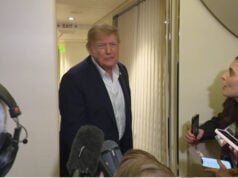
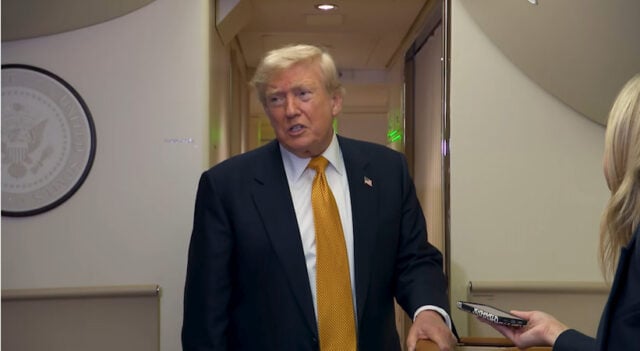
Cruising at high altitude, President Trump broke the tension by walking back to the press cabin for an impromptu, mid-air media gaggle. When reporters immediately pressed him on whether the blackout protocols and the sudden plane swap were dictated by immediate intelligence regarding Iranian surface-to-air missiles or drone interception networks, Trump brushed off the threat with characteristic defiance. He pointedly gestured toward the locked windows, suggesting the precaution was primarily required due to the “sleazebags over here”—an unambiguous reference to the leadership in Tehran.
Despite the operational secrecy, the President used the gaggle to project absolute military dominance over the unfolding conflict in the Persian Gulf. Trump revealed to the aboard press corps that the clerical regime in Tehran had already attempted to establish emergency diplomatic contact following the latest round of American bombardments.
“They want to make a deal so badly,” Trump told the huddle of reporters. “They called a little while ago. I just don’t know if they’re worthy of making a deal. I don’t know that they’re going to honor the deal. That’s the problem.”
Defending the sheer scale of the American strikes, Trump reinforced his administration’s asymmetrical rules of engagement, vowing that the Pentagon would hit back at a ratio of “20 to 1 every time they hit us.” When asked point-blank if the United States had entered a state of unmitigated, full-scale conventional war with Iran, Trump admitted, “I don’t know,” before asserting that the Iranian military had “very little left” to fight with.
The Shielding Gap: Why the Qatari Luxury Jet Was Sidelined
While the President publicly insisted on social media that the dual-aircraft flight path was arranged “for old time’s sake” and to allow American service members stationed in the United Kingdom to tour the newly acquired Qatari airliner, defense officials and aviation experts pointed to a far more urgent reality. The travel switch exposed glaring technological vulnerabilities within the administration’s fast-tracked presidential fleet conversion.
The new VC-25B Bridge aircraft was absorbed into the federal inventory as a $400 million luxury asset donated by the royal family of Qatar. To circumvent years of severe engineering delays plaguing Boeing’s official Next-Generation Air Force One project, the defense contractor L3Harris Technologies was commissioned to perform a rapid, ten-month defensive retrofit on the Qatari hull. However, the U.S. Air Force has openly conceded that to achieve this accelerated timeline, several highly complex, long-lead engineering modifications were intentionally excluded from the interim Bridge aircraft.
Most notably, recent high-resolution photographs of the Qatari-gifted airframe reveal that it lacks the extensive, blister-like external fairings that house the advanced directional infrared countermeasures (DIRCM), electronic radar-jamming pods, and hardened electromagnetic pulse (EMP) shielding native to the older VC-25A fleet.
In a high-risk environment where Iranian military forces possess Shahed loitering drones and Shahab ballistic missiles capable of precision strikes across an 800-mile range—easily reaching into Turkish territory—the lack of automated missile-defense enclosures made the Qatari jet an unacceptable risk for Secret Service planners. While other European heads of state departed Ankara utilizing fully trackable civilian transponders, the older Air Force One disabled its tracking arrays entirely during takeoff, operating under total radio and electronic silence to shield the executive from regional tracking networks.
The Spanish Embargo and the 5% NATO Rupture
The tactical anxiety in the skies mirrored a profound diplomatic civil war that erupted on the floor of the Ankara summit itself. Tensions centered around the aggressive push by Washington and NATO Secretary General Mark Rutte to force all thirty-two alliance members to commit to a massive new defense spending benchmark: investing 5% of their total Gross Domestic Product (GDP) into military infrastructure by 2035. This proposal significantly escalated the 3.5% traditional defense target codified during the 2025 Hague Summit.
The primary target of Trump’s fury was Spain. Led by Socialist Prime Minister Pedro Sánchez, the Spanish government had aggressively resisted the spending hikes, successfully negotiating a specialized technical exemption during the previous year’s meetings to cap its defense liabilities at 2.1% of GDP. Furthermore, Sánchez had emerged as Europe’s most vocal domestic critic of the American military intervention against Iran, accusing Washington of dragging the international community into an unprovoked conflict that generated nothing but “insecurity and pain.”
In a direct act of defiance that infuriated White House planners, the Spanish minority leftist government officially closed its sovereign airspace to American military aircraft and barred the United States from utilizing joint military installation bases in southern Spain to launch or logistically support offensive sorties against Iranian targets.
The domestic pushback triggered an explosive reaction from the American president during a bilateral meeting with Secretary General Rutte. In front of a pool of reporters, Trump lambasted Spain as a “terrible partner” that refuses to pay its dues or participate in collective security operations. Turning directly to Treasury Secretary Scott Bessent, Trump issued a sweeping executive directive to destabilize Madrid’s economic baseline.
“Spain is a wasted cause,” Trump declared flatly. “We don’t want to do any trade business with Spain anymore. Cut off all trade with Spain, please, including visits. OK, we don’t want anything to do. Watch them come running back.”
The sudden economic decree sent shockwaves through the European Union, which operates under strict structural rules requiring all trade policies and international negotiations to be executed as a unified, single continental bloc. While the Spanish Prime Minister’s office issued a measured public statement downplaying the remarks—insisting that Madrid continues to enjoy “magnificent social, cultural, and economic relations with the U.S.A.”—domestic cabinet members fought back fiercely. Spanish Health Minister Mónica García openly rebuked the administration’s tactics, stating that Spain is a sovereign democracy that refuses to bow to external coercion, adding that it was a tragedy to “confuse diplomacy with thuggery.”
Touchdown at Mildenhall
The dual-jumbo-jet formation eventually concluded its tense trans-European transit by touching down for a previously unannounced logistical stopover at Royal Air Force (RAF) Mildenhall in the United Kingdom. British aviation enthusiasts and base personnel witnessed extraordinary, wartime-style security measures deployed across the airfield. Ground crews quickly erected extensive plastic privacy fences along the perimeter walls, while heavy military transport trucks were strategically parked across base gates to intercept any clear public line of sight.
On the British tarmac, Trump officially transitioned back into the Qatari-gifted VC-25B Bridge jet for the final, trans-Atlantic leg of the journey, satisfying his desire to showcase the vehicle to deployed American service members before arriving under cover of darkness at Joint Base Andrews. Yet, as the administration attempts to frame the dramatic flight home as a routine display of military morale and aircraft versatility, the twin shadows of an expanding Middle Eastern war and a collapsing economic relationship with European allies suggest that the real turbulence is only just beginning.
Sources and Links:
- Associated Press: Reported by Michelle L. Price, Konstantin Toropin, and Zeke Miller. Trump flies partway home from Turkey in an old Air Force One, not the new Qatari-gifted jet
- The Business Times: Editorial Wire Report. Trump orders halt to US trade with Spain over Nato
- TIME Magazine: Editorial Staff Report. Trump Orders U.S. to Cut All Trade With Spain as Feud Escalates at NATO Summit
- Fox News: Live Breaking News Analysis by Jasmine Baehr. Iran war back on after Tehran attacks in Hormuz trigger Trump to declare ceasefire ‘over’
- Anadolu Agency: Reported by Senhan Bolelli from Madrid. Spain stands firm against NATO’s proposed 5% defense spending target
- Center for Strategic and International Studies (CSIS): Strategic Policy Briefing. What Does NATO Defense Spending Look Like Heading into the Ankara Summit?
Disclaimer
Artificial Intelligence Disclosure & Legal Disclaimer
AI Content Policy.
To provide our readers with timely and comprehensive coverage, South Florida Reporter uses artificial intelligence (AI) to assist in producing certain articles and visual content.
Articles: AI may be used to assist in research, structural drafting, or data analysis. All AI-assisted text is reviewed and edited by our team to ensure accuracy and adherence to our editorial standards.
Images: Any imagery generated or significantly altered by AI is clearly marked with a disclaimer or watermark to distinguish it from traditional photography or editorial illustrations.
General Disclaimer
The information contained in South Florida Reporter is for general information purposes only.
South Florida Reporter assumes no responsibility for errors or omissions in the contents of the Service. In no event shall South Florida Reporter be liable for any special, direct, indirect, consequential, or incidental damages or any damages whatsoever, whether in an action of contract, negligence or other tort, arising out of or in connection with the use of the Service or the contents of the Service.
The Company reserves the right to make additions, deletions, or modifications to the contents of the Service at any time without prior notice. The Company does not warrant that the Service is free of viruses or other harmful components.