The U.S. economy has been growing faster than expected in recent months. Unemployment remains historically low. And the stock market has hit several all-time highs lately, boosting 401(k) and investment account balances.
By several major metrics, the economy is doing quite well. But many Americans don’t feel like they’re winning. What gives?
The latest consumer sentiment readings from the University of Michigan and The Conference Board show an improvement in June as gas and oil prices retreated from the spike following the start of the Iran war. Even so, Americans remain notably pessimistic.
This disconnect between what everyday Americans are feeling and what economic data shows has been referred to as a “vibecession.” However, a recent report from the New York Federal Reserve Bank suggests that it’s not just the vibes that are off. U.S. workers are not benefiting from U.S. economic growth as they once did.

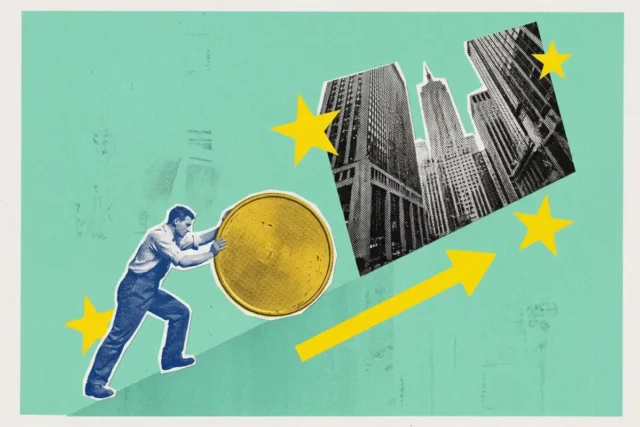
In the NY Fed report, the researchers highlighted that the so-called “labor share” has hit an all-time low. This measure represents the share of all income that goes to workers through wages and salaries.
For the first three months of 2026, the share fell to 53.7% — the lowest on record dating back to 1947.
Workers get a smaller piece of the pie
Following World War II, U.S. workers received more than 65% of the national income pie. Their share stayed above 60% into the early 2000s before falling steadily from the dot-com bust and again from the Great Recession in 2008.
The COVID-19 pandemic deepened the decline, and the NY Fed report concluded that the trend isn’t a blip that appears likely to reverse. Rather, it’s an acceleration of a persistent phenomenon that’s been plaguing workers for decades.
“It looks like across all industries the labor share is coming down,” Richard Audoly, one of the authors of the NY Fed report, told S&P Global.
And if the share for workers is shrinking, that means it’s growing for others. In this case, experts say, corporations and investors are seeing major gains in the form of higher profits and larger dividends.
According to separate data from the U.S. Commerce Department, the share of income resulting in corporate profits hit 12.2% — the highest since at least 1929, when the government first began collecting those figures.
There are several reasons why the slice of the income pie has been shrinking for workers, explained labor economist Raymond Robertson to Fortune earlier this year. They all boil down to fewer workers or suppressed wages.
For instance, some firms are investing in artificial intelligence over people. Megacorporations are padding CEO pay and raising prices. Meanwhile, the overall labor force (and population) is shrinking due to fewer immigrants entering the country.
“Data right now is very mixed,” Robertson said. “But I think it also all consistently points to this idea that things are getting worse for workers and much better for billionaires.”
Disclaimer
Artificial Intelligence Disclosure & Legal Disclaimer
AI Content Policy.
To provide our readers with timely and comprehensive coverage, South Florida Reporter uses artificial intelligence (AI) to assist in producing certain articles and visual content.
Articles: AI may be used to assist in research, structural drafting, or data analysis. All AI-assisted text is reviewed and edited by our team to ensure accuracy and adherence to our editorial standards.
Images: Any imagery generated or significantly altered by AI is clearly marked with a disclaimer or watermark to distinguish it from traditional photography or editorial illustrations.
General Disclaimer
The information contained in South Florida Reporter is for general information purposes only.
South Florida Reporter assumes no responsibility for errors or omissions in the contents of the Service. In no event shall South Florida Reporter be liable for any special, direct, indirect, consequential, or incidental damages or any damages whatsoever, whether in an action of contract, negligence or other tort, arising out of or in connection with the use of the Service or the contents of the Service.
The Company reserves the right to make additions, deletions, or modifications to the contents of the Service at any time without prior notice. The Company does not warrant that the Service is free of viruses or other harmful components.