If you’ve tried to lease commercial or industrial space in Florida lately, you probably know the pitch by heart. The broker quotes a rate per square foot, then adds that industrial vacancy is tight, so you’ll want to sign for three years, maybe five. For a growing product company, that math rarely fits the way business actually moves. You need a lot of room in November, half of it in February, and a truck’s worth of overflow the week a trade show comes to the convention center.
That mismatch — between how storage is sold and how inventory actually behaves — is the reason a quieter model has been gaining ground across the region. It’s usually called on-demand warehousing, and for a lot of Florida operators it has started to look less like a novelty and more like plain common sense.
What “on-demand” actually means
The traditional way to store goods is a third-party logistics contract, or 3PL. You commit to a fixed amount of space for a fixed term, and you pay for it whether your shelves are full or nearly empty. It works well for companies with steady, predictable volume. It works badly for almost everyone else.
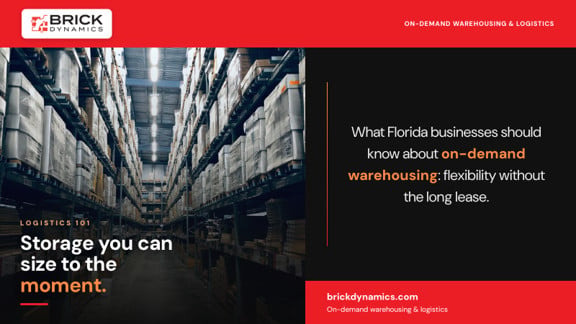
On-demand warehousing flips the arrangement. Instead of leasing a set footprint, a business rents storage as it needs it and pays for what it uses — closer to a pay-as-you-go phone plan than a mortgage. Space can be added when a shipment lands and released when the stock moves out. There’s no permanent infrastructure to carry and no penalty for a slow season.

For a region with as much seasonal swing as Florida, that flexibility is not a small thing. Retailers ramp for the winter tourist crowd and pull back in the summer. Importers deal with container timing they don’t fully control. Event and exhibit companies live and die by a calendar that clusters heavily around Miami’s trade-show weeks. A fixed lease forces all of them to pay year-round for a peak that lasts a few months.
Why the timing makes sense here
Three local pressures have pushed this model forward.
The first is real estate. Industrial rents in Florida have climbed steadily as warehouse land near the ports and the airport has grown scarce. When space is expensive and hard to find, paying for empty square footage stops being a rounding error and starts being a real drag on margin.
The second is the last-mile problem. Customers now expect fast delivery, which means inventory has to sit close to where people live, not in a single hub three states away. Keeping stock local — actually inside the market you serve — shortens the trip to the customer’s door. That’s the logic behind local warehousing: position goods near demand so the final leg of delivery is measured in hours, not days.
The third is weather, and Floridians don’t need this explained. Hurricane season reshapes how any serious operator thinks about where product lives. A single storage node in a low-lying flood zone is a gamble. Spreading inventory across more than one location, and being able to move it before a storm, is the kind of resilience that used to be reserved for large corporations with logistics departments. On-demand models put a version of that within reach of much smaller companies.
The trade-offs worth naming
None of this makes fixed warehousing obsolete. If your volume is high and steady all year, a long-term lease or a dedicated 3PL contract will usually be cheaper per unit. On-demand space carries a convenience premium, the same way renting a car for a weekend costs more per day than owning one you drive daily.
The model earns its keep in the gaps: seasonal peaks, product launches, overflow when a container arrives early, or a temporary presence in a new market you’re still testing. The smartest operators tend to run a blend — a stable base of committed space for their core inventory, plus flexible capacity they can switch on and off around it.
There’s also a coordination cost people underestimate. Splitting inventory across locations only helps if you can see all of it in one place and move work orders without a dozen phone calls. That’s a software problem as much as a real estate one, and it’s worth asking any provider how their logistics and field-service operations connect to the systems you already use. Storage that you can’t track in real time isn’t flexible. It’s just stuff you’ve temporarily lost.
Questions to ask before you sign anything
If you’re a Florida business owner weighing this, a few practical questions cut through the sales talk fast.
How is pricing structured — per pallet, per square foot, per month — and what triggers a minimum? Ask for the full fee schedule, including receiving, handling, and outbound charges, not just the headline storage rate. Convenience models can hide their cost in the per-transaction fees.
How quickly can space actually be turned on? “On-demand” should mean days, not weeks. If the answer sounds like a traditional lease negotiation, it isn’t really on-demand.
Where are the facilities, physically? For hurricane planning and for delivery speed, geography matters. A provider with local execution across major U.S. markets can be useful if you sell beyond Florida, but for your regional stock, you want to know exactly which building it’s sitting in.
And what happens in an emergency? Ask how a provider handles a storm warning, a sudden spike in demand, or a last-minute event. The answer tells you whether you’re buying square footage or an actual operations partner.
The bigger shift
Step back and the trend is less about warehouses than about how businesses want to spend. Companies increasingly prefer to turn fixed costs into variable ones — to pay for capacity in step with demand rather than betting on a forecast years out. Cloud computing did this to servers. On-demand models are doing something similar to physical space, and Florida’s swingy, weather-exposed, event-heavy economy is close to an ideal test case.
For the region’s small and mid-sized businesses, the takeaway isn’t that leases are bad or that on-demand is always right. It’s that storage has finally become something you can size to the moment. In a market where the only certainty is that next season will look different from this one, being able to grow and shrink your footprint on short notice may be the most valuable inventory decision a Florida operator makes all year.
Disclaimer
Artificial Intelligence Disclosure & Legal Disclaimer
AI Content Policy.
To provide our readers with timely and comprehensive coverage, South Florida Reporter uses artificial intelligence (AI) to assist in producing certain articles and visual content.
Articles: AI may be used to assist in research, structural drafting, or data analysis. All AI-assisted text is reviewed and edited by our team to ensure accuracy and adherence to our editorial standards.
Images: Any imagery generated or significantly altered by AI is clearly marked with a disclaimer or watermark to distinguish it from traditional photography or editorial illustrations.
General Disclaimer
The information contained in South Florida Reporter is for general information purposes only.
South Florida Reporter assumes no responsibility for errors or omissions in the contents of the Service. In no event shall South Florida Reporter be liable for any special, direct, indirect, consequential, or incidental damages or any damages whatsoever, whether in an action of contract, negligence or other tort, arising out of or in connection with the use of the Service or the contents of the Service.
The Company reserves the right to make additions, deletions, or modifications to the contents of the Service at any time without prior notice. The Company does not warrant that the Service is free of viruses or other harmful components.