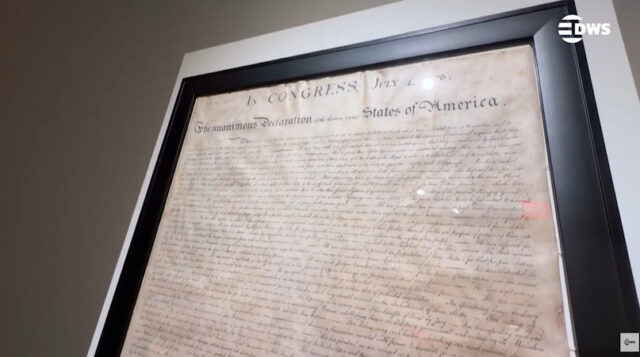
The Declaration of Independence is more than a foundational text; it is a physical survivor of centuries of displacement, environmental decay, and improbable discovery. While the formal, hand-signed parchment manuscript rests securely within the heavy gold-plated frames of the National Archives Rotunda, its survival story weaves through wartime evacuations, deteriorating display cases, and a legendary junk-shop find that stunned the art world. The dual narrative of how America’s birth certificate has been both lost and found, and subsequently preserved, illustrates the shifting value a nation places on its tangible heritage.
The Miracle of the Dunlap Broadside
The story of the Declaration’s dissemination begins on the night of July 4, 1776. Once the Continental Congress approved the text, printer John Dunlap worked feverishly through the night in his Philadelphia shop to produce hundreds of typographic broadsides. These first editions, containing only the printed names of John Hancock and Charles Thomson, were dispatched across the colonies to be read aloud to the public and pasted onto town hall doors. Over the centuries, these fragile sheets of paper largely vanished into history. By the late 20th century, only a handful of Dunlap Broadsides were known to exist.
Then came the legendary discovery of 1989. A shopper browsing a flea market in Adamstown, Pennsylvania, purchased a dismal, torn old painting for four dollars, solely intending to salvage its wooden frame. When the buyer attempted to dismantle the frame, the painting fell apart, revealing a crisp, folded piece of paper hidden behind the canvas backing. It was an exceptionally well-preserved copy of the Dunlap Broadside—one of only 26 surviving examples in the world. This four-dollar investment went on to fetch $2.42 million at auction in 1991, and later sold for a staggering $8.1 million in 2000, underscoring the immense cultural and financial value embedded in these rare physical remnants of 1776.

A Vagabond Document
While individual printed broadsides were lost to time, the original engrossed parchment signed by the delegates—collectively known with the Constitution and Bill of Rights as the Charters of Freedom—endured a precarious, vagabond existence. In its infancy, the Continental Congress carried the parchment from city to city to evade advancing British forces. During the War of 1812, as British troops marched on Washington, D.C., clerk Stephen Pleasants frantically packed the document into coarse linen sacks and smuggled it to a deserted gristmill in Virginia, saving it from the flames that consumed the capital.
Even during the twentieth century, global conflict jeopardized the document. Just days before Christmas in 1941, following the attack on Pearl Harbor, the Declaration of Independence and the Constitution were quietly removed from public display at the Library of Congress. Wrapped in acid-free paper and padlocked inside a custom-made bronze container, the documents were transported via an armored convoy under military escort to the U.S. Bullion Depository at Fort Knox, Kentucky. There, guarded by machine guns and subterranean vaults, the foundational texts remained safely ensconced until their triumphant return to Washington in 1944.
The Science of Modern Display
The permanent display of the Declaration of Independence has presented an entirely different battle: the war against environmental decay. In 1952, the Charters of Freedom were transferred under military guard to their permanent home at the newly constructed National Archives Building. Initially, the documents were sealed in heavy, glass-and-bronze enclosures filled with inert helium gas, a technique believed at the time to be the pinnacle of archival preservation.
However, science caught up with history. In the late 1980s, specialized monitoring equipment detected tiny crystals and microscopic liquid droplets forming on the inner surface of the encasement glass. Archival experts diagnosed this as a severe case of glass deterioration. Left unchecked, the chemical off-gassing from the degrading glass would eventually attack the fragile parchment and original ink underneath.
This discovery prompted a massive, multi-year restoration initiative. On July 5, 2001, the National Archives closed its exhibition halls and withdrew the documents from public view. For two years, elite conservators meticulously examined the Declaration letter by letter, using micro-droplets of a specialized gelatin adhesive to carefully reattach microscopic, lifting flakes of historic ink. When the renovated Rotunda reopened on September 17, 2003, the documents were unveiled inside state-of-the-art titanium and aluminum frames. Filled with chemically inert argon gas rather than helium, and kept under strict climate, humidity, and light controls, these modern encasements ensure that the physical manifestation of American liberty is shielded from the ravages of time.
Sources and Links:
- The Story of the Declaration of Independence (eBooks2go) https://www.ebooks2go.com/img/samplefiles/9781545746165_Sample.pdf
- Society of American Archivists (Access to United States Government Records at NARA) https://www2.archivists.org/sites/all/files/07_David_MENGEL.pdf
- National Council for the Social Studies (Letter from Archibald MacLeish about Relocating the Charters of Freedom) https://www.socialstudies.org/system/files/publications/articles/se_6705248.pdf
- Pennsylvania State University Journals (Returning The Declaration of Independence to Philadelphia) https://journals.psu.edu/pmhb/article/download/43434/43155/43273
Disclaimer
Artificial Intelligence Disclosure & Legal Disclaimer
AI Content Policy.
To provide our readers with timely and comprehensive coverage, South Florida Reporter uses artificial intelligence (AI) to assist in producing certain articles and visual content.
Articles: AI may be used to assist in research, structural drafting, or data analysis. All AI-assisted text is reviewed and edited by our team to ensure accuracy and adherence to our editorial standards.
Images: Any imagery generated or significantly altered by AI is clearly marked with a disclaimer or watermark to distinguish it from traditional photography or editorial illustrations.
General Disclaimer
The information contained in South Florida Reporter is for general information purposes only.
South Florida Reporter assumes no responsibility for errors or omissions in the contents of the Service. In no event shall South Florida Reporter be liable for any special, direct, indirect, consequential, or incidental damages or any damages whatsoever, whether in an action of contract, negligence or other tort, arising out of or in connection with the use of the Service or the contents of the Service.
The Company reserves the right to make additions, deletions, or modifications to the contents of the Service at any time without prior notice. The Company does not warrant that the Service is free of viruses or other harmful components.