From dangerous heat and expanding drought to wildfire smoke that could travel hundreds of miles, AccuWeather expert meteorologists say July is shaping up to be a month of various weather extremes across the United States.
CENTRAL U.S.: Heat Gives Way to Severe Storms
July begins with dangerous heat across parts of the Plains, Midwest and Ohio Valley before the pattern shifts after Independence Day. While temperatures ease in many areas, the threat of severe thunderstorms continues, and drought concerns are expected to grow in parts of the country.
- Damaging thunderstorms could disrupt travel and outdoor plans before the Fourth of July, especially across parts of the Midwest.
o The threat comes after Illinois surpassed its annual record for preliminary tornado reports before the end of June

- Texas is expected to turn significantly drier after a wet June, raising the risk of flash drought development later in the month
EASTERN U.S.: Heat Relents, Drought Expands
The East will get a break from its most dangerous stretch of heat after the July 4 holiday,[GP1] [GP2] though temperatures are still expected to remain 5 to 10 degrees above historic average throughout the month.
- Damaging thunderstorms could sweep across parts of the Northeast, Mid-Atlantic and Carolinas very late in June to early July leading into the holiday weekend before rainfall and storms become more sporadic during the 4th of July holiday and beyond
- Drought conditions are expected to intensify in parts of Virginia, the Delmarva Peninsula and Florida, while additional rounds of severe weather remain possible later in the month
CORN BELT: Crop Stress Concerns Increase
After generally favorable growing conditions in June, most of the Corn Belt is expected to turn hotter and drier in July, though periodic thunderstorms will continue across the region.
Early July thunderstorms could produce damaging wind and hail. Flash drought is also possible if long stretches between rounds of rain develop. The greatest concern is across the northern Plains and Upper Midwest, where below-average snowfall over the winter has left soil moisture lower than normal. Even so, only minor stress is expected for emerging crops, and widespread crop damage is not anticipated.
Much of the Corn Belt, from southern Wisconsin and eastern Iowa eastward into the Ohio Valley, enters July with favorable soil moisture following spring rainfall. Some drier spots can develop in July that remain outside of the thunderstorm paths.
“The percentage of corn in good to excellent condition will likely drop by several percentage points in the Corn Belt in July with a slightly drier than average month expected,” said AccuWeather Senior Meteorologist Chad Merrill.
WESTERN U.S.: Fire Season Intensifies
The Western U.S. enters July with widespread heat, drought, and low humidity. While some of the strongest winds will ease after a volatile late-June pattern, conditions remain highly favorable for wildfire growth and smoke production.
“New and previous fires such as the Cottonwood Fire in Utah will continue to burn and generate very poor quality in the vicinity,” said Merrill.
Wildcards to Watch
AccuWeather experts say there are two factors that could significantly alter the July forecast: wildfire smoke and tropical activity. Both have the potential to affect weather patterns far from their source regions.
- An active Western and Canadian fire season could bring hazy skies all the way to the East Coast
- Air quality impacts could resemble major smoke events experienced during summer 2023
- Western Pacific storms could cause stormy, cool weather
TROPICS: Activity Expected to Remain Quiet Early in July
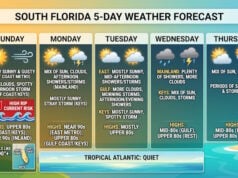
The Atlantic hurricane basin is expected to remain relatively quiet through at least the first half of July, as dry air and strong wind shear continue to limit tropical development. If a system were to form during the first half of the month, it would most likely develop off the Southeast coast along a stalled or slow-moving front.
AccuWeather expert meteorologists expect atmospheric conditions to become somewhat more favorable for tropical development during the second half of July. Even so, a slow start to the month is not unusual.
“The average date for the Atlantics’s second named storm is July 17,” said AccuWeather Lead Hurricane Expert Alexander DaSilva. “Tropical activity typically begins to increase more noticeably in August.”
Summer Heat, Severe Weather and El Nino Update
The El Nino continues to intensify, but the actions across the U.S. will take a break. Generally, wet and cooler conditions are more common from the mid-section to the east during El Nino summers. However, the next several days will be less active with high heat.
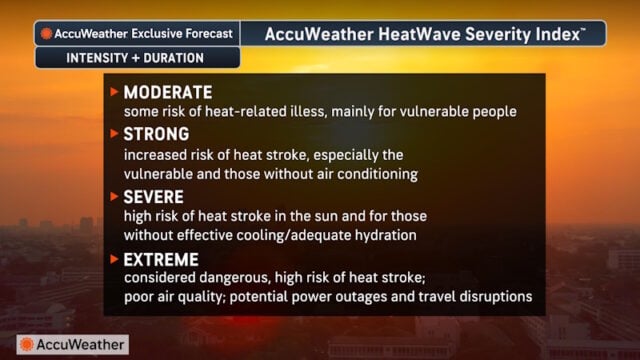
A massive high-pressure dome is expected to build across the eastern United States as the jet stream retreats northward, bringing dangerous heat to a large portion of the country and driving up cooling demand. During the Independence Day holiday weekend, a series of strong weather systems moving over top of the heat dome is expected to trigger rounds of thunderstorms, some capable of producing damaging winds, heavy rainfall and localized flooding. Those same systems will also help weaken the heat dome across the East.
The threat of severe weather will not end after the holiday weekend. Instead, AccuWeather expert meteorologists say a new upper-level pressure system, or heat dome, could develop over the Rockies late next week. As thunderstorms ride along the northern and eastern edge of the heat dome, rounds of severe weather could sweep across parts of the Plains, Midwest and Ohio Valley through mid-July, bringing the risk of destructive storms and heavy rainfall.
Disclaimer
Artificial Intelligence Disclosure & Legal Disclaimer
AI Content Policy.
To provide our readers with timely and comprehensive coverage, South Florida Reporter uses artificial intelligence (AI) to assist in producing certain articles and visual content.
Articles: AI may be used to assist in research, structural drafting, or data analysis. All AI-assisted text is reviewed and edited by our team to ensure accuracy and adherence to our editorial standards.
Images: Any imagery generated or significantly altered by AI is clearly marked with a disclaimer or watermark to distinguish it from traditional photography or editorial illustrations.
General Disclaimer
The information contained in South Florida Reporter is for general information purposes only.
South Florida Reporter assumes no responsibility for errors or omissions in the contents of the Service. In no event shall South Florida Reporter be liable for any special, direct, indirect, consequential, or incidental damages or any damages whatsoever, whether in an action of contract, negligence or other tort, arising out of or in connection with the use of the Service or the contents of the Service.
The Company reserves the right to make additions, deletions, or modifications to the contents of the Service at any time without prior notice. The Company does not warrant that the Service is free of viruses or other harmful components.