We have all been there. You walk into your local grocery store, grab a handful of items, and head toward the front of the store. Seeing a massive line at the traditional lanes with human cashiers, you decide to take your chances with the self-checkout kiosks. At first, everything goes smoothly as you scan your items. But the moment you try to scan a bag of loose produce, the machine freezes. A robotic voice loudly announces, “Please wait for assistance,” and a bright red light flashes above your head. You look around, desperate to find the lone employee who is currently trying to help five other frustrated shoppers deal with their own technical glitches. It is a stressful, annoying experience that has become all too common in modern grocery shopping.
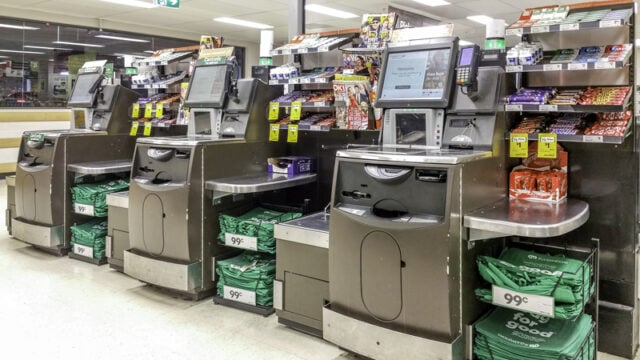
As you can see in a typical supermarket setup, rows of self-checkout machines place a massive burden on a single employee who has to watch every single screen at once. Starting on January 1, 2027, grocery stores in Rhode Island will be required by law to assign at least one dedicated worker for every three self-checkout stations in operation. Right now, it is entirely normal to see a single, stressed-out employee trying to manage six, eight, or even ten kiosks at the same time. They run back and forth, clearing age-verification prompts for alcohol, overriding weight errors on bagging platforms, and fixing paper jams. By capping the ratio at one worker for every three machines, the law ensures that employees can do their jobs effectively without burning out, while shoppers spend less time waiting around.
This legislative victory was heavily backed by the United Food and Commercial Workers (UFCW) Local 328. For years, labor unions have warned that the rapid, unchecked rollout of automation in grocery stores wasn’t actually about making things faster or better for consumers. Instead, they argued it was a convenient way for massive retail corporations to cut labor costs, trim hours, and pile an unfair amount of work onto the remaining employees. The Rhode Island bill was a cornerstone of the UFCW’s broader “Affordable Groceries and Good Jobs Campaign.” Labor advocates pointed out that when a single worker is forced to police a small army of machines, it overtaxes their focus and ruins their working environment. Under the new guidelines, when an employee is assigned to the self-checkout zone, they must be completely relieved of all other duties—meaning they cannot be asked to run a standard register or stock nearby shelves at the same time.

But this law isn’t just about making life easier for employees and less annoying for shoppers who can’t get their produce to scan correctly. There is another major reason why lawmakers and unions pushed for this change: retail theft. It turns out that when you replace human cashiers with automated machines, shoplifting and shrinkage (inventory loss due to theft or scanning errors) skyrocket. Some of it is intentional, but a lot of it happens because people get confused, make mistakes, or simply give up trying to scan tricky items. The UFCW brought hard data to the table to convince lawmakers to take action. They cited a striking report from Capital One showing that retailers in Rhode Island lost a staggering $244 million in 2022 alone due to retail theft. When an area is understaffed, it is incredibly easy for items to slip through unscanned. Having more human eyes on the floor directly combats this massive financial drain.
Rhode Island might be the first state to turn this into an official law, but it is far from alone in its skepticism of total retail automation. Across the United States, a massive counter-revolution against self-checkout is quietly building steam. For nearly two decades, major grocery chains pitched self-checkout as the ultimate win-win future: faster lines for you, lower overhead for them. However, the reality has fallen far short of the corporate promise. Now, states like California, Connecticut, Massachusetts, New York, Ohio, and Washington are actively considering similar legislative restrictions. Even major retail giants are voluntarily pulling back. We have seen companies like Target, Walmart, and Dollar General quietly limit their self-checkout hours, reduce the number of items you can bring to a kiosk, or remove the machines entirely from certain locations because theft and dropping customer satisfaction simply weren’t worth the labor savings.
Of course, the Rhode Island law includes a few practical exceptions to keep things realistic for business owners. Lawmakers recognized that grocery stores operate at wildly different paces depending on the time of day. Because of this, grocers will not be forced to maintain the strict one-to-three staffing ratio during off-peak hours. Specifically, the rules lift between the hours of 8:00 p.m. and 8:00 a.m., when foot traffic slows to a crawl and fewer registers are open. The ratio is also temporarily suspended if the state enters an official state of emergency or if a severe weather alert is active. This gives grocery managers the flexibility they need during unusual circumstances, ensuring they aren’t unfairly penalized when conditions are completely out of their hands.
What happens if a grocery store decides to ignore the rules and leaves a worker alone with six open machines on a busy Friday afternoon? The enforcement mechanism is designed to encourage compliance rather than just punish immediately. For a first offense, a grocery store will receive a written warning detailing the violation. However, if a store continues to violate the staffing ratio, things will get expensive quickly. Fines for multiple violations can reach up to $500 per day. Interestingly, the specific amount of the daily fine is tied directly to local labor economics: it will match the exact wages of a four-hour shift calculated using the highest hourly wage currently paid to retail clerks. It is a clever system that ensures the penalty directly mirrors the cost of the labor the store tried to avoid paying in the first place.
This victory in Rhode Island is just one piece of a much larger puzzle for labor advocates who are trying to preserve the dignity of retail work in an increasingly digital world. The UFCW’s campaign is taking aim at several other modern tech trends that have quietly crept into your local supermarket. For instance, the union is actively fighting against the widespread adoption of electronic shelf labels. While stores love them because they allow prices to be changed instantly across the entire store with a single click from corporate headquarters, labor groups argue they open the door to “dynamic pricing”—where grocery prices could spike during peak hours, similar to how ride-sharing apps use surge pricing. The campaign is also tackling retail data collection and other pricing practices that they argue discriminate against everyday working-class families who might not have access to digital apps or smartphone coupons.
Ultimately, Rhode Island’s new law marks a fascinating turning point in our relationship with technology. It serves as an official acknowledgment that automation has its limits and that humans are an irreplaceable part of a functional society. Technology is great when it makes our lives smoother, but when it isolates us, overburdens workers, and creates an environment of frustration and suspicion, it is time to reassess. When the law takes full effect in 2027, walking into a Rhode Island grocery store will look a little bit different, and hopefully, a whole lot calmer. It is a bold experiment that the rest of the country will be watching closely. So, the next time you find yourself stuck at a self-checkout machine, take comfort in knowing that the pendulum is finally swinging back toward human connection.
Sources and Links:
- Grocery Dive / Retail Dive: Rhode Island becomes first state to mandate staffing ratio for self-checkout
Disclaimer
Artificial Intelligence Disclosure & Legal Disclaimer
AI Content Policy.
To provide our readers with timely and comprehensive coverage, South Florida Reporter uses artificial intelligence (AI) to assist in producing certain articles and visual content.
Articles: AI may be used to assist in research, structural drafting, or data analysis. All AI-assisted text is reviewed and edited by our team to ensure accuracy and adherence to our editorial standards.
Images: Any imagery generated or significantly altered by AI is clearly marked with a disclaimer or watermark to distinguish it from traditional photography or editorial illustrations.
General Disclaimer
The information contained in South Florida Reporter is for general information purposes only.
South Florida Reporter assumes no responsibility for errors or omissions in the contents of the Service. In no event shall South Florida Reporter be liable for any special, direct, indirect, consequential, or incidental damages or any damages whatsoever, whether in an action of contract, negligence or other tort, arising out of or in connection with the use of the Service or the contents of the Service.
The Company reserves the right to make additions, deletions, or modifications to the contents of the Service at any time without prior notice. The Company does not warrant that the Service is free of viruses or other harmful components.