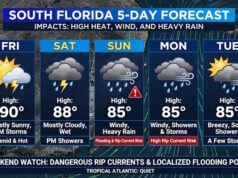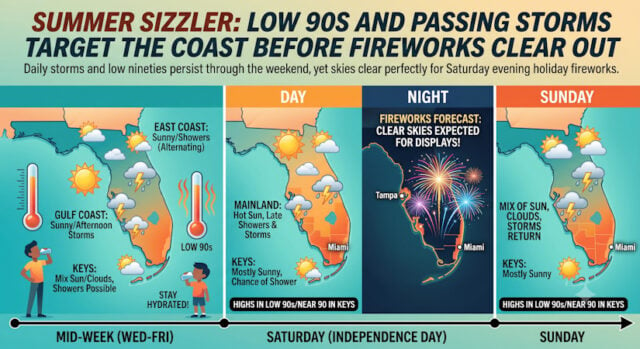
Wednesday features mostly sunny skies alternating with periods of showers and storms in the East Coast metro area. The Gulf Coast will be sunny with afternoon storms, while the Keys will see a mix of sun and clouds, with a chance of showers or storms. Wednesday’s highs will be mostly in the low 90s — but it will feel much hotter, so stay hydrated and out of the sun.
Thursday will bring sun, clouds, and mainly afternoon showers and storms to the East Coast metro area. The Gulf Coast will be mostly sunny with periods of showers and storms. Look for mostly sunny skies and a stray shower or storm in spots in the Keys. Thursday’s highs will be in the low 90s.
Friday will feature mostly sunny skies and periods of showers and storms on the mainland, while the Keys will see lots of sun and maybe a shower or storm. Friday’s highs will be in the low 90s.
Independence Day will see hot sun, some clouds, and mainly afternoon and early evening showers and storms on the mainland. The Keys will be mostly sunny with just the chance of a shower. Right now, it looks like showers and storms should clear out in time for fireworks displays on Saturday night. Saturday’s highs will be in the low 90s in the East Coast metro area and near 90 degrees along the Gulf Coast and in the Keys.

Sunday’s forecast calls for a mix of sun, clouds, and periods of showers and storms on the mainland, while the Keys will be mostly sunny with the chance of a shower. Highs on Sunday will be in the low 90s in the East Coast metro area and near 90 degrees along the Gulf Coast and in the Keys.
In the tropics, those disorganized showers and storms off the North Carolina coast have no chance of developing into a depression.
Disclaimer
Artificial Intelligence Disclosure & Legal Disclaimer
AI Content Policy.
To provide our readers with timely and comprehensive coverage, South Florida Reporter uses artificial intelligence (AI) to assist in producing certain articles and visual content.
Articles: AI may be used to assist in research, structural drafting, or data analysis. All AI-assisted text is reviewed and edited by our team to ensure accuracy and adherence to our editorial standards.
Images: Any imagery generated or significantly altered by AI is clearly marked with a disclaimer or watermark to distinguish it from traditional photography or editorial illustrations.
General Disclaimer
The information contained in South Florida Reporter is for general information purposes only.
South Florida Reporter assumes no responsibility for errors or omissions in the contents of the Service. In no event shall South Florida Reporter be liable for any special, direct, indirect, consequential, or incidental damages or any damages whatsoever, whether in an action of contract, negligence or other tort, arising out of or in connection with the use of the Service or the contents of the Service.
The Company reserves the right to make additions, deletions, or modifications to the contents of the Service at any time without prior notice. The Company does not warrant that the Service is free of viruses or other harmful components.