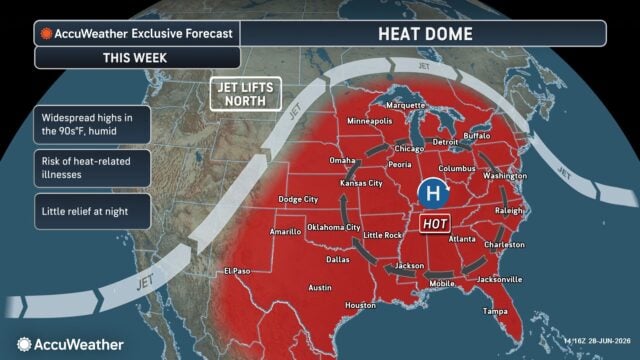
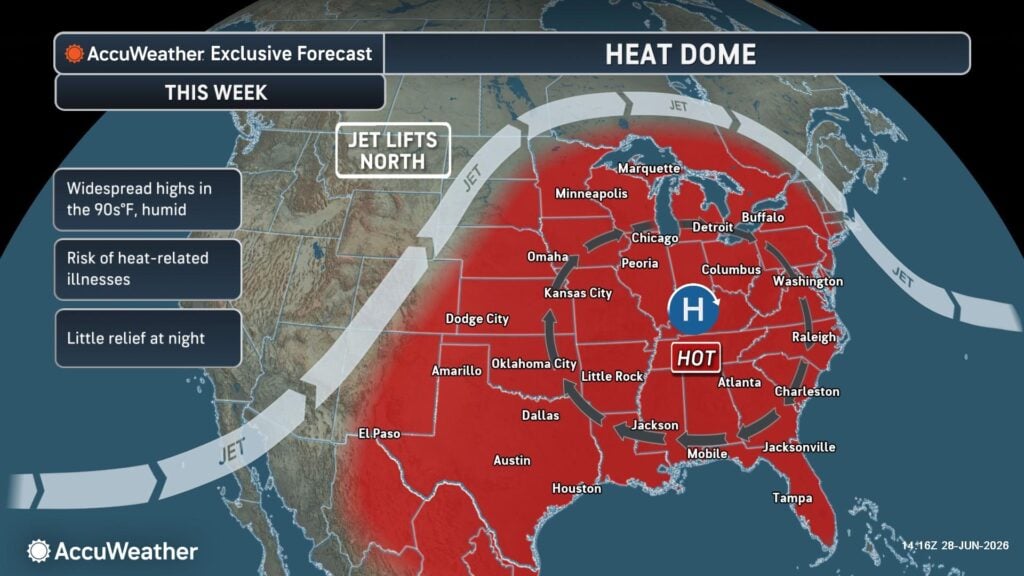
The Heat Dome setting up over the United States continues to intensify, and this week’s heatwave could be the worst in New York City in 20-years. The risk these extreme temperatures will bring will lurk long after the sun sets, with corresponding overnight temperatures 15-20 degrees above historic average.
“While temperatures during the day will be dangerous, the lack of any relief from the heat and humidity at night can be especially stifling and even deadly, especially for those that don’t have air conditioning,” said AccuWeather expert meteorologist Matt Benz.
This week’s heat dome will bring daily afternoon temperatures in the upper-90s to 100 degrees to hundreds of millions of Americans, with AccuWeather RealFeel® highs near 110 degrees. This kind of extreme heat can have a significant impact on power and utilities.

“Extreme heat is a double threat, it endangers lives and strains the electric grid simultaneously. As more people turn to air conditioning to survive the heat, demand spikes, increasing the risk of blackouts and brownouts. At night, in densely populated neighborhoods or apartment buildings where air flow is minimal and cooling options are scarce, those outages can turn deadly.” said AccuWeather expert meteorologist Tyler Roys.
“For many Americans, the heat is already here. However, in many cities and communities, the hottest days are still ahead. As temperatures and AccuWeather RealFeel® Temperatures continue to climb through the week, it’s important to take the heat seriously by limiting time outdoors during the hottest part of the day, staying hydrated and checking on those most at risk for heat-related illness, including the elderly, children and pets,” said AccuWeather expert meteorologist Carl Erickson.
How You Do Your Part to Relieve Stress on the Grid
- Set your thermostat to the highest comfortable temperature and avoid frequent adjustments.
- Run dishwashers, washers, and dryers during the morning or evening instead of peak afternoon hours.
- Keep blinds and curtains closed to reduce heat gain and lessen the workload on your air conditioner.
- Turn off unnecessary lights and electronics to reduce energy use.
- Delay charging electric vehicles until overnight, when electricity demand is lower.
- Be prepared for potential outages by keeping phones charged and flashlights and batteries on hand.
The AccuWeather HeatWave Severity Index™ is forecasting a strong or severe heatwave in Raleigh, NC, Philadelphia, Washington, DC and New York. The heatwave in New York City could be the strongest since 2005.
AccuWeather Heatwave Counter and Severity Index™
The exclusive AccuWeather HeatWave Counter and Severity Index™ measures heat waves by duration and intensity. Heat waves are defined as three or more consecutive days in which the temperature exceeds a location-specific threshold. In New York City, Chicago and Philadelphia, this threshold is set at 90 degrees Fahrenheit. In Raleigh, this threshold is set at 95 degrees Fahrenheit. The severity depends on the duration of the heat wave and the extent to which temperatures exceed the threshold.
AccuWeather RealFeel®
AccuWeather RealFeel® Temperature combines more than a dozen factors to provide an accurate measure of how representative the current or forecast weather conditions really “feel” to an appropriately dressed person.
Disclaimer
Artificial Intelligence Disclosure & Legal Disclaimer
AI Content Policy.
To provide our readers with timely and comprehensive coverage, South Florida Reporter uses artificial intelligence (AI) to assist in producing certain articles and visual content.
Articles: AI may be used to assist in research, structural drafting, or data analysis. All AI-assisted text is reviewed and edited by our team to ensure accuracy and adherence to our editorial standards.
Images: Any imagery generated or significantly altered by AI is clearly marked with a disclaimer or watermark to distinguish it from traditional photography or editorial illustrations.
General Disclaimer
The information contained in South Florida Reporter is for general information purposes only.
South Florida Reporter assumes no responsibility for errors or omissions in the contents of the Service. In no event shall South Florida Reporter be liable for any special, direct, indirect, consequential, or incidental damages or any damages whatsoever, whether in an action of contract, negligence or other tort, arising out of or in connection with the use of the Service or the contents of the Service.
The Company reserves the right to make additions, deletions, or modifications to the contents of the Service at any time without prior notice. The Company does not warrant that the Service is free of viruses or other harmful components.