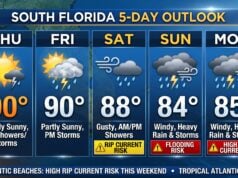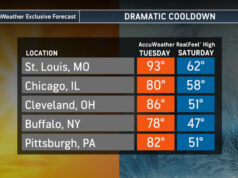
High temperatures above 100 degrees and a heatwave in some of America’s biggest cities. That’s what hundreds of millions will experience this week and greet those traveling to celebrate America250.
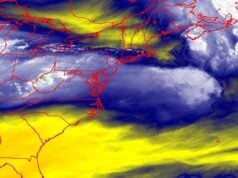
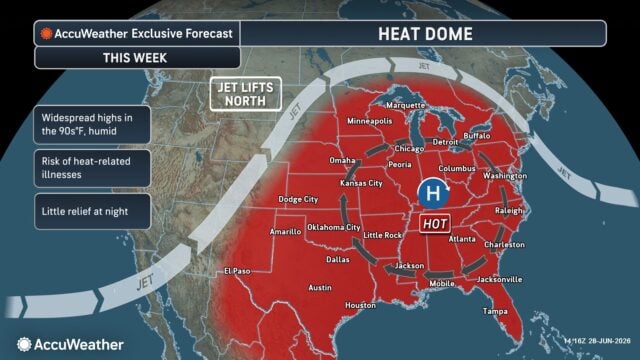
A ‘heat dome’ is building across much of the Midwest and Eastern United States bringing widespread 90-and 100-degree air temperatures beginning today through the holiday weekend. For many, the AccuWeather RealFeel® temperatures will soar above 110 degrees. The extreme heat will impact everything from everyday life to beach vacations and outdoor cookouts to watching the fireworks.
“This Fourth of July week, millions of Americans will be celebrating outdoors during one of the most intense stretches of heat we’ve seen so far this summer, including across parts of the Ohio Valley, the Mississippi Valley and the I-95 corridor from Washington, D.C. to Philadelphia. Anyone traveling or spending time outdoors should make heat safety part of their plans this entire holiday week,” said AccuWeather expert meteorologist Carl Erickson.
“Temperatures get magnified under a heat dome as sinking air associated with high pressure aloft bakes the air mass underneath it. The longer these features stick around, the hotter it tends to get at the surface of the earth,” Erickson aded.

Nighttime Temperatures Can Be Dangerous, Too
It’s not just the daytime temperatures that people need to monitor closely.
“While temperatures during the day will be dangerous, the lack of any relief from the heat and humidity at night can be especially stifling and even deadly, especially for those that don’t have air conditioning,” said AccuWeather expert meteorologist Matt Benz.
How to Prepare for the Extreme Heat This Week
The AccuWeather Heatwave Counter and Severity Index ™ is forecasting strong and even severe heatwaves in Philadelphia, Raleigh, NC, and Chicago. On the rim of the heat dome, there could be storms, some severe, producing long-lived, intense lines of wind gusts and damage known as derechos.
- Limit Heat Exposure: Stay hydrated, avoid prolonged time outdoors, schedule activities for cooler morning or evening hours, and wear lightweight, light-colored clothing.
- Stay Cool & Protect Vulnerable People: Spend time in air-conditioned spaces or cooling centers, check on older adults, children, and those with medical conditions, and never leave children or pets in vehicles. There may be little relief at night from the heat, especially in urban centers.
- Prepare for Power Outages & Conserve Energy: Reduce electricity use during peak afternoon hours, run major appliances early or late, and keep emergency supplies (water, food, flashlights, first-aid kit) ready.
- Monitor Conditions & Know the Risks: Watch for signs of heat illness (dizziness, nausea, rapid heartbeat, intense thirst), check air quality and RealFeel®weekend temperatures, and ensure cooling systems are working properly.
Fast Historical Facts about Heat Waves in Philly and NYC
- The last time Philadelphia reached 100 degrees or higher was June 24, 2025, when the temperature reached 101. Before that, the last time Philadelphia hit 100 degrees dates back to July 2012.
- Since the summer of 2010, Philadelphia has experienced a heat wave (defined by AccuWeather as three or more consecutive days with temperatures at or above 90 degrees) 11 times around the Fourth of July holiday. The most recent was July 4-10, 2024.
- Since the summer of 2010, New York City has experienced a heat wave (defined by AccuWeather as three or more consecutive days with temperatures at or above 90 degrees) four times around the Fourth of July holiday. The most recent was June 30- July 3, 2018.
- The last time it reached 100 was in 2012 in New York City. This ended a 3-year stretch of reaching the 100s for the city. The highest temperature reached during this stretch was 104 degrees on July 22, 2011.
AccuWeather Heatwave Counter and Severity Index™
The exclusive AccuWeather HeatWave Counter and Severity Index™ measures heat waves by duration and intensity. Heat waves are defined as three or more consecutive days in which the temperature exceeds a location-specific threshold. In New York City, Chicago and Philadelphia, this threshold is set at 90 degrees Fahrenheit. In Raleigh, this threshold is set at 95 degrees Fahrenheit. The severity depends on the duration of the heat wave and the extent to which temperatures exceed the threshold.
AccuWeather RealFeel®
AccuWeather RealFeel® Temperature combines more than a dozen factors to provide an accurate measure of how representative the current or forecast weather conditions really “feel” to an appropriately dressed person.
Disclaimer
Artificial Intelligence Disclosure & Legal Disclaimer
AI Content Policy.
To provide our readers with timely and comprehensive coverage, South Florida Reporter uses artificial intelligence (AI) to assist in producing certain articles and visual content.
Articles: AI may be used to assist in research, structural drafting, or data analysis. All AI-assisted text is reviewed and edited by our team to ensure accuracy and adherence to our editorial standards.
Images: Any imagery generated or significantly altered by AI is clearly marked with a disclaimer or watermark to distinguish it from traditional photography or editorial illustrations.
General Disclaimer
The information contained in South Florida Reporter is for general information purposes only.
South Florida Reporter assumes no responsibility for errors or omissions in the contents of the Service. In no event shall South Florida Reporter be liable for any special, direct, indirect, consequential, or incidental damages or any damages whatsoever, whether in an action of contract, negligence or other tort, arising out of or in connection with the use of the Service or the contents of the Service.
The Company reserves the right to make additions, deletions, or modifications to the contents of the Service at any time without prior notice. The Company does not warrant that the Service is free of viruses or other harmful components.