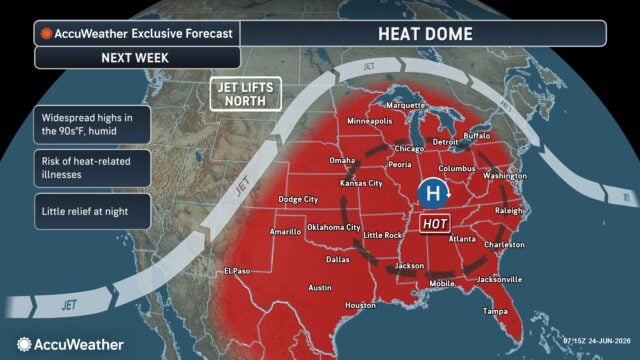
As tens of millions of Americans prepare to pack their bags, grab their sunscreen, and head toward the nation’s beaches, lakes, and campgrounds for the upcoming July 4th holiday weekend, nature is preparing an extraordinary and dangerous meteorological event. This year’s celebrations carry immense historical weight as the United States marks its semiquincentennial—America250. However, the historic milestone will coincide with a monumental atmospheric setup. A massive, sprawling “heat dome” is forecast to anchor itself over the eastern half of the United States early next week, sending temperatures soaring deep into the 90s and potentially hitting the triple digits in several major metropolitan areas well before the holiday fireworks illuminate the sky.
The timing of this intense heat wave presents significant challenges for public safety officials and holiday travelers alike. With millions planning extended outdoor gatherings, parades, concerts, and family barbecues, exposure to extreme heat will be at an annual high. This intense weather pattern will dominate the central and eastern states, expanding across a massive geographic footprint that leaves very few regions untouched.
Demystifying the Heat Dome: The Atmospheric Engine
To understand the severity of the upcoming forecast, it is essential to look at the mechanics behind this specific atmospheric phenomenon. A heat dome is not a typical summer warm spell; it is a structural, self-sustaining weather engine.

“A heat dome is a sprawling area of high pressure that creates hot and humid conditions for days or weeks at a time,” explained AccuWeather expert meteorologist Dan Pydynowski. “Heat domes can prevent clouds from forming, resulting in abundant sunshine that boosts temperatures, potentially toward record levels.”
When a strong, static ridge of high pressure parks itself in the upper levels of the atmosphere, it acts exactly like an invisible lid on a boiling pot. As warm air attempts to rise naturally from the Earth’s surface, it encounters this dense wall of high pressure. Instead of rising and cooling to form clouds and rain, the air is forced back downward. As this trapped air sinks, it undergoes compressed heating, crowding the air molecules into a smaller volume and driving temperatures steadily upward.
Because the dome effectively diverts incoming storm tracks and prevents cloud development, the landscape below is subjected to uninterrupted, blistering solar radiation. This dries out the soil, which in turn reduces evaporative cooling, creating a vicious feedback loop that intensifies the heat day after day. The heat dome expected to set up early next week features a monumental scale, spanning all the way from the oil fields of Texas to the hills of Pennsylvania, and stretching vertically from the coastal plains of Florida up to the northern lakes of Minnesota.
The Firecracker Forecast: Extreme Temperatures and RealFeel Realities
For those tracking the AccuWeather Firecracker Forecast, the incoming data indicates an extended stretch of highly stressful conditions. Dangerous heat will push ambient thermometer temperatures deep into the 90s across much of the central and eastern United States. Major urban corridors throughout the Midwest and South will bear the brunt of this prolonged event. Cities such as Chicago, Illinois, and St. Louis, Missouri, are facing the distinct possibility of a week or more of consecutive 90-degree heat—a duration that severely tests both regional power grids and human physiology.
However, focusing strictly on the thermometer reading understates the true physical toll of this air mass. Because this high-pressure system is pulling massive quantities of moisture from the Gulf of Mexico, the humidity levels will be thick and oppressive. When high humidity combines with intense heat, the human body loses its ability to cool itself effectively through the evaporation of sweat.
| Region / Major Hubs | Ambient Temperatures | RealFeel Outlook | Primary Weather Risk Factors |
| Midwest (Chicago, St. Louis) | Mid-to-upper 90s °F | 100°F to 105°F+ | Prolonged heat duration, consecutive 90+ degree days |
| Central & Southern Plains (Texas) | 95°F to 100°F+ | 105°F to 110°F+ | Extreme triple-digit peaks, minimal overnight cooling |
| Mid-Atlantic & Northeast (Pennsylvania) | Low-to-mid 90s °F | 98°F to 103°F | “Ring of Fire” storm clusters, high derecho risk Tue/Wed |
| Southeast & Florida | Low-to-mid 90s °F | 102°F to 108°F | Oppressive tropical humidity, high baseline heat stress |
Consequently, AccuWeather RealFeel® Temperatures are forecast to hit or exceed 100 degrees each afternoon across a vast territory. More concerning still for public health professionals is the forecast for elevated overnight lows. In many urban environments, temperatures will fail to drop below the mid-to-upper 70s, or even the 80-degree mark, during the nighttime hours.
This lack of nocturnal cooling prevents the human body from recovering from daytime heat stress, compounding the biological toll. This dynamic creates an exceptionally hazardous situation, especially for vulnerable populations, outdoor workers, the elderly, pets, and the millions of citizens living in homes without functional air conditioning systems.
The Violent Edge: Thunderstorm Clusters and Derecho Threats
While the core of the heat dome will remain largely dry, clear, and sweltering, its outer boundaries will serve as a volatile battleground for severe weather. As the jet stream is forced to swerve around the massive dome of high pressure, atmospheric disturbances will ride along its perimeter. This zone, often referred to by meteorologists as the “ring of fire,” provides the perfect ingredients for explosive, long-lived convective storm systems.
Storm clusters will form on the heat dome’s edge, fueled by the immense energy and moisture trapped underneath the high pressure. Atmospheric conditions are uniquely aligned to promote long lines of fast-moving thunderstorms capable of producing widespread, straight-line damaging winds that can stretch for hundreds of miles. These significant windstorms, known technically as derechos, can match the destructive power of tornadoes or tropical systems over an immense geographic path.
“With heat and humidity nearby, any clusters of thunderstorms that develop can produce damaging winds, resulting in downed trees, power outages, and other damage. Intense thunderstorm clusters can even form into a derecho, a long-lived and significant windstorm. The risk of thunderstorm clusters with damaging winds may be highest next Tuesday or Wednesday,” said AccuWeather Chief Meteorologist Jon Porter.
The threat of power outages stemming from these peripheral storms is amplified by the fact that the electrical grid will already be under maximum strain from regional air conditioning demands. A sudden, widespread power outage caused by a derecho would leave hundreds of thousands of families without cooling mechanisms during the peak of an extreme heat wave, escalating a localized weather inconvenience into a major public health emergency.
Mitigating Risks During America250 Celebrations
As the nation prepares for outdoor festivities, adapting behaviors to match these severe conditions is crucial. Local event organizers and citizens participating in America250 gatherings must prioritize hydration and heat mitigation. Emergency management agencies recommend limiting direct exposure to sunlight during peak heating hours, typically between 10:00 AM and 4:00 PM. Drinking water and electrolyte-replenishing fluids consistently—well before the sensation of thirst sets in—is paramount.
Additionally, anyone participating in outdoor recreation at the beach or lake should remain highly vigilant of the shifting sky. Because the thunderstorm clusters on the edge of the heat dome move at rapid speeds, severe weather can arrive with very little visual warning. Checking local radar updates frequently and establishing a clear, structural shelter plan before heading outdoors will ensure that this historic Independence Day remains both memorable and safe.
Sources and Links:
- NOAA Climate Prediction Center (U.S. Hazards Outlook): https://www.cpc.ncep.noaa.gov/products/predictions/threats/threats.php
- National Geographic (Understanding Heat Dome Dynamics): https://www.nationalgeographic.com/environment/article/what-is-heat-dome
- Wikipedia (Heat Dome Meteorological Characteristics & Impacts): https://en.wikipedia.org/wiki/Heat_dome
- AccuWeather
Disclaimer
Artificial Intelligence Disclosure & Legal Disclaimer
AI Content Policy.
To provide our readers with timely and comprehensive coverage, South Florida Reporter uses artificial intelligence (AI) to assist in producing certain articles and visual content.
Articles: AI may be used to assist in research, structural drafting, or data analysis. All AI-assisted text is reviewed and edited by our team to ensure accuracy and adherence to our editorial standards.
Images: Any imagery generated or significantly altered by AI is clearly marked with a disclaimer or watermark to distinguish it from traditional photography or editorial illustrations.
General Disclaimer
The information contained in South Florida Reporter is for general information purposes only.
South Florida Reporter assumes no responsibility for errors or omissions in the contents of the Service. In no event shall South Florida Reporter be liable for any special, direct, indirect, consequential, or incidental damages or any damages whatsoever, whether in an action of contract, negligence or other tort, arising out of or in connection with the use of the Service or the contents of the Service.
The Company reserves the right to make additions, deletions, or modifications to the contents of the Service at any time without prior notice. The Company does not warrant that the Service is free of viruses or other harmful components.