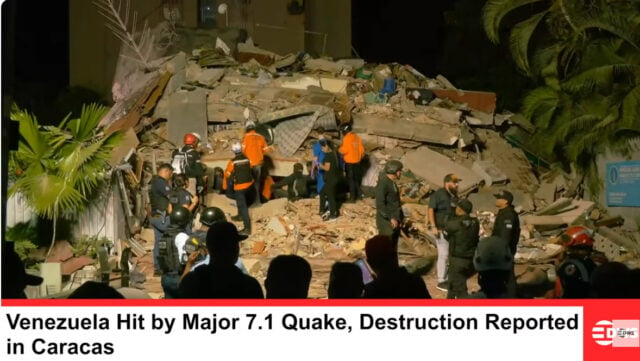
On the evening of Wednesday, June 24, 2026, a deceptive calm hung over the crowded cities and coastal towns of Venezuela. It was shortly after 6:00 p.m. local time—a bustling period when restaurants were filling with patrons and workers were beginning their evening commutes. Within the span of less than a single minute, that routine serenity was completely shattered by one of the most violent geological disruptions the South American nation has seen in over a century. A terrifying pair of back-to-back earthquakes tore through the northwest region of the country, sending shockwaves across multiple states, fracturing vital infrastructure, and flattening buildings in the heart of the capital city, Caracas. The suddenness and sheer magnitude of the disaster instantly thrust the nation into a state of acute emergency, sparking a complex and frantic humanitarian rescue operation amid billowing dust clouds and widespread blackouts.
This is unedied video - a lot of it is live
The Science of the Seismic Doublet
According to data verified by the United States Geological Survey (USGS), the disaster was a classic seismic “doublet”—a rare and highly destructive phenomenon where two major earthquakes of similar magnitude occur in rapid succession within close geographic and temporal proximity. The first event, initially logged as a magnitude 7.1 before being officially upgraded by seismologists to a magnitude 7.2, struck at 18:04 local time. Its epicenter was located roughly 17.6 miles northwest of the town of Montalbán, near the community of San Felipe and west of the vital coastal city of Morón. It originated at a dangerously shallow depth of approximately 13 kilometers (8.2 miles).
Caracas Under Siege
While the epicenters of the twin quakes were situated roughly 100 to 180 miles west of Caracas, the capital city bore the heaviest structural scars of the shifting fault lines. Skyscrapers and concrete high-rises swayed violently from side to side, transforming the urban skyline into a terrifying visual display of structural strain. In neighborhoods across Caracas, the sheer lateral force of the tremors sheared away the exterior brick and concrete walls of multi-story structures, exposing home interiors, living room furniture, and personal belongings directly to the street below.

The historic and upscale neighborhood of Altamira quickly emerged as a major focal point of the urban devastation. Interior Minister Diosdado Cabello confirmed that the area was experiencing “alarming situations,” characterized by totally collapsed residences and heavily compromised multi-family apartment complexes. As structures failed, dense columns of gray dust rose above the city’s commercial and residential blocks, briefly blocking out the twilight sky. Shattered glass from broken storefronts and torn entryways littered major thoroughfares, while deep fissures cracked open highways and residential roads, making vehicular travel incredibly perilous for fleeing residents.
Human Terror and the Diaspora’s Panic
The psychological toll on the civilian population was immediate and overwhelming. Thousands of panicked residents poured out of swaying structures that suddenly felt like death traps, filling the city streets. Many remained outside for hours long after nightfall, sitting directly on the debris-covered asphalt, embracing family members and pets as minor aftershocks continued to rattle the ground.
Eyewitness testimonies paint a vivid picture of the sheer chaos of the moment. Hector Ricci, a resident of Caracas, described the unfolding nightmare to journalists:
“It started off gently and then gradually grew, and in the end, we all had to leave our houses, go outside and gather together. The building really shook from side to side. It was unreal.”
Another local resident, Roberto Gamas, echoed the sentiment of survival, stating, “We were walking and it was tossing us around. Everything in the apartment fell. Well, thank God we were able to get out.”
Compounding the physical danger was an almost instantaneous collapse of critical infrastructure. Portions of the capital lost both electrical power and cellular signals, plunging millions into total digital isolation. This sudden communication blackout caused intense emotional distress not only within Venezuela but across the globe. With more than 7.7 million Venezuelans living abroad as a result of the nation’s long-standing socio-economic and political crises, the inability to verify the safety of loved ones triggered a secondary wave of panic throughout the international diaspora. From exile, prominent opposition leader Maria Corina Machado took to social media to urge calm, writing, “May strength, serenity, and solidarity prevail among us in the face of this difficult time.”
Government Mobilization and Rescue Operations
Faced with a catastrophe of historic proportions, the state apparatus moved quickly to implement emergency response protocols. Speaking directly to the public on the state-run television channel, Venezolana de Televisión, Interior Minister Diosdado Cabello sought to manage the rising panic while acknowledging the gravity of the situation. He explicitly noted that multiple injuries had been reported across various states and issued an urgent plea to motorists to clear roads completely so that ambulances and heavy rescue equipment could navigate the debris-strewn streets.
“We understand that some people may be desperate, but we are acting according to protocols to activate aid and rescue efforts to help those who need it most,” Cabello stated during his broadcast. He instructed citizens to remain outdoors throughout the night, emphasizing that the compromised structures were highly vulnerable to total collapse from the anticipated barrage of aftershocks. “Be very careful with children and the elderly; call each other and check that no one has been harmed,” he implored. Concurrently, acting president Delcy Rodríguez announced the closure of regional airports and the total cancellation of academic classes nationwide while preparing to deliver a comprehensive address to the stricken nation.
International Tremors and Tsunami Warnings
The immense energy liberated by the 7.2 and 7.5 doublet events was not contained by Venezuela’s geopolitical borders. Seismic stations and witnesses in neighboring Colombia reported strong, rolling tremors that sent brief waves of anxiety through border communities. Shockingly, the effects of the mainshock were felt as far away as the dense forests of Brazil’s Amazon basin, located more than 1,700 kilometers (1,050 miles) south of the Caribbean coast, illustrating the extraordinary power of the seismic waves.
Beyond the immediate mainland devastation, the earthquakes generated severe concerns of a maritime disaster. Within minutes of the secondary rupture, the National Weather Service’s U.S. Tsunami Warning System and the Pacific Tsunami Warning Center issued active tsunami threats and advisories for a massive swath of the Caribbean. Initial alerts warned that coastal zones in Venezuela, Aruba, Bonaire, and Curaçao could be hit by hazardous, fluctuating waves and exceptionally powerful ocean currents. Tsunami advisories were also broadcast for Puerto Rico and both the U.S. and British Virgin Islands. For a tense couple of hours, coastal residents throughout the Caribbean basin prepared for potential evacuations. Fortunately, after extensive data analysis by duty scientists, the sea-level anomalies were deemed non-threatening, and all regional tsunami alerts were safely canceled without further incident.
The Path Forward and Long-Term Recovery
As dawn approaches following the catastrophic events of June 24, 2026, the true scale of the tragedy is only beginning to come into sharp focus. The USGS has warned that due to the high magnitude, shallow depths, and urban density affected, extensive structural damage and significant casualties are highly probable, with some initial statistical ranges suggesting deep humanitarian losses.
For Venezuela, this natural disaster represents an unprecedented challenge superimposed on an already fragile economic and social foundation. The task of clearing thousands of tons of concrete rubble, stabilizing compromised infrastructure, restoring fragile power grids, and providing medical care to thousands of displaced and injured citizens will require an immense mobilization of resources. In a nation where medical supplies, construction materials, and public funding have been severely constrained for over a decade, the recovery process will inevitably demand substantial international assistance and cooperation. The twin quakes have not only altered the physical landscape of cities like Caracas and Morón, but they have also set the stage for a long, grueling journey toward national reconstruction and systemic resilience.
Sources and Links:
- AP News: Airport closed, classes canceled after Venezuela earthquakes across states, acting president says
- CBS News: Two 7+ magnitude earthquakes strike Venezuela, heavy damage reported in Caracas
- Al Jazeera: Venezuela struck by back-to-back earthquakes, many casualties feared
- Times of India: 7.2, 7.5 powerful back-to-back earthquakes rock Venezuela, high casualties likely; tsunami alert issued
- India Today: Magnitude 7.1 quake rocks Venezuela, buildings damaged in tremor
Disclaimer
Artificial Intelligence Disclosure & Legal Disclaimer
AI Content Policy.
To provide our readers with timely and comprehensive coverage, South Florida Reporter uses artificial intelligence (AI) to assist in producing certain articles and visual content.
Articles: AI may be used to assist in research, structural drafting, or data analysis. All AI-assisted text is reviewed and edited by our team to ensure accuracy and adherence to our editorial standards.
Images: Any imagery generated or significantly altered by AI is clearly marked with a disclaimer or watermark to distinguish it from traditional photography or editorial illustrations.
General Disclaimer
The information contained in South Florida Reporter is for general information purposes only.
South Florida Reporter assumes no responsibility for errors or omissions in the contents of the Service. In no event shall South Florida Reporter be liable for any special, direct, indirect, consequential, or incidental damages or any damages whatsoever, whether in an action of contract, negligence or other tort, arising out of or in connection with the use of the Service or the contents of the Service.
The Company reserves the right to make additions, deletions, or modifications to the contents of the Service at any time without prior notice. The Company does not warrant that the Service is free of viruses or other harmful components.