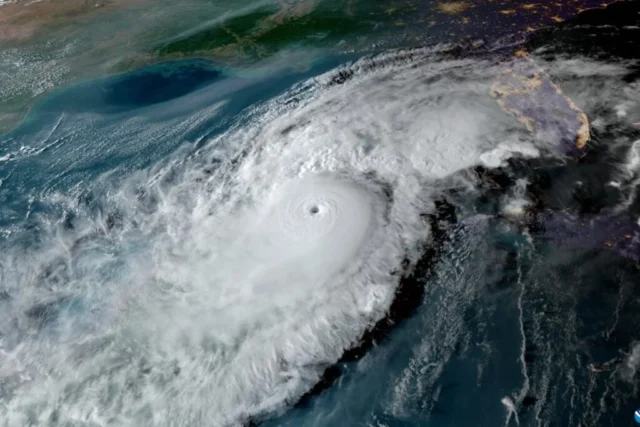
When Hurricane Sandy slammed into the Eastern Seaboard in October 2012, it left an unforgettable trail of devastation. Across 24 states, an estimated 60 million people felt its wrath, with New York and New Jersey bearing the brunt of a historic storm surge. The economic toll alone exceeded $62 billion. For years, the damage left behind by such extreme weather events has felt like an unavoidable tax levied by a warming planet. But what if we didn’t have to just sit there and take it? What if we could subtly push a hurricane out of the way?
A groundbreaking perspectives paper published in the journal PLOS Water suggests that this sci-fi concept might actually be achievable. Researchers are proposing a radical new methodology they call “weather jiu-jitsu.” The core philosophy relies on using artificial intelligence and minor, highly targeted atmospheric interventions to alter the paths of some of the world’s most dangerous weather systems before they ever reach land.
The Philosophy of Weather Jiu-Jitsu
Traditional weather modification, which has been studied and debated for decades, typically focuses on cloud seeding to force rain over a specific local area suffering from drought. Weather jiu-jitsu works on an entirely different scale. Instead of fighting a massive storm with brute force, this technique aims to exploit the inherent instabilities of the global jet stream—the fast-flowing atmospheric air currents that act as steering wheels for extreme weather systems.
Qin Huang, a PhD student specializing in climate science, artificial intelligence, and complex systems at Arizona State University, co-authored the study. She explained that our current physical and financial safety nets—ranging from physical dams and levees to insurance systems—are consistently overwhelmed by catastrophic events. Climate change is widening these gaps every year.

According to Huang, dynamical systems theory proves that the jet stream is unstable in predictable ways. The research team set out to discover whether that instability could be deliberately manipulated. The goal is not to suppress the storm at the injection site, but rather to introduce a tiny, precise disturbance—a “perturbation”—days in advance. This small nudge is designed to trigger a domino effect through the atmosphere, amplified by the planet’s own natural dynamics, to redirect a harmful storm trajectory thousands of miles away.
Testing the Theory with AI
To test whether this theory holds up under real-world complexities, the research team conducted proof-of-concept simulation experiments. They combined traditional atmospheric circulation models with Aurora, a cutting-edge, large-scale AI model engineered for high-resolution weather forecasting.
The researchers looked at three notorious, historical extreme weather events as their primary case studies:
- Hurricane Sandy (2012): The devastating East Coast superstorm.
- The Texas Freeze (2021): A winter storm that famously crippled the state’s power grid.
- A California Atmospheric River (2022): A massive “river in the sky” that caused widespread flooding.
The AI-driven simulations yielded astonishing results. For the 2021 Texas Freeze, the model indicated that applying carefully calculated atmospheric perturbations ahead of the event could have mitigated the extreme cold, raising minimum temperatures across the state by roughly 18 degrees Fahrenheit (10 degrees Celsius). When applied to the 2022 California atmospheric river, the simulated interventions successfully shifted the storm’s track and reduced the total volume of water it carried by 5%.
The results for Hurricane Sandy were even more dramatic. The simulation showed that if scientists had introduced a small atmospheric perturbation exactly one week prior to landfall, the intervention could have successfully shifted Sandy’s track by roughly 200 miles (322 kilometers). In the simulation, that 200-mile nudge was enough to keep the core of the destructive hurricane primarily offshore.
The Tricky Realities of Changing the Weather
While the thought of pushing a multi-billion-dollar natural disaster away from major cities sounds like a miracle cure, atmospheric scientists warn that the practical, legal, and ethical hurdles are monumental.
One of the chief complications is that a hurricane cannot simply be erased; it can only be moved. Reshaping a storm’s trajectory means it will inevitably end up somewhere else. For instance, while the simulation successfully steered Hurricane Sandy away from its catastrophic collision course with New York and New Jersey, the modified path ended up bringing the storm dangerously close to other communities, including Cape Cod, Martha’s Vineyard, and Nantucket.
Kerry Emanuel, a post-tenure professor of atmospheric science at the Massachusetts Institute of Technology (MIT), points out that this reality introduces massive legal liabilities. If an atmospheric intervention successfully saves a major metropolitan area like New York but inadvertently causes a storm to destroy a smaller community like Nantucket, the organizations responsible would face unprecedented legal fallout.
Furthermore, Emanuel notes there is a rigid, challenging trade-off built into atmospheric physics: predictability versus energy. The less physical energy you introduce into the atmosphere during a seeding event, the longer you have to wait for that minor perturbation to grow and alter the storm’s path. Therefore, to minimize the energy required for the nudge, scientists must conduct the intervention many days in advance. However, acting so far ahead drastically reduces the predictability of the final outcome. In an open atmospheric system, even minor uncertainties can compound over a week, leading to unintended and potentially hazardous consequences for areas along the altered path.
Looking Toward the Future
The creators of the weather jiu-jitsu concept are fully aware of these daunting complications. They emphasize that their current study is intended purely as a first-stage proof of concept demonstrating that small perturbations can yield measurable track shifts. It is not an active, optimized operational blueprint.
To move past these limitations, the next phase of the team’s research will focus on developing a far more complex, dynamic steering framework. Instead of executing a single, one-time atmospheric nudge and hoping for the best, an operational version of weather jiu-jitsu would require a continuous loop of interventions. Scientists would need to evaluate the storm’s progress at every step, using real-time data to repeatedly apply micro-corrections that safely guide the storm along an engineered path toward the open ocean, entirely away from any populated coastlines.
There are also technical doubts to iron out. Professor Emanuel remains skeptical that cloud seeding is the most reliable means of generating these precise atmospheric nudges, given that it can only operate under very specific, cooperative meteorological conditions.
The research team plans to dive deeper into what a practical, physical perturbation would look like in the real world. Over the long term, they hope to transition from digital AI models to controlled field experiments. These trials would take place in strictly safe environments, attempting to nudge minor systems that are already entirely over the open ocean, far out of reach of human populations.
For the time being, human civilization remains entirely at the mercy of global weather patterns. But as climate change continues to fuel stronger, wetter, and more unpredictable natural disasters, the line between science fiction and climate adaptation is blurring. The idea of hacking the jet stream to steer hurricanes may face a long, uncertain road to reality, but it is a radical prospect that society may eventually find too vital to ignore.
Sources Used
- Primary Source Article: Gizmodo: Wild New Study Claims We Can Nudge Hurricanes Away From Land
- Scientific Perspectives Paper Referenced: “Weather jiu-jitsu” study published in the journal PLOS Water by co-authors Qin Huang, Moyan Liu, and Upmanu Lall.
- Expert Commentary: Interview insights from Kerry Emanuel, post-tenure professor of atmospheric science at the Massachusetts Institute of Technology (MIT), via Gizmodo.
- Preprint & Paper Access: You can read the foundational outline of the methodology via the ESS Open Archive (PDF Document) or review their atmospheric modeling application on arXiv: Instability-Aware Steering of an Extreme Atmospheric River in an AI Weather Foundation Model.
- Companion Predictability Study: The team’s evaluation of the AI foundation model’s capabilities on extreme weather is also documented in arXiv: Evaluating the Predictability of Selected Weather Extremes with Aurora.
Disclaimer
Artificial Intelligence Disclosure & Legal Disclaimer
AI Content Policy.
To provide our readers with timely and comprehensive coverage, South Florida Reporter uses artificial intelligence (AI) to assist in producing certain articles and visual content.
Articles: AI may be used to assist in research, structural drafting, or data analysis. All AI-assisted text is reviewed and edited by our team to ensure accuracy and adherence to our editorial standards.
Images: Any imagery generated or significantly altered by AI is clearly marked with a disclaimer or watermark to distinguish it from traditional photography or editorial illustrations.
General Disclaimer
The information contained in South Florida Reporter is for general information purposes only.
South Florida Reporter assumes no responsibility for errors or omissions in the contents of the Service. In no event shall South Florida Reporter be liable for any special, direct, indirect, consequential, or incidental damages or any damages whatsoever, whether in an action of contract, negligence or other tort, arising out of or in connection with the use of the Service or the contents of the Service.
The Company reserves the right to make additions, deletions, or modifications to the contents of the Service at any time without prior notice. The Company does not warrant that the Service is free of viruses or other harmful components.