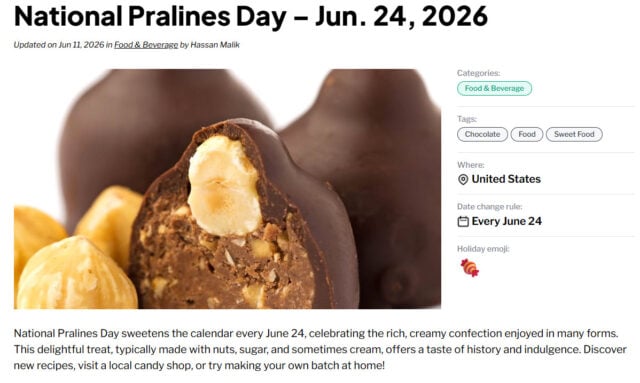
On June 24th, National Pralines Day honors a confection made from nuts (whether in whole pieces or ground) and sugar syrup. Pralines may also refer to any chocolate cookie containing the ground powder of nuts.
- 1600s – Marshal du Plessis-Praslin’s chef, Clement Lassagne, invented the praline by mixing cooked caramel with almonds. These first pralines were whole almonds, individually coated in caramelized sugar.
- 17th Century – Although the stories surrounding the creation differ, it is widely agreed that pralines are named after a French diplomat from the early 17th century whose name and title were César, duc de Choiseul, comte du Plessis-Praslin.
- 1727 – Ursuline nuns arrive in New Orleans from France and are credited in local tradition with teaching young women to make pralines, helping establish pralines in Louisiana cooking.
- 1800s – Free women of color were permitted to sell pralines as Pralinieres, which offered them greater economic security and better opportunities.
- 1800s – As French praline recipes adapt to local conditions, cooks in Louisiana substitute plentiful native pecans for scarce almonds, creating the distinct American-style pecan praline.
- 19th Century – During the 19th century, New Orleans chefs substituted pecans for almonds, added cream to thicken the confection, and thus created what is known throughout the Southern United States as the praline.
- 1857 – In Brussels, pharmacist Jean Neuhaus begins coating bitter medicines in chocolate to make them more palatable, an experiment that lays the groundwork for the later Belgian “praline” chocolate.
- 1912 – Jean Neuhaus Jr. replaces his father’s medicinal fillings with sweet centers and introduces bite-sized chocolates with a hard shell and soft interior, which come to be known as Belgian pralines.
- 1915 – Louise Agostini, wife of Jean Neuhaus II, developed the first ‘ballotin’, a box in which French pralines were packed.
- 20th Century – By the late 1900s, “praline” could mean French caramelized nuts, New Orleans–style creamy pecan candies, or Belgian-filled chocolates, reflecting centuries of regional adaptation of the original idea.
- 2000s – Pralines have remained very similar to their origins and are considered an essential part of southern culinary tradition.
- The powder made by grinding up sugar-coated nuts is called pralin. This is an ingredient in many types of cakes, pastries and ice creams. When this powder is mixed with chocolate, it becomes praliné in French, which gave birth to what is known in French as chocolat praliné.
- The French settlers brought their praline recipe into Louisiana, an area of the United States where both sugar cane and pecan trees were plentiful.
- In New Orleans and along the Gulf Coast, where many communities were settled by the French, the pronunciation is prah-leen, with the long aaah sound. Other regions of the country, including parts of Texas, Georgia, and New England, have anglicized the term, pronouncing it pray-leen.
- In Europe, the praline has evolved to an entirely different candy altogether. In Belgium and France, praline is a smooth paste of cocoa blended with finely ground nuts and used to fill chocolate bon-bons, but in New Orleans it took a different path.
- Pralines contributed to Creole cuisine by blending French confectionery techniques with local ingredients like pecans, enriching the region’s culinary heritage.
- There are three main types:
- Belgian pralines are also known as “(soft-center) Belgian chocolates”, “Belgian chocolate fondants,” and “chocolate bonbons” in English-speaking countries.
- French pralines began in the home of the French Count of Plessis-Praslin (1598 – 1675); the word praline is derived from the name Praslin.
- American pralines are a softer, creamier combination of syrup and pecans, hazelnuts or almonds with milk or cream, resembling fudge
Sources:

Just Fun Facts
Disclaimer
Artificial Intelligence Disclosure & Legal Disclaimer
AI Content Policy.
To provide our readers with timely and comprehensive coverage, South Florida Reporter uses artificial intelligence (AI) to assist in producing certain articles and visual content.
Articles: AI may be used to assist in research, structural drafting, or data analysis. All AI-assisted text is reviewed and edited by our team to ensure accuracy and adherence to our editorial standards.
Images: Any imagery generated or significantly altered by AI is clearly marked with a disclaimer or watermark to distinguish it from traditional photography or editorial illustrations.
General Disclaimer
The information contained in South Florida Reporter is for general information purposes only.
South Florida Reporter assumes no responsibility for errors or omissions in the contents of the Service. In no event shall South Florida Reporter be liable for any special, direct, indirect, consequential, or incidental damages or any damages whatsoever, whether in an action of contract, negligence or other tort, arising out of or in connection with the use of the Service or the contents of the Service.
The Company reserves the right to make additions, deletions, or modifications to the contents of the Service at any time without prior notice. The Company does not warrant that the Service is free of viruses or other harmful components.