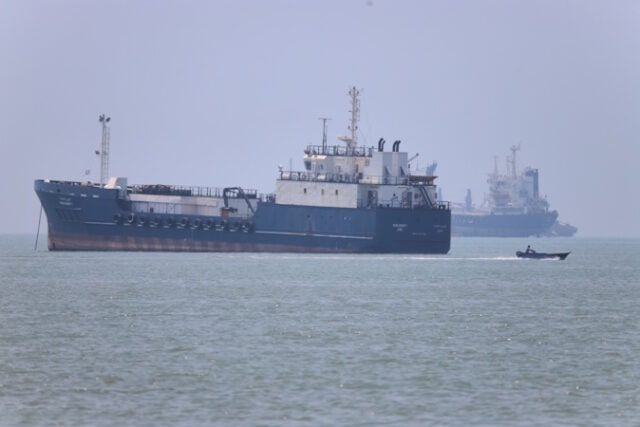
TEHRAN — In a dramatic move that threatens to plunge global energy markets into absolute chaos, Iran’s top joint military command announced the formal closure of the Strait of Hormuz to all maritime traffic. The declaration, broadcast across Iranian state media, abruptly shatters a fragile diplomatic breakthrough achieved just days prior under the Islamabad Memorandum of Understanding.
BREAKING: Iran has directly rejected an Axios report claiming Foreign Minister Abbas Araghchi is traveling to Switzerland for negotiations on Saturday, stating no delegation will be sent and no talks will resume until Article 13 of the US-Iran MOU is fully implemented. (Tasnim)…
— Hormuz Report (@HormuzReport) June 20, 2026
The announcement, issued by the Khatam al-Anbiya Central Headquarters—the unified command coordinating the Islamic Revolutionary Guard Corps (IRGC) and Iran’s regular armed forces—sent immediate shockwaves through international shipping registries and commodity trading floors. According to state-run outlets, Tehran has warned all international vessels to avoid the narrow waterway, declaring that any maritime security in the zone is completely compromised.
Washington Skeptical of Blockade
Adding a sharp layer of confusion to the developing crisis, Washington has offered a highly skeptical view of the ground reality. U.S. Vice President JD Vance publicly downplayed the severity of Tehran’s declarations, stating that American intelligence and naval tracking systems have yet to observe definitive evidence of a total physical shutdown of maritime traffic.

“We are tracking the statements coming out of Tehran very closely, but right now, our naval assets and intelligence services see no actual physical evidence that the Strait of Hormuz is closed,” Vance stated during a media briefing. “The United States and our allies remain fully committed to maintaining the free flow of commerce through these vital international shipping lanes, and commercial vessels are continuing to navigate the region under close observation.”
The conflicting reports have left shipping conglomerates in a difficult position as they attempt to verify whether the passage remains safe for transit or if Iran’s threats will manifest into physical interventions on the water.
Shattering a Fragile Truce
The sudden shutdown comes less than forty-eight hours after the Persian Gulf Strait Authority had introduced a brand-new permitting system designed to manage commercial shipping transits. The underlying geopolitical deal appeared to be holding until a severe escalation of violence occurred along the Israel-Lebanon border.
Iranian command officials asserted that the closure is a direct retaliation against what they termed persistent breaches of commitments by the United States and Israel. Specifically, Tehran pointed to continued Israeli military strikes targeting South Lebanon, which resulted in significant casualties, including the deaths of forty-seven individuals in a single day of airstrikes. Iran claims these actions fundamentally invalidated the security framework established on June 17.
Describing the maritime blockade as merely a “first step of response,” the IRGC warned that secondary punitive measures would be deployed rapidly if western and regional military aggression does not cease immediately.
Maritime Routing in Peril
The practical situation on the water remains incredibly volatile and highly contested. Under international law, the Strait of Hormuz is separated into a recognized Traffic Separation Scheme. The northern transit route, which snakes directly through Iranian territorial waters near Larak Island, is now entirely blocked by Iranian naval assets according to state claims. Furthermore, maritime security analysts report that the IRGC Navy has actively seeded parts of these primary shipping lanes with naval mines.
The alternative southern route, which curves through Omani territorial waters, is being heavily monitored by the United States Navy’s Naval Cooperation and Guidance for Shipping (NCAGS) via the Joint Maritime Information Center. While western authorities have advised that commercial vessels remain legally free to utilize the southern route, Iran does not recognize these alternative lanes. It remains highly uncertain whether Iranian fast-attack craft will attempt to cross international boundaries to seize or target vessels attempting to bypass their northern blockade, despite the lack of current physical disruption reported by the White House.
Severe Economic and Market Ramifications
The economic stakes tied to this narrow strip of water can hardly be overstated. The Strait of Hormuz is universally recognized as the single most critical maritime chokepoint on Earth.
- Daily Oil Volume: Approximately 20 million barrels of crude oil pass through the strait every single day.
- Global Share: This staggering volume represents roughly 20% to 25% of the planet’s total seaborne petroleum trade.
- Natural Gas: The strait acts as the primary exit gateway for massive liquefied natural gas (LNG) exports originating from Qatar and the United Arab Emirates.
Energy markets, which had only just begun to price in economic relief following the recent de-escalation framework, reacted with instant volatility. Shipping insurance premiums for vessels operating anywhere in the Persian Gulf or Gulf of Oman have skyrocketed overnight, and several prominent international shipping conglomerates have already ordered their fleets to drop anchor outside the conflict zone until clear security guarantees can be established.
Future Diplomatic Hopes Under Strain
The sudden implementation of the blockade has thrown high-stakes diplomatic schedules into total disarray. Bilateral talks between U.S. and Iranian officials, which were actively scheduled to resolve lingering security disputes, were abruptly called off following the intense combat flare-up in Lebanon.
Despite the immediate military lockdown, mediated communication channels remain desperately active behind the scenes. Qatari and Pakistani diplomats are working around the clock to salvage the collapsed peace architecture. The Pakistani Foreign Ministry released a formal statement confirming that technical-level implementation talks are still tentatively scheduled to proceed in Burgenstock, Switzerland.
Whether these emergency diplomatic interventions can successfully convince Tehran to roll back its aggressive blockade—or if the reality aligns more closely with Washington’s assessment of open lanes—remains a critical question for the global economy.
Sources and Links:
- Forbes: Iran Says Strait Of Hormuz Is Closed After Lebanon Attacks—U.S. Denies It’s Shut
- The Hindu: West Asia war LIVE updates: Iran closes Strait of Hormuz over ceasefire violations, reports say
- BeInCrypto: Iran Closes Strait Hormuz, Shattering Fragile Ceasefire
- Seatrade Maritime News: Iran declares the Strait of Hormuz closed
Disclaimer
Artificial Intelligence Disclosure & Legal Disclaimer
AI Content Policy.
To provide our readers with timely and comprehensive coverage, South Florida Reporter uses artificial intelligence (AI) to assist in producing certain articles and visual content.
Articles: AI may be used to assist in research, structural drafting, or data analysis. All AI-assisted text is reviewed and edited by our team to ensure accuracy and adherence to our editorial standards.
Images: Any imagery generated or significantly altered by AI is clearly marked with a disclaimer or watermark to distinguish it from traditional photography or editorial illustrations.
General Disclaimer
The information contained in South Florida Reporter is for general information purposes only.
South Florida Reporter assumes no responsibility for errors or omissions in the contents of the Service. In no event shall South Florida Reporter be liable for any special, direct, indirect, consequential, or incidental damages or any damages whatsoever, whether in an action of contract, negligence or other tort, arising out of or in connection with the use of the Service or the contents of the Service.
The Company reserves the right to make additions, deletions, or modifications to the contents of the Service at any time without prior notice. The Company does not warrant that the Service is free of viruses or other harmful components.