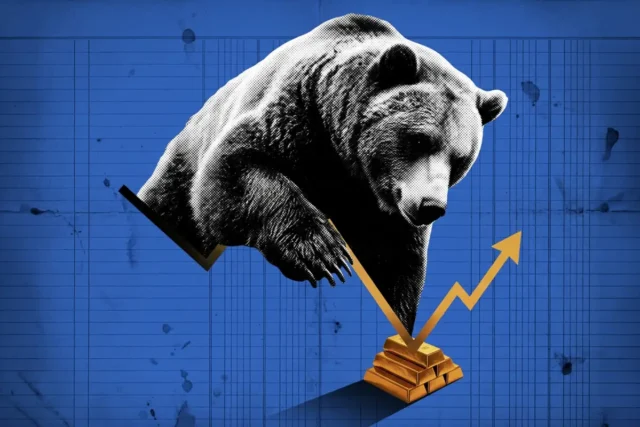
Investors are beginning to panic that gold, which has gained more than 126% since the start of 2023, might be starting to lose its luster.
Last week, the precious metal briefly entered a bear market, with prices falling more than 23% from its all-time high in January. Despite stabilizing over the past five days, gold prices continue to teeter and are less than 2% away from re-entering that bearish territory.
But many of the macro conditions that fueled gold’s historic rally over the past few years remain firmly in place. That suggests that the current selloff — and the accompanying panic among precious metal investors — could be overblown and short-lived while offering a discounted entry point.
Is gold’s bull market over?
Gold is famously a safe-haven asset. During periods of geopolitical unrest, high inflation or elevated equity market volatility, the precious metal has traditionally offered portfolio stability. But right now, it isn’t behaving that way.

“Gold has shown that it is highly sensitive this year,” says Jordan Rizzuto, chief investment officer at GammaRoad Capital Partners. “Since the outbreak of the [Iran] war, to whatever the perceived path of the Fed’s monetary policy is… gold has really moved down in tandem.”
Rizzuto says that as energy prices have increased and governments look to secure supplies in a tighter market, many of them were forced to convert some of their gold reserves into dollars, which explains part of the precious metal’s price correction.
Another catalyst for the current selloff stems from oil producers themselves. Middle Eastern countries that have taken a material hit to their oil revenues have tapped into their gold liquidity as a short-term means of funding ongoing expenses, according to Rizzuto.
Other factors are at play, too. As the stock market continues setting record highs, equities offer an appealing alternative for investors. Meanwhile, the U.S. dollar remains down around 11% since the start of President Donald Trump’s second term, but the greenback has recovered some of those losses and gained nearly 4% since February. Since gold is priced in U.S. dollars, its strong performance can disincentivize global gold buying.
“I think it’s behavioral after we’ve seen a multiyear run-up,” Rizzuto says. “And if you look at a long-term [price] chart going back at least to the early ’70s, during the large multiyear secular bull markets for gold, a 20% correction is perfectly within reasonable expectations.”
What feels different this time is the rate at which prices have fallen. During gold’s previous bear market in 2022, it took 282 days for prices to fall 25%. But this year, from gold’s all-time high on Jan. 29, it took just 91 days for a 20% decline — the fastest the precious metal has fallen into a bear market since 2008 and the Great Financial Crisis. That does not, however, suggest that more downside price action is imminent.
“During the run-up in gold during the 1970s, we saw corrections of nearly 30% and then in the late ’70s, almost 46%, and gold went on to gain many multiples higher after that,” Rizzuto says. “This looks more like a correction. So is gold’s bull market story over? We certainly don’t think so.”
As gold takes a breather, its primary price driver remains intact
Rizzuto shares that sentiment with the major investment banks. After reaching its all-time high of $5,608.35 per troy ounce, gold is currently trading around $4,266. But JPMorgan Chase and Wells Fargo are maintaining their year-end price targets in the $6,000 to $6,300 range, while Goldman Sachs forecasts $5,400.
Even Morgan Stanley’s more conservative forecast of $4,800 to $5,200 per troy ounce by the end of 2026 suggests as much as 22% potential upside from gold’s current price. That would indicate that the big banks think we have not yet seen the top in the gold market, according to Rizzuto.
“If you look at the underlying long-term drivers for gold, they seem to still be in place,” he says. “And if you look at historical comparisons, we seem to be in very different circumstances today than at prior gold peaks.”
One of those drivers is inflation. After the consumer price index (CPI) reached a post-pandemic bottom of 2.3% in April 2025, the metric has been steadily increasing ever since. Most recently, those increases are attributable to the fallout from the Iran war.
Despite a framework to end the conflict in place, geopolitical instability in the Middle East will likely persist, as will higher costs.
“The uncertainty raises at least a non-trivial possibility that higher price levels are going to be more sticky,” Rizzuto says.
Those price impacts have already begun to materialize. In May, the consumer price index hit 4.2% — its highest reading in three years — due largely to a 23.5% year-over-year increase in energy prices. Higher inflation can bolster precious metal prices, with gold, silver, platinum and palladium historically acting as hedges against fiat currency devaluation.
In the near term, further price fluctuations in the precious metal are expected. But gold’s long-term investment thesis remains in place.
“Gold is like any commodity — it’s a very volatile asset. And while this may not be the top of this bull cycle, we could certainly continue to see more volatility in price discovery in the months ahead,” Rizzuto says. “So when we say the story is intact, we’re talking about the big picture, the decade-long view.”
Disclaimer
Artificial Intelligence Disclosure & Legal Disclaimer
AI Content Policy.
To provide our readers with timely and comprehensive coverage, South Florida Reporter uses artificial intelligence (AI) to assist in producing certain articles and visual content.
Articles: AI may be used to assist in research, structural drafting, or data analysis. All AI-assisted text is reviewed and edited by our team to ensure accuracy and adherence to our editorial standards.
Images: Any imagery generated or significantly altered by AI is clearly marked with a disclaimer or watermark to distinguish it from traditional photography or editorial illustrations.
General Disclaimer
The information contained in South Florida Reporter is for general information purposes only.
South Florida Reporter assumes no responsibility for errors or omissions in the contents of the Service. In no event shall South Florida Reporter be liable for any special, direct, indirect, consequential, or incidental damages or any damages whatsoever, whether in an action of contract, negligence or other tort, arising out of or in connection with the use of the Service or the contents of the Service.
The Company reserves the right to make additions, deletions, or modifications to the contents of the Service at any time without prior notice. The Company does not warrant that the Service is free of viruses or other harmful components.