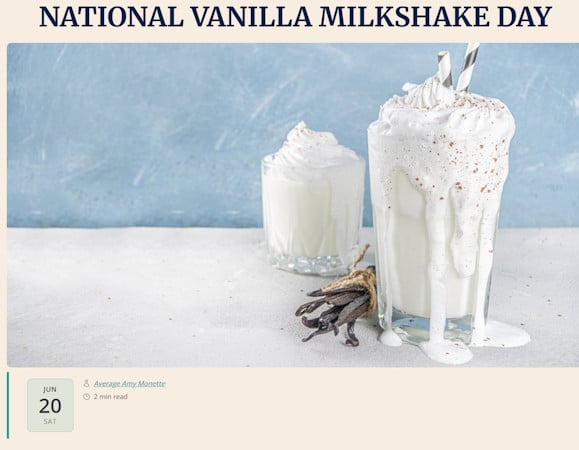
On June 20th each year, National Vanilla Milkshake Day celebrates the cold beverage made with vanilla ice cream, vanilla and milk.
- 1885 – the term “milkshake” was first used in print. The first milkshake is made for adults, containing eggs and whiskey
- 1897 – Malted milk powder was invented in 1897 by James and William Horlick
- 1900 – a milkshake often referred to as “wholesome drinks made with chocolate, strawberry or vanilla syrups.”
- 1900s – In these frothy beverages, ice cream was nowhere to be found. However, a few years later, in the early 1900s, people began asking for this new treat with a scoop of ice cream.
- 1922 – Steven Poplawski invented the electric blender in 1922 just for milkshakes. Before that, the effort of shaking them up must have required considerable upper-body motion.
- 1922 – Ivar Coulson, a soda jerk at a Walgreens drug store, was the first to add ice cream and malted milk powder to milkshakes. This created the malted milkshake or just plain “malt.”
- 1937 – Bandleader Fred Waring and inventor Fred Osius debuted the famous Waring Blender (originally called the Miracle Mixer), which brought the appliance into home kitchens and bars.
- 1930s – By the 1930s, malt shops were serving milkshakes all over the United States.
- 1946 – John Oster purchased Poplawski’s original company and introduced the Osterizer blender.
- 1948 – Nestlé invented the first chocolate-flavored powdered milkshake mix in the USA. It was marketed under the name of Nestlé Quik.
- 1949 – Dairy Queen adds milkshakes to their menus
- 1950s – The device became a vital scientific tool when Dr. Jonas Salk utilized it in his lab to help develop the polio vaccine.
- 1950s – By the 1950s, popular places to drink milkshakes were Woolworth’s “5 & 10” lunch counters, diners, burger joints, and drugstore soda fountains. These establishments often prominently displayed a shiny chrome or stainless-steel milkshake-mixing machine.
- 1963 – the CIA unsuccessfully tried to assassinate Fidel Castro with a poisoned chocolate milkshake.
- 21st Century – The vanilla milkshake remains a traditional favorite, enjoyed by people of all ages.
- 2000 – The Comfort Diners, Parmalat USA, and the American Dairy Association made the world’s largest milkshake with a volume of 22,712.47 liters (6,000 US gal.), equivalent to 50,000 normal-sized shakes! The record-breaking milkshake was made in New York, USA on 1 August 2000 to mark The Comfort Diners’ Fourth Annual August Milkshake Celebration.
- ‘Shakes’ got their name from being served in bars. If the customer enjoyed the specialty drink, he shook hands with the bartender. If not, the bartender wouldn’t get a tip.
- The first diner milkshakes were made with a mixture of milk, malt, and flavoring (vanilla, chocolate, etc.). The malt added an ‘ice cream’ texture to the drink.
- In parts of New England, a milkshake is often referred to as a “frappe” (the e is silent)
- A surefire cure for hangovers is to drink a banana milkshake sweetened with honey. It helps soothe your stomach and replenish depleted blood sugar levels and electrolytes such as magnesium and potassium.
- It’d take 3,200,000 average-sized milkshakes to fill up an Olympic-sized pool.
- Milkshakes were a popular food of the extras dressed in ape costumes during the filming of the original PLANET OF THE APES movie. Their masks didn’t allow them to eat a regular meal, but they placed a straw in their mouths.
Sources

Just Fun Facts
Disclaimer
Artificial Intelligence Disclosure & Legal Disclaimer
AI Content Policy.
To provide our readers with timely and comprehensive coverage, South Florida Reporter uses artificial intelligence (AI) to assist in producing certain articles and visual content.
Articles: AI may be used to assist in research, structural drafting, or data analysis. All AI-assisted text is reviewed and edited by our team to ensure accuracy and adherence to our editorial standards.
Images: Any imagery generated or significantly altered by AI is clearly marked with a disclaimer or watermark to distinguish it from traditional photography or editorial illustrations.
General Disclaimer
The information contained in South Florida Reporter is for general information purposes only.
South Florida Reporter assumes no responsibility for errors or omissions in the contents of the Service. In no event shall South Florida Reporter be liable for any special, direct, indirect, consequential, or incidental damages or any damages whatsoever, whether in an action of contract, negligence or other tort, arising out of or in connection with the use of the Service or the contents of the Service.
The Company reserves the right to make additions, deletions, or modifications to the contents of the Service at any time without prior notice. The Company does not warrant that the Service is free of viruses or other harmful components.