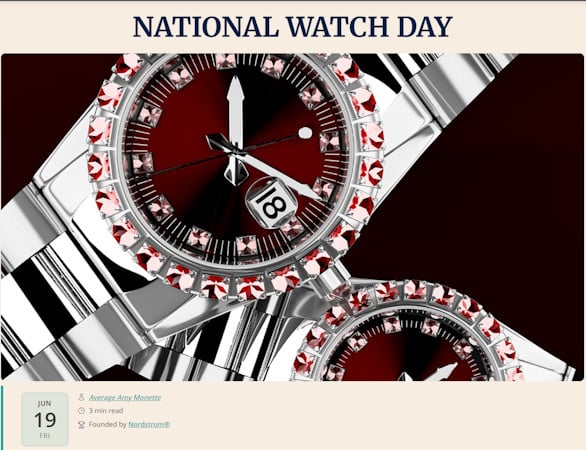
On June 19th, National Watch Day recognizes an industry that has been around for more than 500 years and is steadily evolving. Choosing a watch is very personal as the choices are vast and numerous.
Even with the advent of smartphones and smartwatches, the classic wristwatch signals individual taste, culture, and a rich history that cannot be disputed.
- 2000 BC – Though historians believe the Sumerians were the first to record time in 2000 BC, the earliest evidence of using a physical object to keep time comes from the ancient Egyptians. They used a large, stone obelisk that would be placed in a specific location. As the sun moved, so did the stone’s shadow. They estimated the time from the length and direction of this shadow.
- 1542 – The Oxford English Dictionary records the word watch in association with a timepiece from at least as early as 1542.
- 1542 – Wristwatches were first designed for women. At the time watches were created, it was fashionable for men to wear a pocket watch. The first woman to wear a wristwatch was Elizabeth I, who received one as a gift from Robert Dudley, her suspected lover.
- 1574 – The first pocket watch is created in bronze
- 17th Century – Pocket watches were first worn in the Tudor times and by Henry VIII himself however there were only single-hour markers, and the minute hand did not become part of a pocket watch until the 17th century.
- 1700s – The fake watch industry isn’t anything new. In the late 1700s to early 1800s, manufacturers along the Swiss-French border towns made a living knocking off British watch designs at a lower quality and price. It was one of the things that contributed to the killing off of the British watch industry.
- 1790 – Geneva was already exporting more than 60,000 watches according to the Federation of the Swiss Watch Industry FH.
- 19th Century – According to SalonQP, the expression “on the ball” stems, in fact, from a 19th-century Ohio jeweler by the name of Webster Clay Ball, who kept America’s burgeoning rail network on time
- 1810 – Breguet Builds a Wristwatch for the Queen of Naples. Abraham-Louis Breguet designed a bracelet-style watch for Caroline Murat, often cited as the first purpose-made wristwatch.
- 1868 – The first “modern” wristwatch was made for another noblewoman. Patek Philippe produced a wristwatch for Countess Koscowicz of Hungary, later recognized as one of the first Swiss wristwatches.
- 1880 – Recent research has shown that it was Girard-Perregaux who first mass-produced a wrist-worn watch, in 1880 – 2,000 pieces in total, at the behest of Kaiser Wilhelm I for his German naval officers, all adorned with a cross-hatched grill to protect the glass.
- 1899 – British officers used wristwatches during the Second Boer War, highlighting their practicality over pocket watches for coordinating maneuvers.
- 1905 – Rolex was founded as a brand. Not in Switzerland but in London. Rolex eventually moved to Geneva in 1920.
- 1918 – Soldiers in the trenches rely on robust, luminous wristwatches, and returning veterans help make them standard men’s wear after the war.
- 1926 – Rolex created the first watch with a water-resistant case – the Oyster. It was achieved with a screwed-in caseback and screwed-down crown, both sealed with rubber gaskets. To prove its water resistance, Hans Wilsdorf asked Mercedes Gleitze to wear it when she attempted to swim the Channel a year later. She obliged and made the front page of the Daily Mail.
- 1939 – During the Second World War, the military needed watches to issue to army personnel – civilian watches didn’t quite make the mark. With British watchmaking on the wane, and Switzerland firmly neutral, they invited any Swiss manufacturer who could build their rigidly specified “Watch. Wrist. Waterproof” or “W.W.W.”.
- 1951 – The Sturmanskie watch manufactured by the First Moscow Watch Company was worn by Yuri Gagarin when he became the first person in space in 1951.
- 1953 – For her coronation, Queen Elizabeth II wore a Jaeger-LeCoultre Calibre 101, It’s the smallest mechanical movement in the world.
- 1962 – Bond’s wristwatch has always played a starring role in his outlandish exploits, whether it’s dissecting a train or unzipping a woman’s dress – all despite the famous story of producer Cubby Broccoli having to provide Sean Connery with his own Rolex Submariner in Dr. No (1962) after Rolex shortsightedly refused to loan a single watch.
- 1969 – After years of failed or rapidly obsolete attempts at electronic timekeeping, Japan’s Seiko succeeded in miniaturizing electronic timekeeping regulated by a vibrating quartz crystal – 1969’s Astron costing about the same as a medium-sized car.
- 1970 – Most of us are well aware of the Omega Speedmaster’s ubiquitous role throughout NASA’s Apollo program – it’s known as ‘the Moon watch’.
- Most don’t know how critical it was on Apollo 13. With all instrumentation shut down, Commander Jack Swigert began using his NASA-issue Speedmaster’s precise chronograph function to accurately time the 14-second thruster burn that corrected their course and allowed for the crew’s safe re-entry. In recognition of its instrument’s sterling performance under critical conditions, Omega was awarded NASA’s coveted Snoopy Award
- 2001 – For “2001: A Space Odyssey,” Stanley Kubrick requested then-American-now-Swiss brand Hamilton design a suitably futuristic watch, according to Watches in Movies. The prop was finally released as a working limited edition in 2009, called “X-01”.
- Although watches come in a variety of colors, the most popular color watch is black. Black can be styled for both formal and casual occasions and paired with a variety of watch types, such as dress watches, diver watches, and more.
- The most complicated mechanical watch ever created is the Vacheron Constantin reference 57260 pocket watch. The numbers behind the creation of this unique masterpiece are astonishing.
- The creation process took eight years of research, prototyping, manufacturing, and assembly. 85 prototypes were created before the final product.
- The watch has 2,826 components, 57 complications, and 242 jewels.
- The watch has 33 hands and two faces (there’s just not enough space to fit all the hands and scales on a single face). The case diameter is 10 cm, the thickness is 5 cm, and the watch weighs almost a kilo (957 grams).
- The price of the watch, agreed upon by the undisclosed owner and the company, is confidential, but is believed to exceed $10 million.
- A pair of jeans has a small pocket above the right pocket. This was used to store a pocket watch.
- Seiko is such a complete watchmaker that they even grow their own quartz crystals, in towering multistorey autoclaves that look like something from the film Alien.
- The most inexpensive Swiss automatic mechanical watch is Swatch’s Sistem51, at just over £100. Like the original Swatch Watch of 1983, it contains just 51 parts, and unlike any other mechanical watch, is made and assembled entirely by robots.
- Watches on display in shops are often pre-set to ten minutes past ten or ten minutes to two. This is known as ‘happy time’ because the watch’s face resembles a smiley face.
- The Casio G-Shock models are known throughout the industry as being nearly indestructible. They are waterproof to great depths, shock-resistant, and as reliable as a watch can be. When Casio was testing this watch, they tested shock resistance using the most logical method possible: dropping prototypes from a 4th-story window.
- Most people wear their watch on the other arm from the one they use to write with. This is because your writing hand is constantly sliding over different surfaces and can more easily scratch your watch or watch strap.
- The Apple Watch is a global hit and one of the best-selling watches.
- Actor Paul Newman’s Rolex Daytona was sold for $5.4 million.
- Horology schools, such as those in Switzerland, train new generations in the precise art of watchmaking.
- Horology is the scientific and artistic discipline of measuring time and constructing timekeeping devices
Sources

Disclaimer
Artificial Intelligence Disclosure & Legal Disclaimer
AI Content Policy.
To provide our readers with timely and comprehensive coverage, South Florida Reporter uses artificial intelligence (AI) to assist in producing certain articles and visual content.
Articles: AI may be used to assist in research, structural drafting, or data analysis. All AI-assisted text is reviewed and edited by our team to ensure accuracy and adherence to our editorial standards.
Images: Any imagery generated or significantly altered by AI is clearly marked with a disclaimer or watermark to distinguish it from traditional photography or editorial illustrations.
General Disclaimer
The information contained in South Florida Reporter is for general information purposes only.
South Florida Reporter assumes no responsibility for errors or omissions in the contents of the Service. In no event shall South Florida Reporter be liable for any special, direct, indirect, consequential, or incidental damages or any damages whatsoever, whether in an action of contract, negligence or other tort, arising out of or in connection with the use of the Service or the contents of the Service.
The Company reserves the right to make additions, deletions, or modifications to the contents of the Service at any time without prior notice. The Company does not warrant that the Service is free of viruses or other harmful components.