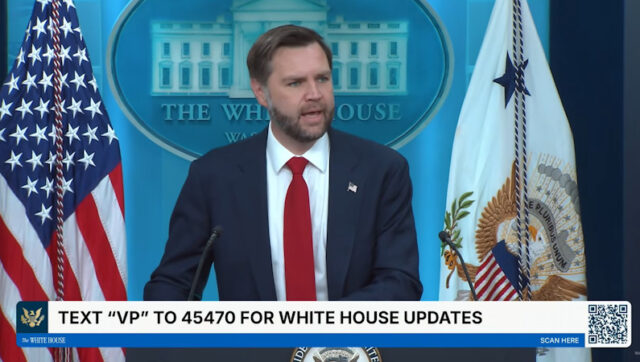
WASHINGTON — In a high-stakes White House press briefing on Thursday, Vice President JD Vance announced that the United States has begun lifting its naval blockade on Iranian ports, signaling the operational start of a major diplomatic framework designed to bring an end to the recent war.
Speaking from the James Brady Press Briefing Room, Vance confirmed that the U.S. Navy has already permitted more than a dozen merchant vessels to pass unhindered into Iranian waters. The move represents a tangible, front-end concession by the Trump administration under a newly struck memorandum of understanding (MOU) with Tehran. Vance, widely regarded as the chief architect of the administration’s diplomatic pivot, faced a barrage of questions from reporters eager to understand the long-term concessions, verification mechanisms, and political exposure of a deal that has already fractured opinions on Capitol Hill.
“We are honoring our end of the early part of the agreement on the military side,” Vance stated, framing the immediate resumption of commercial maritime traffic as proof of the administration’s commitment to stabilizing volatile global markets.
Maritime Gridlock Breaks in the Strait of Hormuz
The suspension of the blockade was felt across global energy corridors. According to data cited by the Vice President, more than 12.5 million barrels of crude oil surged through the critical chokepoint of the Strait of Hormuz on Wednesday night alone. Earlier in the week, early indicators of the detente emerged when two supertankers carrying an estimated 3.8 million barrels of Iranian crude crossed previous U.S. military lines without interception.

For months, the Persian Gulf had been a theater of economic stagnation and military risk, with shipping industry analysts estimating that roughly 1,500 commercial vessels remained effectively stranded inside the Gulf, waiting for security clearances to move. The closure of the waterway during active hostilities sent shockwaves through energy sectors, driving up prices and strangling regional economies.
Vance pointed to the sudden influx of shipping activity as an immediate economic dividend, pushing back against critics who argue the White House gave up its military leverage too quickly. While Iranian state media simultaneously reported that maritime operations had “normalized” at its southern ports, Tehran noted that the Strait of Hormuz remains under the close supervision and defensive control of the Iranian military, highlighting the fragile nature of the current armistice.
The Sixty-Day Countdown Begins
A core revelation from Thursday’s Q&A was the official activation of the clock. Vance explicitly told reporters that the interim agreement’s timeline has shifted from theory to practice.
“I would say the 60-day period officially started today,” Vance said.
This 60-day window, established by the memorandum of understanding approved by President Donald Trump and Iranian leadership, serves as an interim cooling-off and preparatory period. It is intended to pave the way for formal, comprehensive negotiations to resolve the deeper structural causes of the conflict. Vance indicated that he intends to travel to Switzerland to lead the next phase of implementation talks, though exact dates for the European summit have yet to be finalized.
The upcoming diplomatic rounds face immense pressure. The interim pact secured a ceasefire and initial economic relief by deliberately deferring the most contentious geopolitical disputes. Analysts and regional experts have already expressed deep skepticism regarding whether sixty days will suffice to iron out permanent border, security, and governance terms for the region.
When pressed by reporters on what the ultimate governance structure of the Strait of Hormuz would look like after these sixty days expire, Vance reiterated the United States’ foundational posture: the international supply route must remain entirely free of tolls and military interference.
“The final negotiations can set the terms of what comes afterwards,” Vance remarked, acknowledging that the hardest diplomatic work remains ahead.
High Stakes, High Risks for the Vice President
The public rollout of the Iran agreement has thrust the 41-year-old Vice President into a delicate political spotlight. While President Donald Trump and Secretary of State Marco Rubio attend the G7 summit abroad, Vance has been left on the home front to serve as the public face and primary defender of the policy.
The arrangement carries significant political risk for Vance, who remains a front-runner for the 2028 Republican presidential nomination. Within his own party, prominent lawmakers have raised alarms, drawing unfavorable comparisons between this framework and the 2015 Joint Comprehensive Plan of Action (JCPOA) orchestrated by former President Barack Obama—a deal that President Trump famously dismantled during his first term in office.
The administration’s internal dynamics have also drawn scrutiny. While Vance has maintained strict public alignment with the President, political reports suggest he was among the most vocal skeptics within the administration regarding the initial utility of launching the war. Now, he finds himself tasked with selling the peace. President Trump himself captured the political tightrope Vance is walking, colorfully noting at a prior press conference that if the deal succeeds, the executive office will take credit, but if it falters, the blame will fall squarely on the Vice President.
Congressional Skepticism and the Nuclear Question
On Capitol Hill, lawmakers from both sides of the aisle are demanding a closer look at the unreleased text of the memorandum. Under the Iran Nuclear Agreement Review Act (INARA)—a legislative holdover from the Obama era—Congress maintains the right to review any foreign compact concerning Iran’s nuclear materials, though exercising that oversight depends entirely on congressional consensus to force the issue.
Senior U.S. officials have quietly briefed reporters that the full diplomatic roadmap includes benchmarks that could eventually grant Iran access to frozen assets, broad sanctions relief, and a projected $300 billion international reconstruction fund to rebuild its war-torn infrastructure. However, the administration has insisted that these financial rewards are strictly back-loaded. Vance previously emphasized to media outlets that “Iran doesn’t get a dime of money unless they perform their obligations.”
The primary point of friction remains Iran’s nuclear capabilities. Last summer, intensive U.S. military strikes heavily damaged underground nuclear facilities, but questions linger over how much highly enriched uranium remains intact. Lawmakers, including Senate leaders, want explicit answers on:
- Which international bodies will be responsible for on-the-ground verification.
- The exact process by which remaining stockpiles of enriched uranium will be dismantled or physically removed from Iranian soil.
- What long-term guarantees exist to ensure Tehran cannot rapidly pivot back to nuclear weapon development.
Republican senators, such as Lindsey Graham of South Carolina, have called on Vance to formally present the package to lawmakers on the Hill, naming him the true “architect” of the policy. In response, Vance has cautioned lawmakers not to succumb to external messaging or hard-line rhetoric emanating from Tehran, urging them instead to evaluate the strict legal conditions written into the text.
A Shift in Tehran’s Leadership Structure
Compounding the domestic political battle is a profound skepticism regarding Iran’s reliability as a negotiating partner. The country is navigating its own internal transitions; its new Supreme Leader, Mojtaba Khamenei—the son of the previous leader—rules over a government where the paramilitary Islamic Revolutionary Guard Corps (IRGC) still exerts massive domestic and regional authority.
Despite the continuity of the regime’s core factions, Vice President Vance has defended the validity of the talks by asserting that the current geopolitical reality has forced a structural shift in how Tehran operates. In prior media appearances leading up to Thursday’s briefing, Vance argued that the heavy toll of the recent military conflict has left a “fundamentally… much different group of people” at the helm of Iranian decision-making, driven more by economic survival than ideological expansion.
Furthermore, regional complexities continue to threaten the ceasefire. Iranian leadership has repeatedly asserted that any lasting regional peace must take into account broader conflicts across the Middle East, including active hostilities involving Western-backed forces and Iran-aligned groups like Hezbollah in Lebanon. Navigating these overlapping alliances will test the limits of the 60-day window.
As commercial tankers continue to clear the U.S. Navy’s relaxed perimeter and oil output rises, the immediate economic relief is undeniable. Yet, as the Vice President made clear from the White House podium, the true measure of the agreement will not be judged by the ships passing through the Strait this week, but by the permanent terms negotiated in the critical two months ahead.
Sources and Links:
- The Washington Post: US allows more than a dozen ships through to Iranian ports, lifting blockade under deal, Vance says
- The Associated Press: Trump’s Iran deal greeted with skepticism and scrutiny on Capitol Hill
- Al-Monitor: Vance says 60-day period in Iran deal begins Thursday
- The Jerusalem Post: JD Vance says 60-day period in Iran deal begins today
- Colorado Politics: For Vance, Iran deal presents opportunity and risk
- NPR (via WWNO): Trump to face questions at G7 press conference
- WRAL (AP Feed): Vance says US allows more than dozen ships through to Iranian ports, lifting blockade under deal
Disclaimer
Artificial Intelligence Disclosure & Legal Disclaimer
AI Content Policy.
To provide our readers with timely and comprehensive coverage, South Florida Reporter uses artificial intelligence (AI) to assist in producing certain articles and visual content.
Articles: AI may be used to assist in research, structural drafting, or data analysis. All AI-assisted text is reviewed and edited by our team to ensure accuracy and adherence to our editorial standards.
Images: Any imagery generated or significantly altered by AI is clearly marked with a disclaimer or watermark to distinguish it from traditional photography or editorial illustrations.
General Disclaimer
The information contained in South Florida Reporter is for general information purposes only.
South Florida Reporter assumes no responsibility for errors or omissions in the contents of the Service. In no event shall South Florida Reporter be liable for any special, direct, indirect, consequential, or incidental damages or any damages whatsoever, whether in an action of contract, negligence or other tort, arising out of or in connection with the use of the Service or the contents of the Service.
The Company reserves the right to make additions, deletions, or modifications to the contents of the Service at any time without prior notice. The Company does not warrant that the Service is free of viruses or other harmful components.