If you looked at the economic calendar this morning, you probably expected a tense, tightly scripted day in Washington. The Bureau of Labor Statistics just dropped its much-anticipated Consumer Price Index report for May 2026, and the numbers were, frankly, pretty rough. For the third consecutive month, headline inflation accelerated, jumping to a year-over-year rate of 4.2%. That is the highest annual inflation rate the United States has seen in over three years, driven heavily by an expensive and unpredictable conflict with Iran that has sent global energy markets into a tailspin.
For almost any ordinary administration, a report like this triggers an immediate, all-hands-on-deck damage control operation. You expect economic advisors huddling behind closed doors, press secretaries drafting statements about how they are “fighting every single day to lower costs,” and a generally somber acknowledgment of the financial strain hitting regular people.
But Donald Trump has never been one for standard political scripts.
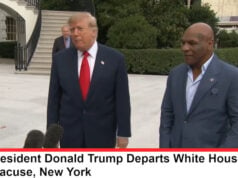
Standing in the Oval Office this morning, surrounded by reporters, the President was asked directly if he felt any concern about the fresh wave of surging prices. Instead of minimizing the numbers or shifting the blame, Trump leaned in with a trademark, off-the-cuff declaration that left economists and political opponents completely stunned.

“No, I love it,” Trump said plainly. “The numbers were great. You know what I really love? I love the inflation.”
Breaking Down the Grim Math of the May CPI Report
To understand why that quote sent shockwaves through the political landscape today, we have to look closely at what the Bureau of Labor Statistics actually reported. The data shows that inflation isn’t just ticking up quietly in the background; it is actively chipping away at the purchasing power of everyday Americans, largely because of what is happening at the gas pump and on utility bills.
Here is a quick snapshot of the key economic indicators released by the government today:
| Economic Indicator | Monthly Change (May) | Year-Over-Year Change |
| Headline CPI-U (All Items) | +0.5% | +4.2% |
| Core CPI (Excluding Food & Energy) | +0.2% | +2.85% |
| Energy Index | +3.9% | +23.54% |
| Gasoline Prices | +5.4% | +40.5% |
| Food Prices | +0.16% | +3.08% |
When you look at this breakdown, the real culprit behind the 4.2% headline spike stands out instantly: energy. The price of energy has surged an astonishing 23.54% over the last 12 months, with gasoline prices skyrocketing by more than 40%. Other essential daily costs like electricity and apparel also climbed.
The silver lining in the report is “Core CPI,” which strips out the highly volatile categories of food and energy. That number rose a modest 0.2% for the month, settling at an annual rate of 2.85%. While the core rate actually came in slightly below what many Wall Street analysts expected, the massive overall headline number is what hits families where it hurts most.
Inside Trump’s Wartime Energy Strategy
So, why on earth would a sitting president look at a three-year high inflation rate and declare that he “loves” it? As the press conference continued, Trump laid out a characteristically freewheeling, highly theatrical narrative to explain his logic.
In Trump’s view, the current price spikes aren’t an economic failure—they are a temporary, calculated side effect of his aggressive foreign policy. Since the war with Iran erupted earlier this year, the crucial Strait of Hormuz has been heavily disrupted, choking off global oil supplies and pushing crude prices up around $85 a barrel. But Trump insists that behind the scenes, the United States is executing a high-stakes strategy to fundamentally break its adversaries and eventually flood the market with cheap oil.
Trump went on to describe a series of clandestine, late-night military operations aimed at draining oil supplies from both Iran and Venezuela. He boasted to the press that the U.S. military recently carried out a stealth operation to seize 22 Iranian cargo vessels.
“We took 22 ships the other night, late at night, without lights,” Trump said, claiming that the operations went undetected because U.S. forces had completely destroyed the local radar networks. “Because they don’t have any radars. Because we blasted the crap out of it.”
He also pointed to a lightning-fast “48-minute operation” inside Venezuela, claiming that the U.S. is now successfully extracting millions of barrels of oil from there as well. According to Trump’s math, these aggressive moves will soon create a massive energy surplus that will send domestic fuel costs plummeting.
The President even admitted that he fully anticipated a severe economic shock when he authorized heavy military action in the Middle East. He revealed that he explicitly warned his inner circle that launching B-2 bombers against Iranian targets could cause Wall Street to drop significantly.
“I told them that the stock market would go down 25%,” Trump remarked. “But it was worth it. Worth the clear goal of ensuring Iran does not obtain nuclear weapons.”
The Backlash: Firestorms on Capitol Hill and Social Media
Unsurprisingly, telling a nation struggling with high grocery bills that you “love the inflation” is a political lightning rod. Within minutes of the press conference, social media erupted, and the phrase quickly turned into a weapon for Trump’s political opponents.
By midday, the hashtag #CantAffordTrump was trending heavily across online platforms. Frustrated voters shared pictures of their recent receipts from gas stations and grocery stores, expressing disbelief that the administration could sound so detached from their daily financial struggles. High-profile critics online hammered the President, with many arguing that watching families struggle to afford basic shelter and food is treated like just another casual day at a high-stakes casino.
On Capitol Hill, congressional Democrats immediately weaponized the comments. Representative Don Beyer of Virginia, a senior member of the House Ways and Means Committee and the Joint Economic Committee, issued a stinging public statement. He argued that American families are paying a devastating price for what he called the administration’s “disastrous policies” and sweeping international tariffs.
“Any real wage gains have been swallowed up by higher prices,” Congressman Beyer stated. “Families are working just as hard and finding that they can afford no more than they could months ago—and these higher prices are the direct result of President Trump’s choices.”
Beyer’s point about wages hitting a wall is backed up by the fine print in today’s labor data. The BLS reported that real average weekly earnings actually decreased by 0.15% from April to May, confirming that inflation is officially outpacing wage growth.
DNC Rapid Response Director Kendall Witmer issued an equally fierce rebuke, noting the sharp contrast between Trump’s campaign trail promises to “defeat inflation on Day One” and the current reality of a costly, grinding conflict in the Middle East that continues to destabilize the domestic economy.
The Republican Defense: Reframing the Economic Narrative
While critics spent the day lambasting the President’s phrasing, congressional Republicans mounted a coordinated defense to reframe the entire economic picture. Instead of panicking over the headline 4.2% number, conservative lawmakers chose to plant their flag firmly on the 2.9% core inflation metric.
House Ways and Means Committee Chairman Jason Smith released an official statement arguing that the structural core of the American economy is actually in far better shape than it was under previous leadership. Smith highlighted that core inflation today is less than half of the 6.0% peak witnessed during the Biden administration.
Smith and his allies argued that the spike in headline inflation is entirely a temporary byproduct of global market volatility and Middle Eastern geopolitical tensions, both of which they believe will resolve quickly. They maintained that the administration’s sweeping domestic tax cuts—including cornerstone policies like eliminating taxes on tips, overtime, and Social Security benefits—are actively protecting worker paychecks from being entirely wiped out by global energy spikes.
Caught in the Middle: The Federal Reserve and the Average Consumer
Away from the political spin and the messaging wars in Washington, today’s inflation report leaves ordinary citizens and central bankers in an incredibly tight spot.
A newly released consumer sentiment survey from the Federal Reserve Bank of New York reveals that American households are growing deeply pessimistic about their financial futures. Concerns are mounting over the long-term trajectory of the labor market, the potential for corporate layoffs, and the sheer durability of household budgets under the weight of a prolonged wartime energy shock.
This reality complicates life immensely for the Federal Reserve. Normally, when headline inflation accelerates for three straight months and hits 4.2%, a central bank wants to keep interest rates high—or even raise them—to cool the economy down. However, Donald Trump has spent the better part of the past year publicly hammering the Fed, demanding that policymakers slash interest rates immediately to fuel further domestic growth.
Cutting interest rates while inflation is at a three-year high is highly risky, as it could throw fuel on the fire and cause prices to climb even higher. Yet, keeping interest rates elevated places an immense structural strain on consumers looking for mortgages, car loans, or credit card relief.
With the central bank’s next interest rate decision right around the corner, economic policymakers find themselves caught directly in the crossfire of a volatile international conflict, a deeply anxious public, and a President who looks at a punishing inflation report and openly says he loves it.
Sources and Links:
- U.S. Bureau of Labor Statistics: Consumer Price Index Summary – May 2026 Results
- The Guardian: Trump says ‘I love the inflation’ as rate rises to 4.2% amid Iran war pressure
- Hindustan Times: Trump reacts to latest Consumer Price Index data amid Iran war: ‘I love the inflation’
- Hindustan Times: ‘Can’t Afford Trump’ trends amid POTUS’s ‘I love inflation’ remark on CPI report
- Democrats.org: Trump Says “I Love the Inflation” as Prices Surge
- U.S. House Committee on Ways and Means: Chairman Smith on CPI Report: Core Inflation Today Is Less Than Half At Same Time Under Joe Biden
- Congressman Don Beyer Press Office: As Inflation Surges, Republicans in Congress Are Looking the Other Way
Disclaimer
Artificial Intelligence Disclosure & Legal Disclaimer
AI Content Policy.
To provide our readers with timely and comprehensive coverage, South Florida Reporter uses artificial intelligence (AI) to assist in producing certain articles and visual content.
Articles: AI may be used to assist in research, structural drafting, or data analysis. All AI-assisted text is reviewed and edited by our team to ensure accuracy and adherence to our editorial standards.
Images: Any imagery generated or significantly altered by AI is clearly marked with a disclaimer or watermark to distinguish it from traditional photography or editorial illustrations.
General Disclaimer
The information contained in South Florida Reporter is for general information purposes only.
South Florida Reporter assumes no responsibility for errors or omissions in the contents of the Service. In no event shall South Florida Reporter be liable for any special, direct, indirect, consequential, or incidental damages or any damages whatsoever, whether in an action of contract, negligence or other tort, arising out of or in connection with the use of the Service or the contents of the Service.
The Company reserves the right to make additions, deletions, or modifications to the contents of the Service at any time without prior notice. The Company does not warrant that the Service is free of viruses or other harmful components.