A perilous direct military escalation between Israel and Iran threatened to plunge West Asia back into full-scale war this morning before both nations abruptly halted their missile strikes following a forceful intervention from U.S. President Donald Trump.
The dramatic exchange of fire, marking the most significant challenge to date for the tenuous ceasefire brokered on April 8, brought the 100-day-old war—dubbed Operation Epic Fury—to its most critical tipping point. However, by mid-morning on June 8, 2026, a high-stakes combination of intense diplomatic pressure, a public ultimatum from the White House, and a mutual calculation of deterrence successfully restored a fragile cessation of direct hostilities between Jerusalem and Tehran.
The Spark: A Ceasefire in Tatters over Lebanon
The rapid collapse into direct cross-border warfare followed weeks of simmering tensions regarding the scope and enforcement of the April 8 truce. While the U.S. and Iran had been engaging in back-channel peace negotiations, the situation on the ground in Lebanon had grown increasingly unsustainable.

According to statements from Lebanese Prime Minister Najib Mikati, Israel had carried out nearly 3,500 strikes inside Lebanese territory during the supposed ceasefire period, arguing that it retained the right to target Hezbollah infrastructure and prevent the group from violating the truce framework. The friction reached a boiling point on Sunday, June 7, when Israel launched heavy airstrikes against Beirut’s southern suburbs. Tehran viewed the bombardment of the Lebanese capital as an explicit violation of the broader U.S.-brokered ceasefire agreements and vowed immediate retaliation, defying explicit requests from the Trump administration to stand down.
A Night of Fire: Ballistic Missiles and Air Defense Interceptions
Tehran’s promised retaliation materialized overnight and into the early morning hours of June 8. The Iranian military’s Khatam al-Anbiya Headquarters and the Islamic Revolutionary Guard Corps (IRGC) unleashed multiple waves of ballistic missiles aimed directly at the Israeli heartland.
Israeli military officials confirmed that Iran launched approximately 30 ballistic missiles in three distinct waves. Air raid sirens wailed across central and northern Israel as the country’s Iron Dome and Arrow air defense networks scrambled to intercept the incoming projectiles. Explosions from the interceptions could be heard over major population centers, sending residents rushing to bomb shelters.
Fortunately, the Israeli Home Front Command reported that the defensive shield proved highly effective. While falling missile debris ignited several localized brush fires in the central West Bank and other regions, no Israeli casualties or significant infrastructure damage were initially reported. As a strict precautionary measure, Israeli authorities ordered all schools closed across the country for Monday.
The regional fallout from the attack was immediate. Neighboring countries, including Iraq and Syria, hastily closed their respective airspaces to commercial aviation as heavy missile fire crossed the skies. Meanwhile, the conflict rapidly expanded along its proxy axes. In Yemen, the Iran-backed Houthi rebels launched an independent missile strike toward Israel—which was successfully intercepted—and declared a “complete and total ban on Israeli maritime navigation in the Red Sea,” re-igniting fears of economic chaos in global shipping lanes. Regional security reports also indicated a drone strike targeting an Iranian Kurdish opposition camp east of Erbil in Iraq, alongside an attack launched from Yemen targeting Prince Sultan Air Base in Saudi Arabia.
The Israeli Response: Direct Strikes on Iranian Soil
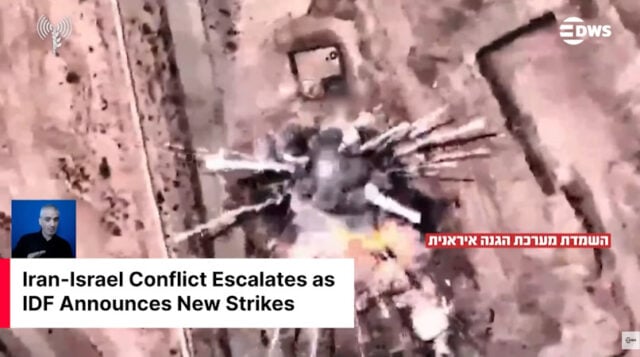
Refusing to let the ballistic missile barrage pass without a kinetic response, Israel launched a series of powerful retaliatory strikes inside Iran during the early morning hours of Monday. This counteroffensive bypassed regional proxies and hit targets deep within Iranian territory across two distinct waves.
The first wave of Israeli strikes focused on neutralizing Iranian air defense networks, missile launch sites, and primary military infrastructure in central and western Iran. Significant explosions were recorded around the capital of Tehran—specifically targeting the Aerospace University and positions belonging to the Basij militia—as well as the cities of Isfahan, Kermanshah, Karaj, and Tabriz. According to regional intelligence reports, the strikes successfully hit a major unmanned aerial vehicle (UAV) production facility in Isfahan and infrastructure surrounding Tehran’s Mehrabad Airport.
The second wave of Israeli airstrikes shifted southward, focusing heavily on a large petrochemical plant in the Ahvaz area within the Khuzestan Province. The targeted facility, belonging to the state-linked Karun Petrochemical Company in Mahshahr, is a known producer of nitric acid—a critical precursor chemical utilized by Iran’s domestic weapons industry for manufacturing explosives and heavy ballistic missile propellants.
As smoke billowed over western Iran, the Iranian Civil Aviation Authority suspended all domestic flights and closed the airspace over Tehran and western provinces. International concerns spiked as the Indian Embassy in Tehran and several other foreign missions issued urgent travel advisories, imploring their citizens to avoid travel to Iran and urging those currently inside the country to exit immediately by any available transportation.
“I Call the Shots”: Trump’s High-Stakes Intervention
As the direct exchanges threatened to spiral out of control, President Donald Trump initiated a furious public and private pressure campaign to force both sides back from the brink. The escalation represented a direct test of the Trump administration’s foreign policy, which has spent weeks attempting to finalize a comprehensive “Final Deal” with Iran regarding its regional proxy network and civilian nuclear program.
In an interview with Britain’s Financial Times published late Sunday, President Trump revealed that he had explicitly instructed Israeli Prime Minister Benjamin Netanyahu to refrain from further escalation, asserting that Israel would ultimately have no choice but to fall in line with Washington’s broader diplomatic architecture.
“He won’t have any choice,” Trump told the Financial Times regarding Netanyahu. “I call the shots. I call all the shots. He doesn’t call the shots.”
As Israeli jets completed their morning bombing runs over Iran, Trump took to his social media platform, Truth Social, to issue a public order demanding an immediate cessation of hostilities. “Israel and Iran must immediately stop ‘shooting!'” Trump wrote, warning that regional stability was being jeopardized by ongoing crossfire.
Shortly after his initial demand, Trump posted a follow-up announcement claiming that back-channel diplomacy had successfully halted the conflict. “Both sides, Israel and Iran, are looking to do an immediate CEASEFIRE! Final negotiations on ‘Peace’ are proceeding, subject to ignorance or stupidity getting in its way,” Trump declared. He further emphasized that the tight U.S. naval blockade surrounding the Strait of Hormuz—a central leverage point in the ongoing U.S.-Iran negotiations—would remain “in full force and effect” until a final peace deal is signed.
A Fragile Truce Accompanied by Stern Warnings
President Trump’s heavy-handed diplomacy achieved its immediate objective by mid-morning on Monday, as both capitals issued sequential statements confirming an end to the active fighting.
First, Iran’s Khatam al-Anbiya military headquarters announced that it was concluding its direct military operations against Israel. Iranian military officials stated that the cessation of fire was intended to give diplomacy a chance, claiming that Israel had “learned a lesson” from the accuracy of the IRGC missile barrage. However, Tehran attached a strict, volatile condition to the truce: the military warned that if Israeli forces continue their ground operations or airstrikes in southern Lebanon, Iran will immediately resume its military operations with “much more severe and crushing” strikes.
Minutes later, Israeli media, citing senior government officials and a report by Channel 12, confirmed that Israel had agreed to halt its direct airstrikes against targets inside Iran, explicitly noting that the pause was granted at the personal request of President Trump.
However, Jerusalem matched Tehran’s conditional stance with its own unyielding caveat. Israeli officials stated that while direct strikes on Iranian territory would cease, the Israel Defense Forces (IDF) ground and air operations against Hezbollah targets in southern Lebanon would continue “at full strength” in the coming days. The Israeli government maintains that neutralizing Hezbollah’s border presence remains an absolute national security priority independent of any diplomatic understandings reached with Tehran.
An Uncertain Path Forward
While the skies over Tehran and Tel Aviv have quieted for the moment, international observers remain deeply skeptical about the longevity of this morning’s ceasefire. The fundamental disconnect between the two sides remains unresolved: Iran demands an absolute halt to Israeli operations in Lebanon, while Israel refuses to stop its operations against Hezbollah. Furthermore, the active involvement of peripheral actors—such as the Houthi maritime blockade in the Red Sea and mobilizations by Shiite militias in Iraq—continues to threaten the broader geopolitical fabric.
For now, the world watches Washington, where the Trump administration is scrambling to convert this morning’s narrow escape from regional war into a permanent diplomatic settlement. Whether “Final Peace” can be achieved before local flashpoints trigger another round of missile fire remains the defining question in West Asia.
Sources and Links:
- The Guardian: Middle East crisis live: Iran announces end of attacks against Israel as Trump claims both sides want ‘immediate ceasefire’
- Fox News: Iran peace talks at standstill as Israel trades missiles with Tehran
- The Hindu: West Asia war LIVE: Iran ends military operations against Israel, warns of harsher attacks if strikes on Lebanon persist
- TIME: Israel and Iran Renew Direct Hostilities, Testing Trump Claim That U.S. ‘Calls the Shots’
- Northern Public Radio: Israel and Iran exchange missile fire threatening Middle East truce
- Alma Research and Education Center: Daily Report: Israel–Iran Escalation – June 8, 2026 (17:00)
- The American Legion: Five Things to Know, June 8, 2026
Disclaimer
Artificial Intelligence Disclosure & Legal Disclaimer
AI Content Policy.
To provide our readers with timely and comprehensive coverage, South Florida Reporter uses artificial intelligence (AI) to assist in producing certain articles and visual content.
Articles: AI may be used to assist in research, structural drafting, or data analysis. All AI-assisted text is reviewed and edited by our team to ensure accuracy and adherence to our editorial standards.
Images: Any imagery generated or significantly altered by AI is clearly marked with a disclaimer or watermark to distinguish it from traditional photography or editorial illustrations.
General Disclaimer
The information contained in South Florida Reporter is for general information purposes only.
South Florida Reporter assumes no responsibility for errors or omissions in the contents of the Service. In no event shall South Florida Reporter be liable for any special, direct, indirect, consequential, or incidental damages or any damages whatsoever, whether in an action of contract, negligence or other tort, arising out of or in connection with the use of the Service or the contents of the Service.
The Company reserves the right to make additions, deletions, or modifications to the contents of the Service at any time without prior notice. The Company does not warrant that the Service is free of viruses or other harmful components.