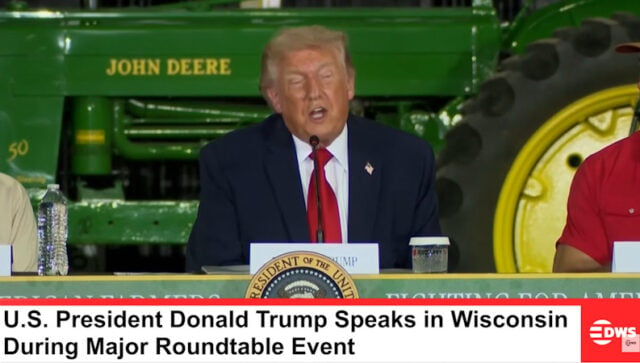
President Donald Trump took the stage at Custer Farms in Chippewa Falls, Wisconsin, on Friday evening, turning a localized agricultural roundtable into a wide-ranging foreign policy address. Speaking from beneath a prominent green sign bearing the slogan “Fighting for American Farmers,” the President laid out his global doctrine. He directly connected the economic struggles of the American Heartland to geopolitical standoffs involving Iran, China, and Cuba.
For the hundreds of farmers, local leaders, and workers gathered inside the hot barn, the message was unmistakable: the administration is pursuing an aggressive, high-pressure strategy abroad, and the current economic pain felt at home is the necessary prelude to a series of historic international victories.
At the core of his speech tonight was an uncompromising assessment of the ongoing conflict with Iran. Facing immense political pressure ahead of the upcoming midterm elections due to elevated domestic fuel prices, Trump sought to reassure his agrarian base by issuing an absolute ultimatum. He declared that the grueling crisis with Tehran will end in one of two ways: either “on paper” through a comprehensive diplomatic surrender or via the devastating, permanent finality of the American military alternative.

The Agricultural Squeeze: Fertilizer, Energy, and Global Disruption
The President’s visit to this critical swing district comes at a moment of deep economic anxiety throughout western Wisconsin’s dairy country. The war with Iran has significantly disrupted international energy distribution, resulting in a severe double-whammy for domestic producers:
- Skyrocketing Diesel Prices: Long-haul distribution and basic field operations have become increasingly cost-prohibitive for family farms.
- Severe Fertilizer Shortages: The conflict has choked off critical chemical components traditionally sourced via Middle Eastern energy corridors, causing prices to spike and forcing farmers to search for emergency alternatives just as the vital planting season reaches its peak.
Acknowledging these difficulties, Trump insisted that the domestic fallout from the conflict is entirely “artificial,” driven by geopolitical friction rather than structural economic weakness. “We’re going to come out and your fertilizer prices are going to go way down just like they were four months ago,” Trump promised the crowd. “Your fertilizer’s down, your energy’s down, your oil, your gas is all coming way down.”
           [Middle East War Impacts]
                       │
         ┌─────────────┴─────────────┐
         ▼                           ▼
[Skyrocketing Fuel]         [Global Fertilizer]
[National Average: $4.21]    [Shortages Hit Peak]
         │                           │
         └─────────────┬─────────────┘
                       ▼
         [Heartland Farm Squeeze]
To soften the political impact in rural communities, Trump teased the possibility of introducing massive new emergency government subsidies to insulate agricultural producers from escalating supply chain shocks, stating, “we’re looking at something.” However, the proposal was met with noticeable silence from the roundtable participants. The quiet in the room highlighted a growing preference among independent producers for open, stable international marketplaces over federal financial handouts. Trump acknowledged this friction with an anecdote, recalling a farmer who told him that fair trade was far more important than government checks. While the crowd applauded the sentiment, Trump noted with a grin that farmers still accept the aid when the checks arrive.
The Iran Standoff: Ending on Paper or the Alternative
Trump used the Wisconsin platform to double down on his “maximum pressure” campaign against Iran, framing the conflict as a necessary operation to protect international maritime trade and dismantle Tehran’s nuclear ambitions. The strategic bottleneck remains the Strait of Hormuz, where an ongoing Iranian naval blockade has successfully reduced daily oil tanker transits from an average of 30 vessels down to a trickle of just one or two rogue ships. This blockade has kept western oil inventories at precariously low levels.
   [ Persian Gulf ]
          │
          ▼
   ═══════ ═══════  ◄── Strait of Hormuz (Mined & Blockaded)
          │             [Normal: 30 Tankers/Day ── Now: 1-2 Tankers/Day]
          ▼
   [ Gulf of Oman ] -> Spiking Global Energy Prices ($4.21 National Avg)
Addressing the status of stalled peace talks, Trump told reporters upon his arrival in Wisconsin that discussions were actively moving forward and that “everything is going very well.” He reiterated his absolute confidence that the war will soon come to an end, predicting that gasoline prices will “drop like a rock” or plummet to $1.85 per gallon the moment a final agreement is signed and normal shipping resumes.
However, behind the optimistic rhetoric lies a rigid diplomatic deadlock. The Trump administration recently rejected a mid-May ceasefire proposal extended by Tehran, labeling it “totally unacceptable” because it left Iran’s long-range ballistic missile capabilities intact. Iranian officials have countersigned the diplomatic impasse by demanding the immediate release of $24 billion in frozen assets held in international bank accounts as a non-negotiable prerequisite for peace.
Trump’s speech tonight made it clear that Washington will not compromise. By repeating his strict formula—that the war will finish “militarily or on paper”—the President served notice that if Tehran continues to demand premature sanctions relief or uses proxy forces to violate the current fragile ceasefire, the United States will shift to “the alternative.” This alternative involves an exhaustive air, sea, and cyber assault designed to permanently destroy Iran’s domestic infrastructure and force a structural collapse of the regime’s power centers.
Expanding the Front: Trump Rebukes China’s Oil Strategy
A significant portion of Trump’s address tonight focused on the People’s Republic of China, which the administration views as the primary financial lifeline sustaining America’s geopolitical adversaries. Under Trump’s directive, the Department of the Treasury’s Office of Foreign Assets Control (OFAC) and the State Department have systematically targeted international networks facilitating illicit trade.
Trump criticized Beijing for exploiting the conflict to secure heavily discounted energy reserves, noting that China has continued to import tens of millions of barrels of sanctioned Iranian crude oil through specialized independent refineries and a massive “shadow fleet” of unregistered cargo vessels. He argued that American military operations in the Middle East have inadvertently protected the commercial shipping lanes that foreign competitors rely upon. “I mean, we’re doing this for the other parts of the world, including countries like China,” Trump asserted, expressing deep frustration that American taxpayers and service members are bearing the security costs for global maritime routes.
            [U.S. Counter-China Enforcement]
                            │
       ┌────────────────────┴────────────────────┐
       ▼                                         ▼
[OFAC Financial Targets]               [Customs Asset Floor]
Sanctioning independent "teapot"       Executive orders forcing foreign
refineries and shadow fleet networks   importers to maintain tangible
converting oil revenue into yuan.      domestic assets within the U.S.
To counter this economic maneuvering, the administration has enacted sweeping trade restrictions, including an executive order designed to strengthen customs enforcement against low-value imports and synthetic supply chains stemming from China. The new directives systematically eliminate duty-free loopholes and mandate that foreign importers maintain strict minimum levels of tangible domestic assets and bonding within the United States. Trump warned that nations continuing to bypass American energy sanctions will face severe secondary tariffs targeting broad sectors of their domestic economies, effectively closing off access to the lucrative U.S. consumer market.
The Caribbean Theater: Pressure Escalates on Cuba
In a move that caught the attention of regional security analysts, Trump explicitly expanded his foreign policy commentary tonight to include Cuba. The island nation is currently spiraling into its most severe economic and humanitarian crisis since the 1959 revolution, characterized by a collapsing electrical grid, widespread blackouts, and critical fuel shortages.
The crisis has been rapidly accelerated by an aggressive American fuel blockade designed to achieve a complete regime change in Havana by the end of 2026. This strategy gained momentum following the recent U.S. military intervention in Venezuela, which successfully ousted President Nicolás Maduro and severed the critical energy pipeline that had historically supplied Cuba with subsidized crude.
[Ouster of Maduro in Venezuela] ──► [Cutoff of Subsidized Energy Pipeline] ──► [Collapse of Cuban Fuel Supply]
Trump used his speech to defend fresh sanctions targeting Cuban President Miguel Díaz-Canel, his immediate family, and key state-controlled financial entities. He dismissed international criticism regarding the humanitarian fallout on the island, flatly labeling Cuba a “failed nation” that has consistently harbored strategic adversaries, sheltered fugitives, and operated foreign listening stations on behalf of Beijing.
Referencing the Justice Department’s recent indictment of 94-year-old Raúl Castro over the 1996 downing of civilian planes operated by exile groups, Trump suggested that past administrations had avoided a direct confrontation for far too long. “It looks like I’ll be the one that does it,” Trump declared, hinting at potential direct military intervention if the current government refuses to step down. The administration’s playbook heavily mirrors the high-stakes campaign executed in Caracas, utilizing a combination of secondary financial blockades and explicit threats of force to isolate Havana from its traditional supporters in Moscow and Beijing.
The Political Stakes and the Midterm Clock
The backdrop for Trump’s speech tonight remains the domestic political calendar. Democratic lawmakers, including Wisconsin Senator Tammy Baldwin, have seized upon $4.21-a-gallon gas prices and agricultural supply chain disruptions to argue that the administration’s foreign policy is actively undermining the American working class. Opponents have framed the President’s rural tour as a sign of political vulnerability ahead of the midterms, claiming that voters are looking for marketplace stability rather than federal intervention or geopolitical conflict.
Trump directly confronted this political calculation by adjusting his rhetorical style. Rather than adopting an empathetic tone regarding the financial hardships facing family farms, he chose to frame his presidency as an immense personal sacrifice, telling the audience, “I don’t need this. I got elected… What the hell do I have to be here for?” He added that he could easily remain in Washington enjoying his second term rather than traveling through heavy rainstorms to defend his platform.
By positioning his global standoffs with Iran, China, and Cuba as a shared national struggle, Trump is betting that the electorate will tolerate temporary economic discomfort in exchange for a permanent restructuring of international trade and national security. The coming months will test whether this high-stakes gamble will solidify his domestic support or amplify the economic vulnerabilities threatening his party’s congressional alignment.
Sources and Links:
The factual reporting, direct quotes, and economic data integrated throughout this article were sourced exclusively from the following news organizations:
- PBS NewsHour: Documented President Trump’s rural roundtable discussion at Custer Farms in Chippewa Falls, Wisconsin, detailing his specific comments on fertilizer alternatives, global energy trends, and his remarks regarding his personal sacrifice in office. WATCH: Trump holds roundtable with farmers in Wisconsin WATCH: Trump holds news conference to answer questions about Iran
- KESQ / CNN Newsource: Reported on the atmosphere inside the Chippewa Falls barn, the muted response to proposed federal subsidies, and Trump’s extensive comments regarding capital city infrastructure. In a visit to farm country, Trump extols ‘beautiful fountains’ back in Washington
- WisPolitics: Detailed the specific legislative and electoral endorsements delivered during the Wisconsin appearance, alongside quotes promising an imminent drop in domestic fertilizer and fuel costs.Trump in Wisconsin says his policies have helped farmers, vows to bring down prices
- Holland & Knight: Provided technical analysis of the May 2026 executive orders authorizing comprehensive secondary sanctions against Cuba’s energy and financial sectors, alongside OFAC actions targeting Chinese oil terminals importing Iranian crude. New Cuba Sanctions, OFAC Targets Iranian Shadow Banking and Chinese Oil Terminal – New Executive Order Opens Door to Tariffs on Countries Selling or Supplying Oil to Cuba
- Firstpost: Covered Trump’s recent public declarations labeling Cuba a “failed nation” and the implementation of direct sanctions against President Miguel Díaz-Canel. ‘Cuba’s Got Nothing’: Trump Escalates Pressure With Fresh Sanctions
- Associated Press (AP News): Reported on the federal criminal indictments brought against former Cuban leader Raúl Castro and Trump’s explicit statements regarding a potential direct military intervention on the island. Trump says ‘it looks like I’ll be the one’ to intervene in Cuba after Castro indictment
- The White House: Provided the official regulatory text of the June 3, 2026 executive order tightening customs enforcement, asset minimums, and tariff structures for foreign importers. Strengthening Customs Enforcement
- PolitiFact: Documented the broader geopolitical context of the 2026 Cuban energy crisis, detailing the economic fallout of the U.S. fuel blockade and the removal of Venezuelan supply lines. Trump has threatened ‘taking Cuba.’ What’s at stake for the US economically, politically?
Disclaimer
Artificial Intelligence Disclosure & Legal Disclaimer
AI Content Policy.
To provide our readers with timely and comprehensive coverage, South Florida Reporter uses artificial intelligence (AI) to assist in producing certain articles and visual content.
Articles: AI may be used to assist in research, structural drafting, or data analysis. All AI-assisted text is reviewed and edited by our team to ensure accuracy and adherence to our editorial standards.
Images: Any imagery generated or significantly altered by AI is clearly marked with a disclaimer or watermark to distinguish it from traditional photography or editorial illustrations.
General Disclaimer
The information contained in South Florida Reporter is for general information purposes only.
South Florida Reporter assumes no responsibility for errors or omissions in the contents of the Service. In no event shall South Florida Reporter be liable for any special, direct, indirect, consequential, or incidental damages or any damages whatsoever, whether in an action of contract, negligence or other tort, arising out of or in connection with the use of the Service or the contents of the Service.
The Company reserves the right to make additions, deletions, or modifications to the contents of the Service at any time without prior notice. The Company does not warrant that the Service is free of viruses or other harmful components.