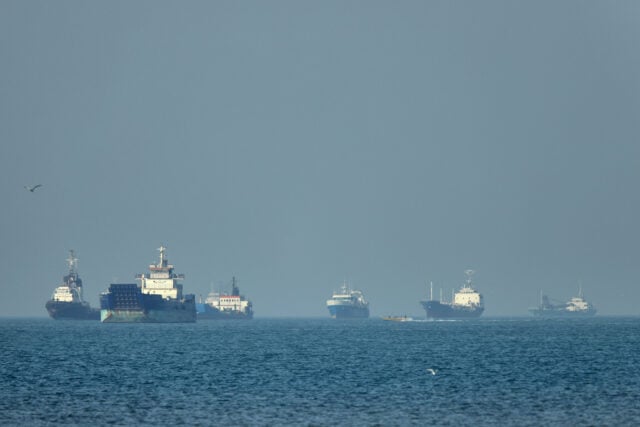
In a dramatic twist to a months-long military conflict, President Donald Trump announced on Saturday, May 23, 2026, that a peace agreement with the Islamic Republic of Iran has been “largely negotiated.” The unexpected declaration has sparked both hope for a permanent end to the war and deep skepticism from international observers, military hardliners, and Iranian state media.
The announcement arrives at a pivotal domestic moment: millions of Americans are hitting the roads for the long Memorial Day weekend, facing the highest holiday gasoline prices in four years—a direct consequence of the wartime closure of the Strait of Hormuz.
The Breakthrough Announcement
Taking to his Truth Social platform late Saturday afternoon, President Trump stated that the “final aspects and details” of a comprehensive “Memorandum of Understanding” are actively being finalized and will be officially made public in short order.

“An Agreement has been largely negotiated, subject to finalization between the United States of America, the Islamic Republic of Iran, and the various other Countries,” Trump posted.
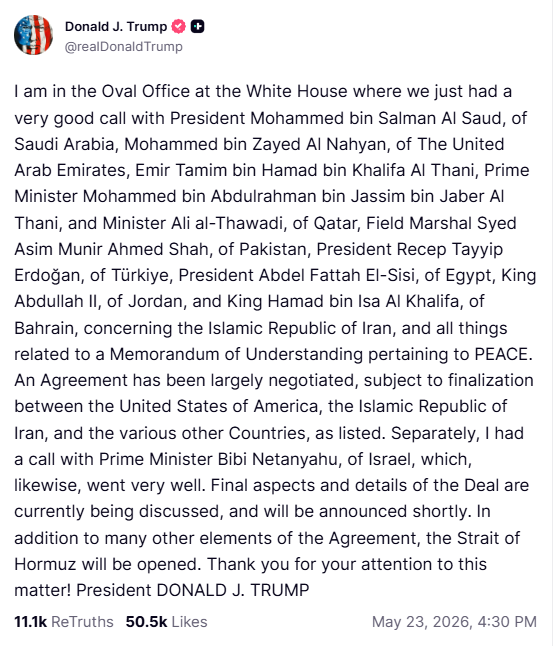
The President specified that the diplomatic breakthrough followed a series of intensive, high-stakes telephone consultations with key international partners, including Israeli Prime Minister Benjamin Netanyahu, various Gulf Arab leaders, and Pakistani mediators. According to senior administration officials, Trump convened a critical strategy session earlier on Friday with his primary negotiating team, which includes Vice President JD Vance, special envoy Steve Witkoff, and senior adviser Jared Kushner.
The sudden shift toward a diplomatic resolution represents a stark pivot for the administration. Only days prior, the Pentagon was actively preparing a fresh round of massive military strikes against Iranian infrastructure. Trump himself recently remarked to reporters that he had been “an hour away” from authorizing a major bombardment before being persuaded by Gulf allies to pause and allow regional diplomacy another window to function.
Inside the Proposed Peace Framework
According to regional officials and diplomatic sources close to the Pakistan-led mediation efforts, the proposed framework is a multi-phased initiative engineered to transition a fragile, weeks-old ceasefire into a permanent cessation of hostilities. The conflict originally erupted in late February 2026, when the United States and Israel launched joint military operations. A temporary ceasefire, brokered by Pakistan, went into effect on April 8 but has been plagued by frequent cross-border violations and intense political posturing.
The core tenets of the emerging 14-clause Memorandum of Understanding reportedly include:
- Official Termination of War: An immediate, permanent declaration ending the active military conflict between Iran, the United States, and Israel.
- Reopening the Strait of Hormuz: A phased restoration of commercial maritime traffic through the vital shipping artery, which previously handled approximately 20% of the world’s daily petroleum supply.
- Sanctions Relief and Asset Unfreezing: A structured, conditional easing of wartime U.S. naval blockades and economic sanctions, alongside the phased release of up to $25 billion in Iranian assets currently frozen in foreign banking institutions.
- Nuclear Program Timetable: A commitment from Tehran to enter dedicated negotiations within 30 to 60 days regarding constraints on its nuclear enrichment capabilities, potentially including the dilution or transfer of its highly enriched uranium stockpile.
- Regional De-escalation: Provisions requiring a simultaneous halt to ongoing hostilities in secondary theaters of the conflict, most notably throughout Lebanon and Iraq.
Tehran Disputes ‘Free Passage’ Claims
While President Trump painted a picture of an imminent diplomatic triumph, the narrative emerging from Tehran remains significantly more guarded and defiant. Iran’s semi-official Fars News Agency, which maintains close institutional ties to the powerful Islamic Revolutionary Guard Corps (IRGC), quickly labeled the American president’s characterization of a finalized deal as “inconsistent with reality.”
In a statement published via Telegram, Iranian state media clarified that any potential diplomatic understanding would not result in an unconditional return to pre-war maritime dynamics.
“The management of the Strait, determining the route, time, method of passage, and issuing permits will continue to be the monopoly and discretion of the Islamic Republic of Iran,” the Fars News Agency report stated.
While Iranian negotiators acknowledged a willingness to allow commercial shipping traffic to gradually scale back up to pre-war volumes, they explicitly rejected the notion of unrestricted “free passage,” emphasizing that the strategic waterway will remain under strict Iranian sovereign oversight. Furthermore, independent reports indicate that Tehran is demanding extensive financial compensation from Washington to cover domestic infrastructure damages sustained during the air campaign—a condition the White House has yet to publicly address.
Domestic Backlash from Hawkish Republicans
President Trump’s sudden push for a negotiated settlement has exposed sharp divisions within his own political party. Prominent conservative lawmakers and former national security officials have aggressively criticized the proposed terms, arguing that the framework repeats the perceived mistakes of past diplomatic agreements with Tehran.
Former Secretary of State Mike Pompeo sharply condemned the administration’s direction, characterizing the framework as a departure from core nationalist foreign policy goals. Pompeo asserted that the deal seemed reminiscent of the Obama administration’s 2015 nuclear pact—which Trump famously withdrew the U.S. from during his first term—stating the approach essentially paid the IRGC while failing to permanently neutralize their weapons programs.
Capital Hill echoed these hawkish anxieties. Texas Senator Ted Cruz voiced deep concern on social media, warning that an agreement leaving the current Iranian government intact and capable of enriching uranium would be a “disastrous mistake.” South Carolina Senator Lindsey Graham similarly cautioned that if the regional perception is that the deal allows the Iranian regime to survive and grow stronger, it would effectively pour gasoline on secondary conflicts throughout Lebanon and Iraq.
Holiday Drivers Face Four-Year Highs at the Pump
The geopolitical breakthrough comes at a moment of severe economic strain for American motorists. As record numbers of holiday travelers hit the roads for the traditional start of the summer driving season, national retail gasoline prices have surged to heights not seen since 2022.
According to data released by AAA, the national average for a gallon of regular unleaded gasoline reached $4.56 per gallon heading into the holiday weekend. This marks a three-cent increase over the prior week and a massive $1.38 jump compared to the same period last year, when the national average hovered around $3.18.
The steep upward trajectory is directly tied to the 12-week military conflict. Since the commencement of hostilities in late February, when the national average sat at a modest $2.98, fuel costs have climbed by more than $1.50 per gallon. Energy analysts note that while domestic gasoline demand has risen seasonally to roughly 8.76 million barrels per day, crude oil supplies have tightened dramatically due to the prolonged blockade of the Strait of Hormuz.
The economic impact varies heavily by geographic region. Motorists in western states are bearing the highest financial burden, with California leading the nation at an average of $6.14 per gallon, followed closely by Washington at $5.78 and Hawaii at $5.64. Conversely, the cheapest fuel can be found across the Gulf Coast states, where Mississippi and Georgia report averages of $4.01 and $4.03 per gallon, respectively.
The Path Forward
The coming days will test whether President Trump’s optimistic declaration materializes into a formal international accord or collapses back into active warfare. Secretary of State Marco Rubio, speaking to international press in Sweden, cautioned that while diplomatic channels remain open, the United States and its global allies are actively maintaining rigorous contingency plans in the event that Iran refuses to fully restore global maritime access.
With the primary channel of communication running through Pakistani military intermediaries in Islamabad, the international community remains on high alert. For American consumers, the stakes extend far beyond foreign policy; a true resolution and the reopening of the Strait of Hormuz represent the only viable path to lowering the historic energy costs currently squeezing household budgets at the pump.
Sources and Verification Links
- The Guardian: Trump says peace deal with Iran ‘largely negotiated’ with strait of Hormuz to open
- CBS News: Live Updates: Peace deal with Iran has been “largely negotiated” and will include reopening Strait of Hormuz, Trump says
- Financial Times: Donald Trump says deal with Iran to reopen Strait of Hormuz ‘largely negotiated’
- AAA Newsroom: Memorial Day Weekend Gas Prices Reach Four-Year Highs
- Washington Examiner: [Gas prices: Rise to new national average record high price for 2026](https://www.washingtonexaminer.com/news/4577598/gas-prices-rise to-new-national-average-record-high-price-for-2026/)
- Mainstreet Daily News: Memorial Day weekend gas prices reach 4-year highs
- Contra Costa News: Memorial Day Weekend Gas Prices Reach Four-Year Highs in California
- Wikipedia: 2026 Iran war ceasefire
Disclaimer
Artificial Intelligence Disclosure & Legal Disclaimer
AI Content Policy.
To provide our readers with timely and comprehensive coverage, South Florida Reporter uses artificial intelligence (AI) to assist in producing certain articles and visual content.
Articles: AI may be used to assist in research, structural drafting, or data analysis. All AI-assisted text is reviewed and edited by our team to ensure accuracy and adherence to our editorial standards.
Images: Any imagery generated or significantly altered by AI is clearly marked with a disclaimer or watermark to distinguish it from traditional photography or editorial illustrations.
General Disclaimer
The information contained in South Florida Reporter is for general information purposes only.
South Florida Reporter assumes no responsibility for errors or omissions in the contents of the Service. In no event shall South Florida Reporter be liable for any special, direct, indirect, consequential, or incidental damages or any damages whatsoever, whether in an action of contract, negligence or other tort, arising out of or in connection with the use of the Service or the contents of the Service.
The Company reserves the right to make additions, deletions, or modifications to the contents of the Service at any time without prior notice. The Company does not warrant that the Service is free of viruses or other harmful components.