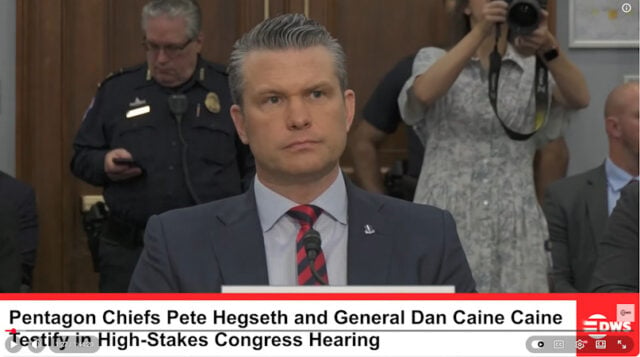
WASHINGTON, D.C. — In a marathon session that spanned nearly eight hours, Secretary of Defense Pete Hegseth faced a relentless barrage of questioning from both sides of the aisle on Tuesday. Testifying before the Senate Appropriations Subcommittee on Defense, Hegseth defended a record-shattering $1.5 trillion budget request and the skyrocketing costs of the ongoing war with Iran. The hearing, which many described as the most combative of his tenure, served as a volatile prelude to his immediate departure for Beijing, where he joins President Donald Trump for a high-stakes state visit.
The Fiscal Siege: $1.5 Trillion and the Cost of War
The centerpiece of the hearing was the Pentagon’s Fiscal Year 2027 budget proposal. At $1.5 trillion, the request represents a 42% increase over 2026 spending levels—a figure Hegseth characterized as “fiscally responsible” and “necessary for the urgency of the moment.” However, lawmakers were less concerned with the total figure than with the transparency of its allocation, particularly regarding the Iran conflict.
Acting Pentagon comptroller Jules Hurst revealed during the testimony that the cost of the nine-week-old war has now climbed to $29 billion, up from $25 billion just one month ago. This revelation sparked a firestorm from Senator Patty Murray (D-WA), the Vice Chair of the Senate Appropriations Committee.

“We have no real details, and yet now you want Congress to send you $1.5 trillion more,” Murray said, her voice rising. “To me, that is unacceptable. The administration’s position seems to be that there is no money for childcare, no money for healthcare, but plenty of money for war.”
Hegseth, leaning into his “America First” rhetoric, countered that national survival outweighs social programs. “We will ensure that every single dollar of taxpayer money is used to fund lethal soldiers, sailors, airmen, and Marines,” he testified. “The War Department will not be distracted by democracy-building, climate change, or woke moralizing.”
Clashes with the “Old Guard” and the “Reckless Naysayers”
The hearing was marked by deeply personal exchanges. Hegseth, who has frequently referred to his critics as “defeatists from the cheap seats,” found himself in a particularly sharp confrontation with Senator Chris Coons (D-DE). Coons, the ranking member of the subcommittee, pressed Hegseth on the strategic failures he perceived in the administration’s “Golden Fleet” initiative—a plan to build massive “Trump-class” naval destroyers.
“We have a president who seems more focused on a billion-dollar ballroom and a victory arch than achieving actual victory,” Coons remarked, referencing the administration’s focus on military aesthetics over modern drone technology. He further criticized Hegseth for focusing on “culture wars”—including book bans and the dismissal of senior military leaders—while the U.S. remains locked in a hot war.
“I am stunned that you fired the 44-year chief of staff of the Army in the middle of a hot war,” Coons said. Hegseth remained undeterred, retorting that his “cleansing” of the Pentagon was necessary to remove “entrenched bureaucrats” who prioritized DEI over lethality.
Republican Friction: Kennedy and Graham
While the Democrats focused on costs and culture, Republican senators focused on global strategy and the administration’s handling of allies. In an unpredictable turn, Senator John Kennedy (R-LA) delivered a stern lecture to the Secretary.
“America First does not mean America alone,” Kennedy warned. He pressed Hegseth on the strategic importance of locations like Diego Garcia and expressed concern that the administration’s isolationist leanings were allowing China to gain a foothold in Africa. Kennedy’s questioning focused on whether military force alone could reopen the Strait of Hormuz, which remains largely paralyzed by the conflict.
The most explosive moment, however, came from Senator Lindsey Graham (R-SC). Graham, usually a staunch ally of the administration, expressed “total distrust” in the mediation role of Pakistan. Citing reports that Iranian military aircraft were being sheltered on Pakistani airbases, Graham demanded to know why the U.S. was still using Islamabad as an intermediary.
“I don’t trust Pakistan as far as I can throw them,” Graham told Hegseth. “If they are parking Iranian planes to shield them from our strikes, we need someone else to mediate.” Hegseth declined to comment on specific intelligence, but Graham snapped back: “No wonder this damn thing is going nowhere.”
The China Mission: From the Hot Seat to the State Visit
As the hearing concluded, Hegseth was whisked away to Andrews Air Force Base to board Air Force One. He is joining President Trump, Secretary of State Marco Rubio, and a delegation of American CEOs—including Elon Musk and Tim Cook—on a state visit to Beijing from May 12 to 15.
The trip is viewed as a critical pivot point for the 2026 Iran war. China, which buys a massive percentage of Iranian oil, holds significant leverage over Tehran. Hegseth had previously announced that Beijing provided “high-level assurances” it would not send weapons to Iran, but the Senate hearing revealed deep skepticism about these promises.
Senator Graham used his final minutes of questioning to implore the Secretary to take a hard line with President Xi Jinping. “When you go to China, realize the person you’re talking to is propping up Russia and Iran,” Graham said.
The visit to the Temple of Heaven and the upcoming state banquet in Beijing will be a far cry from the hostile Senate chamber, but the shadows of the $1.5 trillion budget and the $29 billion war bill follow Hegseth across the Pacific. For Hegseth, the mission in China is clear: leverage the “strong and direct relationship” between Trump and Xi to stabilize a world that many in the Senate fear is spiraling out of control.
Sources Used and Links:
- U.S. Senate Committee on Appropriations: Remarks of Ranking Member Coons and Vice Chair Murray on FY27 Defense Budget. appropriations.senate.gov
- Financial Times: Pentagon’s Iran war bill nears $30bn as Donald Trump renews threats. ft.com
- CBS News: Lawmakers press Hegseth on details on Iran war authorization and Pentagon funding. cbsnews.com
- U.S. House Armed Services Committee: Record Version Statement by Honorable Pete Hegseth, Secretary of War. armedservices.house.gov
- The Guardian: Cost of US war on Iran mounting – live updates. theguardian.com
- Times of India: US official questions Islamabad’s mediation role after Iran aircraft row. timesofindia.indiatimes.com
- Wikipedia: 2026 state visit by Donald Trump to China. en.wikipedia.org
Disclaimer
Artificial Intelligence Disclosure & Legal Disclaimer
AI Content Policy.
To provide our readers with timely and comprehensive coverage, South Florida Reporter uses artificial intelligence (AI) to assist in producing certain articles and visual content.
Articles: AI may be used to assist in research, structural drafting, or data analysis. All AI-assisted text is reviewed and edited by our team to ensure accuracy and adherence to our editorial standards.
Images: Any imagery generated or significantly altered by AI is clearly marked with a disclaimer or watermark to distinguish it from traditional photography or editorial illustrations.
General Disclaimer
The information contained in South Florida Reporter is for general information purposes only.
South Florida Reporter assumes no responsibility for errors or omissions in the contents of the Service. In no event shall South Florida Reporter be liable for any special, direct, indirect, consequential, or incidental damages or any damages whatsoever, whether in an action of contract, negligence or other tort, arising out of or in connection with the use of the Service or the contents of the Service.
The Company reserves the right to make additions, deletions, or modifications to the contents of the Service at any time without prior notice. The Company does not warrant that the Service is free of viruses or other harmful components.