It feels like we’ve been here before, doesn’t it? You walk into the grocery store, grab a basket—because a cart just feels too ambitious for your budget these days—and head straight for the essentials. But by the time you reach the checkout line, that “light trip” has somehow cost you a hundred bucks. If you’ve been feeling that sudden, sharp sting in your wallet this May, you aren’t imagining it. The latest numbers are out, and they confirm what your bank account has been trying to tell you: inflation is back in the driver’s seat, and it’s got a heavy foot on the gas.
The Numbers Behind the Noise
On Tuesday, May 12, 2026, the Bureau of Labor Statistics dropped a bit of a bombshell. The Consumer Price Index (CPI) for April 2026 showed that headline inflation has climbed to 3.8%. Now, in the grand scheme of historical hyperinflation, 3.8% might not sound like a world-ending number, but it’s the direction that has everyone on edge. We were supposed to be cooling off; instead, we’re heating up.
Core inflation, which strips out the “volatile” stuff like food and energy (even though those are the two things we actually spend our money on every single day), is sitting at 2.8%. But here is the kicker: energy costs alone accounted for about 40% of the total monthly increase in April. Between the rising cost of fuel and the growing tension in the Middle East, the “cost of living” is starting to feel more like the “cost of just surviving.”
The data shows that annualized consumer prices rose at the fastest pace in 35 months. The 0.6% month-over-month increase was broad-based, meaning it wasn’t just one or two items dragging everything up. It was a collective push. Gasoline led the charge with a 5.4% jump, followed by electricity at 2.1%. Even apparel saw a 0.6% rise. It seems like no matter where you look, the price tag is being rewritten in real-time.

Why Is My Grocery Receipt So Long?
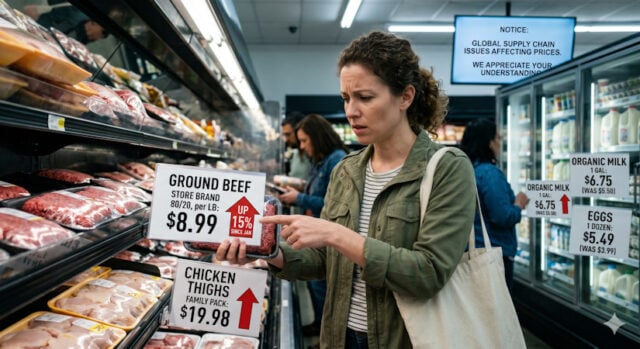
Let’s talk about the grocery aisle, because that’s where the rubber really meets the road for most of us. If you’ve noticed that your favorite cut of steak or even a simple pack of ground beef is starting to look like a luxury item, there’s a reason for that.
According to the latest USDA and BLS data, the index for meats, poultry, fish, and eggs jumped significantly in April. But the real standout—the “inflation MVP” no one asked for—is beef. Beef prices have been hitting record highs, and when you look at the year-over-year data, it’s staggering. In many regions, beef is up over 12% compared to last year.
It’s not just the meat department, though. Other items hitting your budget hard include:
- Fruits and Vegetables: Up 1.8% in April.
- Nonalcoholic Beverages: Up 1.1%.
- Eggs: After a brief period of relief, egg prices are seeing renewed pressure due to lingering supply chain issues and high input costs for farmers.
- Transportation Services: While not a grocery item, the 0.3% rise here means it costs more to get those groceries to the store and more for you to drive there.
Essentially, the “basket of goods” that the government uses to track our lives is getting heavier and more expensive, and for many families, the weight is becoming unbearable. Real average hourly earnings, when adjusted for this inflation, actually slipped into negative territory for the first time in years. You might be getting a raise, but the grocery store is taking it before you even get home.
The “Beef” With Beef: The Administration’s Plan
So, what is the government doing about it? With beef prices at multi-decade highs and the domestic cattle herd at its lowest level in years, the Trump administration is rolling out some aggressive tactics. The herd size is a major bottleneck; we simply don’t have enough cows to meet demand without prices sky-rocketing.
As of early May 2026, the White House announced a multi-pronged strategy to tackle the “beef crisis.” The goal is simple: get more meat on the shelves and lower the price for the average American family. Here is the breakdown:
- Tariff Reductions: The administration is moving to temporarily reduce or suspend tariffs on beef imports. Specifically, they are looking at the “tariff-rate quota” (TRQ). Normally, the U.S. lets a certain amount of beef in at a low rate, and once that limit is hit, the taxes skyrocket. By suspending this, the U.S. can bring in more lean beef from places like Brazil, Argentina, and Australia without the extra cost. This is aimed specifically at the “ground beef” market—the lean trimmings we mix into our burgers.
- Lending Support for Ranchers: The Small Business Administration (SBA) has been directed to increase lending support for domestic ranchers. The hope is that by giving cattle producers more capital, they can start rebuilding the American herd. Rebuilding a herd takes years, but the administration is hoping to signal long-term stability.
- Regulatory Rollbacks: In a move that has sparked debate, the plan includes reducing protections for gray and Mexican wolves under the Endangered Species Act to protect livestock. Additionally, they are looking to ease requirements for electronic ear tags in cattle to reduce the administrative burden on farmers.
While these moves might help the “ground beef” situation eventually, experts warn it won’t be an overnight fix. The market is essentially dictating prices right now, and global supply chains are still incredibly tangled.
“I Don’t Think About Your Financial Situation”
While the economic data was swirling, President Trump made headlines on Tuesday with a comment that left many Americans scratching their heads. In the midst of high-stakes negotiations regarding Iran’s nuclear program and the ongoing conflict in the Middle East, the President was asked about the domestic financial strain.
His response was blunt and focused on the geopolitical big picture:
“I don’t think about American’s financial situation… I think about one thing—we cannot let Iran have a nuclear weapon. That’s all.”
He later clarified that the nuclear threat is the “most important thing by far,” even overshadowing immediate economic concerns like the stock market or grocery prices. From his perspective, a nuclear-armed Iran is an existential threat that makes the price of a gallon of milk look like a minor detail in the long run of history.
However, for the millions of Americans who are currently choosing between filling their gas tank or buying a week’s worth of groceries, being told their “financial situation” isn’t the primary thought in the Oval Office was a tough pill to swallow. The administration’s allies, like Secretary of State Marco Rubio, have stepped in to argue that the two issues are linked: if Iran continues to destabilize the Middle East, oil prices (and thus inflation) will never stay down.
Wall Street’s Nervous Breakdown
If you think you’re stressed, take a look at Wall Street. The combination of “hot” inflation data and the President’s focus on Iran sent the markets into a tailspin on Tuesday, May 12.
The S&P 500 and the Nasdaq both pulled back from their record highs. Tech stocks, particularly the high-flying semiconductor companies, took the biggest hit. The Philadelphia SE Semiconductor index tumbled nearly 6% in a single session.
Why is Wall Street so spooked?
- The “Higher for Longer” Fear: Investors were hoping the Federal Reserve would start cutting interest rates soon. But with inflation at 3.8%, the narrative has shifted. Now, traders are pricing in the possibility that the Fed won’t cut rates at all this year—and some are even whispering about another rate hike.
- The Oil Problem: U.S. crude oil rose to above $100 per barrel on Tuesday. This is a massive psychological and economic barrier. High oil prices are a tax on everything—from the plastic in your toothbrush to the truck that delivered it.
- Geopolitical Uncertainty: With the President describing the ceasefire proposal with Iran as being “on life support,” the “war premium” on oil prices is staying put. Wall Street hates uncertainty, and a potential military escalation is the ultimate uncertainty.
Looking Ahead
As we move through May 2026, the economic picture is anything but clear. We have a government trying to lower the price of your burger through trade deals, a President focused on global nuclear security over domestic wallets, and a stock market that is realizing the “easy money” era is over.
For the rest of us, it’s a matter of watching the labels at the store and hoping that the geopolitical dust settles before the next CPI report comes out. In the meantime, maybe it’s time to check out those “frugal living” tips—because it looks like the cost of the status quo is only going up.
Sources Used and Links:
- USAFacts: What is the current inflation rate in the US?
- Bureau of Labor Statistics (BLS): Consumer Price Index Summary – April 2026
- Interactive Brokers: Hotter-Than-Expected CPI, WTI Above $100 Hurts Investor Sentiment: May 12, 2026
- Charles Schwab: Stubborn Price Growth Persists, Stocks Down Early – May 12, 2026
- Morningstar / MarketWatch: Inflation jumps to 3-year high, CPI shows, and that’s not the end of it
- Investing.com: Reaction roundup: Experts, analysts weigh in on hot April CPI report
- RFD-TV: White House Moving Forward With Beef Import Tariff Reduction
- Drovers: Trump Plans to Tackle Beef Prices with More Imports
- CBS News: Trump says “I don’t think about American’s financial situation” in Iran talks
Disclaimer
Artificial Intelligence Disclosure & Legal Disclaimer
AI Content Policy.
To provide our readers with timely and comprehensive coverage, South Florida Reporter uses artificial intelligence (AI) to assist in producing certain articles and visual content.
Articles: AI may be used to assist in research, structural drafting, or data analysis. All AI-assisted text is reviewed and edited by our team to ensure accuracy and adherence to our editorial standards.
Images: Any imagery generated or significantly altered by AI is clearly marked with a disclaimer or watermark to distinguish it from traditional photography or editorial illustrations.
General Disclaimer
The information contained in South Florida Reporter is for general information purposes only.
South Florida Reporter assumes no responsibility for errors or omissions in the contents of the Service. In no event shall South Florida Reporter be liable for any special, direct, indirect, consequential, or incidental damages or any damages whatsoever, whether in an action of contract, negligence or other tort, arising out of or in connection with the use of the Service or the contents of the Service.
The Company reserves the right to make additions, deletions, or modifications to the contents of the Service at any time without prior notice. The Company does not warrant that the Service is free of viruses or other harmful components.