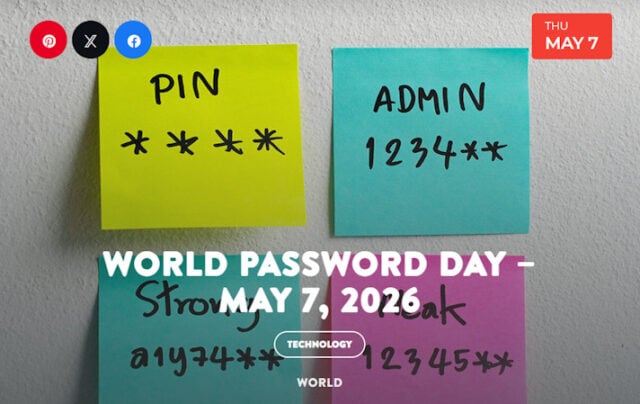
Each year on the first Thursday in May, World Password Day promotes better password habits. Passwords are critical gatekeepers to our digital identities, allowing us to access online shopping, dating, banking, social media, private work, and life communications.
- 1961 – Massachusetts Institute of Technology (MIT) creates the computer password so that multiple people can use a shared computer system.
- 1976 – Public-key cryptography is created so two people can authenticate each other without exchanging a cryptographic key.
- 1978 – A study by Morris and Thompson demonstrates that guessing passwords based on personal information is easier than deciphering them.
- 1986 – Two-factor authentication emerges and is adopted.
- 1999 – hackers revealed a security flaw in Hotmail that permitted anybody to log into a Hotmail account using the password ‘eh’. At the time, it was called “the most widespread security incident in the history of the Internet.”
- 2005 – Security researcher Mark Burnett first encouraged people to have a “password day” to update important passwords in his 2005 book, Perfect Passwords.
- 2020 – the year when the top type of information stolen around the world was credentials.
- In a cyber world, secure passwords are important. Other than keeping your information offline, long, unique and complex passwords protect your valuable information best.
- Another tactic is to change your passwords every few months, or whenever you think your accounts have been compromised.
- Turn on two-factor authentication for your important accounts
- Password-protect your wireless router
- Don’t store passwords on your computer or phone
- Log off when you’re done with a program
- periodically remove temporary Internet files
- Business Insider conducted research to determine how vulnerable accounts are and found that 10,000 of the most common passwords can access 98% of all accounts. In other words, most people are using the same passwords – and many for years at a time.
- Passwords are easily hacked because most humans follow similar patterns. At the beginning of the Web and when passwords were first used, the most popular password was ‘12345’. Today, it may be longer, but is hardly safer – ‘123456’.
- Additionally, research has found that women are famous for using personal names in their passwords, and men opt for their hobbies.
- 59% of people use the same password everywhere.
- 62% of people use the same password for work and personal accounts.
- 7 in 10 people no longer trust passwords to protect their online accounts.
- 86% of people who use 2FA feel their accounts are more secure
- 18% of employees share their passwords with others
- 99.9% — the percentage of threats to passwords that can be stopped using multi-factor authentication, according to Microsoft.
- 60% — the percentage of data breaches that involve credentials.
- 40% — the percentage of people in a 2020 study who said that their company data was compromised because of a weak or cracked password.
- 20 — the number of common categories into which the majority of passwords fit into.
- 40% — the percentage of organizations that rely on sticky notes for remembering passwords.
- 82% — the percentage of workers who admitted to recycling the same passwords.
- 60% — the percentage of recycled passwords that appeared in multiple data leaks in 2020
- 25% — the percentage of data breaches that were a result of credential stuffing in 2020.
- At one point, Facebook had a master password that worked for any account. The password spelled out ‘Chuck Norris,’ more or less, but with upper and lower case, symbols, and numbers.
- For 20 years, the passwords for US nuclear missiles were 00000000.
- These five user passwords accounted for 3.2 million of the 130 million accounts that were stolen in the Adobe hack of 2013: “123456,” “12345678,” “Password,” “Adobe123” and “12345678.” source
- An analysis of 11 million stolen cloud service passwords conducted by Skyhigh Networks found that just 20 passwords account for 10.3% of all passwords in use.
- About 40% of organizations store privileged and administrative passwords in Word documents or spreadsheets.
- Two-thirds of people use no more than two passwords for all their online accounts. Source
- The top 10 most-used passwords have barely changed in the last five years.
- 5 OF THE MOST COMMON PASSWORDS AND HOW LONG IT TAKES TO CRACK THEM!:
- 123456..Less than one second to crack, with 3.5 million uses counted in a study.
- Password – Less than one second to crack, with 1.7 million uses counted in a study
- abc123 – Less than one second to crack, with 610,000 uses counted in a study.
- qwerty – Less than one second to crack, 382,000 uses counted in a study.
- 11111 – Less than one second to crack, with 369,000 uses counted in a study.


Sources

Disclaimer
Artificial Intelligence Disclosure & Legal Disclaimer
AI Content Policy.
To provide our readers with timely and comprehensive coverage, South Florida Reporter uses artificial intelligence (AI) to assist in producing certain articles and visual content.
Articles: AI may be used to assist in research, structural drafting, or data analysis. All AI-assisted text is reviewed and edited by our team to ensure accuracy and adherence to our editorial standards.
Images: Any imagery generated or significantly altered by AI is clearly marked with a disclaimer or watermark to distinguish it from traditional photography or editorial illustrations.
General Disclaimer
The information contained in South Florida Reporter is for general information purposes only.
South Florida Reporter assumes no responsibility for errors or omissions in the contents of the Service. In no event shall South Florida Reporter be liable for any special, direct, indirect, consequential, or incidental damages or any damages whatsoever, whether in an action of contract, negligence or other tort, arising out of or in connection with the use of the Service or the contents of the Service.
The Company reserves the right to make additions, deletions, or modifications to the contents of the Service at any time without prior notice. The Company does not warrant that the Service is free of viruses or other harmful components.