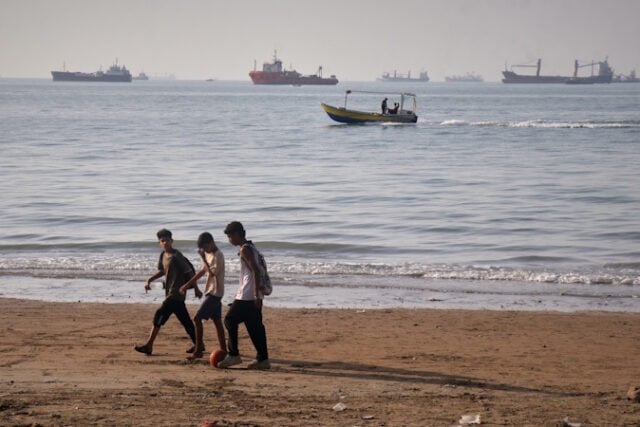
In a dramatic escalation of his administration’s maritime strategy, President Donald Trump announced on Sunday that the United States military will begin a coordinated operation to “guide” stranded commercial vessels through the Strait of Hormuz starting Monday morning, Middle East time.
The initiative, which the President has dubbed “Project Freedom,” is described by the White House as a humanitarian mission aimed at liberating “neutral and innocent” ships caught in the crossfire of the ongoing conflict between the U.S.-led coalition and Iran. The announcement comes as global energy markets remain on edge and thousands of seafarers find themselves trapped in one of the world’s most critical maritime chokepoints.
A Mission of “Guidance”
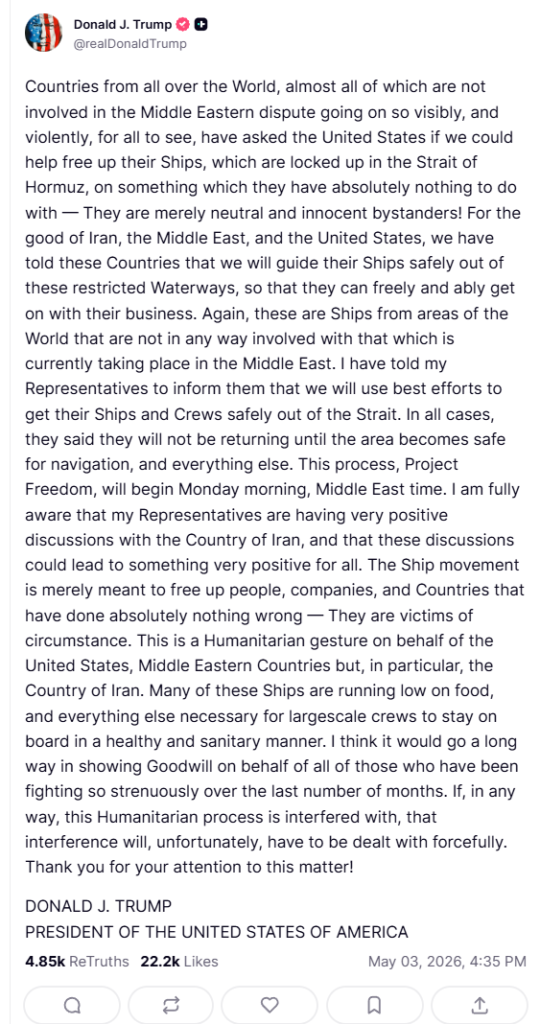 Writing on his social media platform, President Trump stated that multiple nations had reached out to Washington requesting assistance for their vessels, which have been effectively “locked up” since hostilities intensified in late February.
“We have told these Countries that we will guide their Ships safely out of these restricted Waterways, so that they can freely and ably get on with their business,” Trump wrote. He characterized the move as a goodwill gesture not only for the international community but also for the region at large, including Iran. However, the President paired his offer of assistance with a stern warning: “If, in any way, this Humanitarian process is interfered with, that interference will, unfortunately, have to be dealt with forcefully.”

The Strait of Hormuz, a narrow passage between Oman and Iran, typically handles approximately 21 million barrels of oil per day—nearly 20% of global consumption. Since the U.S. and Israel launched military operations on February 28, 2026, maritime traffic has plummeted by an estimated 70%.
Strategic Stakes and Economic Pressure
The introduction of Project Freedom serves as a counterpoint to Iran’s recent efforts to monetize its control over the waterway. Iranian officials have previously asserted their right to stop and inspect vessels, demanding “tolls” from ships not affiliated with the U.S. or Israel in exchange for safe passage.
U.S. Treasury Secretary Scott Bessent, speaking on Fox News on Sunday, dismissed these tolls as a “pittance” compared to Iran’s previous oil revenues, estimating that Tehran has collected less than $1.3 million thus far. Bessent noted that the U.S. naval blockade, in place since April 13, has significantly deprived Tehran of the revenue needed to sustain its economy, which is currently seeing the rial tumble to new lows.
Tensions on the Water
The urgency of the Monday morning start date for Project Freedom was underscored by reports from the British military’s United Kingdom Maritime Trade Operations (UKMTO) center. On Sunday, a northbound cargo ship reported being attacked by multiple small craft off the coast of Sirik, Iran. While the crew was reported safe, the incident marks the latest in over two dozen attacks in and around the strait since the war began.
The U.S. Central Command (CENTCOM) confirmed on Sunday that 49 commercial ships were recently instructed to turn back to avoid the volatile zone. With some 20,000 seafarers currently believed to be on vessels stuck in the Persian Gulf, the logistics of “guiding” these ships out will require a significant U.S. Navy presence.
Diplomatic Backchannels
Despite the military posturing, President Trump hinted at a possible diplomatic off-ramp. He noted that U.S. representatives are currently engaged in “very positive” discussions with Iranian counterparts. While he clarified that these talks are not nuclear negotiations, he expressed optimism that the dialogue “could lead to something very positive for all.”
Iranian state media has thus far characterized the President’s announcement as a “claim,” and Tehran has not officially confirmed whether it will allow Project Freedom to proceed without interference. For now, the world looks toward the dawn of Monday morning in the Middle East to see if the U.S. Navy can successfully restore a semblance of flow to the world’s most vital energy artery.
Sources Used and Links:
- PBS News: Trump says U.S. will help ‘guide’ stranded ships from Strait of Hormuz starting Monday
- Anadolu Agency: Trump says US to help escort neutral ships out of Strait of Hormuz starting Monday
- The Times of Israel: Trump says US launching effort to ‘guide’ stranded ships out of Strait of Hormuz
- Kurdistan24: Trump Announces ‘Project Freedom’ to Escort Neutral Ships Out of Strait of Hormuz
- Navy Times: Trump says US Navy could escort ships through Strait of Hormuz
- CHAT News Today: Trump says the US will ‘guide’ stranded ships from the Strait of Hormuz, starting on Monday
Disclaimer
Artificial Intelligence Disclosure & Legal Disclaimer
AI Content Policy.
To provide our readers with timely and comprehensive coverage, South Florida Reporter uses artificial intelligence (AI) to assist in producing certain articles and visual content.
Articles: AI may be used to assist in research, structural drafting, or data analysis. All AI-assisted text is reviewed and edited by our team to ensure accuracy and adherence to our editorial standards.
Images: Any imagery generated or significantly altered by AI is clearly marked with a disclaimer or watermark to distinguish it from traditional photography or editorial illustrations.
General Disclaimer
The information contained in South Florida Reporter is for general information purposes only.
South Florida Reporter assumes no responsibility for errors or omissions in the contents of the Service. In no event shall South Florida Reporter be liable for any special, direct, indirect, consequential, or incidental damages or any damages whatsoever, whether in an action of contract, negligence or other tort, arising out of or in connection with the use of the Service or the contents of the Service.
The Company reserves the right to make additions, deletions, or modifications to the contents of the Service at any time without prior notice. The Company does not warrant that the Service is free of viruses or other harmful components.