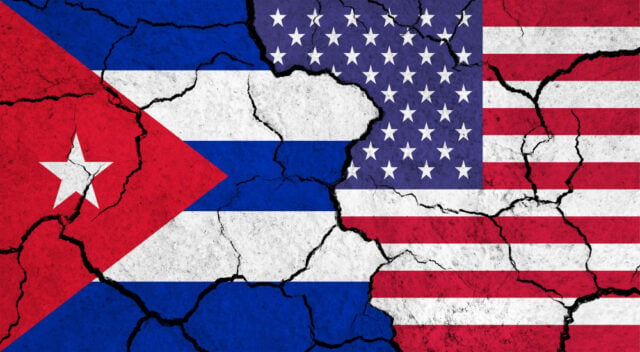
The streets of Havana, once vibrant with the rhythmic clatter of vintage engines and the humid energy of a Caribbean hub, have fallen into a haunting, static silence. As of May 2, 2026, the island nation is no longer just “struggling”—it is navigating a systemic collapse that experts describe as the most acute humanitarian and political crisis in the Western Hemisphere. At the heart of this storm is a renewed, aggressive strategy from the 47th President of the United States, Donald Trump, whose administration has moved beyond traditional containment toward what many are calling a final push for regime change.
The “Friday” Mandate: Maximum Pressure 2.0
On May 1, 2026, President Trump signed an Executive Order that signaled a point of no return for U.S.-Cuba relations. This order expands the existing “Maximum Pressure” campaign by targeting the remaining pillars of the Cuban economy: energy, defense, and mining. The White House has characterized these measures as a necessity for “national security,” citing Cuba’s role as a “permissive environment” for hostile foreign intelligence operations and its continued alignment with adversaries.
The strategy, often referred to within Washington circles as “Operation Southern Spear,” follows the successful ousting of Nicolás Maduro in Venezuela earlier this year. With Venezuela’s oil subsidies now a thing of the past and a U.S.-backed transitional government in Caracas, Cuba has lost its most vital lifeline. The Trump administration has wasted no time in filling that vacuum with a restrictive wall of sanctions.

The Oil Embargo and “Operation Economic Fury”
The defining feature of the 2026 crisis is the U.S. oil embargo, formalized under Executive Order 14380 in late January. Unlike previous iterations of the embargo, this “Total Pressure” approach utilizes secondary sanctions to penalize any third-party nation or entity that provides oil to the island.
The impacts have been immediate and devastating. In February and March, the U.S. began actively blocking tankers, including those from the Mexican state-owned company Pemex. Ships like the Skipper and the Neptune 6 were interdicted or discouraged through the threat of crippling tariffs on their home countries. While Mexico’s President, Claudia Sheinbaum, initially called the halt of shipments a “sovereign decision” to avoid U.S. wrath, she has since pivoted toward a role as a mediator, seeking a humanitarian middle ground that satisfies both the White House’s demands and Havana’s survival needs.
The Humanitarian Toll: Life in the Dark
The statistics emerging from the island paint a bleak picture of a nation on life support. Since the massive power grid failure in October 2024, the energy situation has only worsened. By May 2026, blackouts are no longer “outages”; they are the default state of existence.
According to United Nations reports released this week, the crisis has moved from an economic inconvenience to a lethal reality. Over 96,000 surgeries have been postponed nationwide due to lack of electricity and medical supplies. In neonatal wards, the lives of 11,000 children are currently at risk as incubators and ventilators struggle to remain operational.
The economic contraction is staggering:
- GDP Decline: A cumulative 10% drop over the last five years.
- Extreme Poverty: Currently estimated at 89%.
- Migration: Since 2022, over one million Cubans have fled the island, marking the largest exodus in the country’s history.
For those who remain, daily life is a gauntlet of “searching for a timeline to resume care,” as UN Resident Coordinator Francisco Pichón recently noted. Small businesses have shuttered, food distribution is erratic, and the tourism industry—once the crown jewel of the Cuban economy—has all but vanished under the weight of travel restrictions and infrastructure failure.
The Rhetoric of “Takeover”
Perhaps the most controversial aspect of the current situation is the shift in American rhetoric regarding Cuba’s future. In a Florida speech delivered yesterday, President Trump mused about the inevitability of the regime’s fall, suggesting a “takeover” that might not involve a single shot being fired.
“On the way back from Iran, we’ll have one of our big—maybe the USS Abraham Lincoln aircraft carrier, the biggest in the world—we’ll have that come in, stop about 100 yards offshore, and they’ll say, ‘Thank you very much. We give up.'” — Donald J. Trump, May 1, 2026
This vision of a “friendly takeover” reflects a belief within the administration that the Cuban government is so brittle that a mere show of force, combined with total economic isolation, will trigger a surrender. Analysts, however, are divided. Some see this as a psychological operation intended to demoralize the Cuban military, while others fear it sets the stage for a legitimate military intervention if the “deal” Trump is seeking does not materialize.
The “Rubio Channel” and the Castro Grandson
While the public rhetoric is fiery, the back-channel diplomacy is where the real intrigue lies. Secretary of State Marco Rubio, a long-time hawk on Cuba, is reportedly leading discussions with Raúl Guillermo Rodríguez Castro, the grandson of Raúl Castro and a powerful figure within the regime’s security apparatus.
These talks, reportedly occurring outside official channels, suggest that the U.S. is looking for a “managed collapse”—a way for the regime to step aside in exchange for immunity or a share in a transitional power structure. The Trump administration has been blunt: “The regime has to go,” a senior official told Axios in February, “but what exactly that looks like is up to the President.”
The Geopolitical Stakes
The “takeover” narrative isn’t just about the 145km of water between Florida and Havana; it’s about the broader displacement of Russian and Chinese influence in the Americas. The Pentagon has long viewed Cuba as a “proximate location” for adversary intelligence gathering. By forcing a change in Havana, the Trump administration seeks to solidify the Monroe Doctrine 2.0, ensuring that no hostile extra-regional powers have a foothold in the Caribbean.
However, this aggressive stance has drawn sharp criticism from the international community. At a recent UN conference, diplomats warned that the current blockade amounts to “collective punishment.” The Cuban Foreign Minister, Bruno Rodríguez, has echoed these sentiments, rejecting the “unilateral coercive measures” as a violation of international law.
The Scenarios: What Happens Next?
As we look toward the remainder of 2026, three primary scenarios emerge for the island:
- The “Deal” (Negotiated Transition): Through the Rubio-Castro back-channel, the Cuban government agrees to democratic reforms and the release of all political prisoners in exchange for the lifting of the oil embargo and a path to normalization. This is Trump’s preferred “art of the deal” outcome.
- The “Internal Collapse” (Spontaneous Revolt): The humanitarian crisis reaches a breaking point, leading to a repeat of the July 11, 2021 protests, but on a scale the military can no longer contain. This could lead to a chaotic transition and a massive, sudden migrant surge toward the U.S.
- The “Sovereignty Standoff”: Havana refuses to yield, leaning into a “war economy” and seeking desperate assistance from remaining allies. This would likely lead to a prolonged period of suffering for the Cuban people and a permanent U.S. naval presence just off the coast.
Conclusion: A Nation at the Crossroads
Cuba in 2026 is a nation caught between a revolutionary past that can no longer feed its people and a future that looks increasingly like an American ultimatum. The sanctions are no longer just tools of influence; they are the gears of a machine designed to halt the island’s heart until it changes its rhythm. Whether this leads to a “friendly takeover” or a tragic humanitarian catastrophe remains the most pressing question in the Americas today.
Havana waits in the dark, and for the first time in sixty years, the world is wondering if the lights will ever come back on under the same flag.
Every Source Used
- The White House (May 1, 2026): Fact Sheet: President Donald J. Trump Imposes Sanctions on Cuban Regime Officials Responsible for Repression and Threats to U.S. National Security and Foreign Policy https://www.whitehouse.gov/fact-sheets/2026/05/fact-sheet-president-donald-j-trump-imposes-sanctions-on-cuban-regime-officials-responsible-for-repression-and-threats-to-u-s-national-security-and-foreign-policy/
- The Guardian (May 2, 2026): Cuba says Trump’s fresh sanctions on its economy amount to ‘collective punishment’ https://www.theguardian.com/world/2026/may/02/cuba-trump-new-sanctions-economy
- UNSDG / OCHA (May 1, 2026): Cuba is Running Out of Time. We Need Fuel Now to Save Lives https://unsdg.un.org/latest/stories/cuba-running-out-time-we-need-fuel-now-save-lives
- Wikipedia (2026): 2026 Cuban crisis https://en.wikipedia.org/wiki/2026_Cuban_crisis
- Just Security (April 29, 2026): The United States-Cuba Oil Embargo and International Law https://www.justsecurity.org/137325/us-cuba-embargo-international-law/
- El País (February 19, 2026): The United States demands Cuba make ‘dramatic changes very soon’ https://english.elpais.com/usa/2026-02-19/the-united-states-demands-dramatic-changes-very-soon-from-cuba.html
- RealClearWorld (March 18, 2026): Pursue Negotiations, Not Regime Change, in Cuba https://www.realclearworld.com/articles/2026/03/18/pursue_negotiations_not_regime_change_in_cuba_1171182.html
- CEPR (April 2026): CEPR Sanctions Watch April 2026 https://cepr.net/publications/cepr-sanctions-watch-april-2026/
- Anadolu Agency (May 1, 2026): UN warns of worsening humanitarian crisis in Cuba amid energy shortages https://www.aa.com.tr/en/americas/un-warns-of-worsening-humanitarian-crisis-in-cuba-amid-energy-shortages/3924565
Disclaimer
Artificial Intelligence Disclosure & Legal Disclaimer
AI Content Policy.
To provide our readers with timely and comprehensive coverage, South Florida Reporter uses artificial intelligence (AI) to assist in producing certain articles and visual content.
Articles: AI may be used to assist in research, structural drafting, or data analysis. All AI-assisted text is reviewed and edited by our team to ensure accuracy and adherence to our editorial standards.
Images: Any imagery generated or significantly altered by AI is clearly marked with a disclaimer or watermark to distinguish it from traditional photography or editorial illustrations.
General Disclaimer
The information contained in South Florida Reporter is for general information purposes only.
South Florida Reporter assumes no responsibility for errors or omissions in the contents of the Service. In no event shall South Florida Reporter be liable for any special, direct, indirect, consequential, or incidental damages or any damages whatsoever, whether in an action of contract, negligence or other tort, arising out of or in connection with the use of the Service or the contents of the Service.
The Company reserves the right to make additions, deletions, or modifications to the contents of the Service at any time without prior notice. The Company does not warrant that the Service is free of viruses or other harmful components.