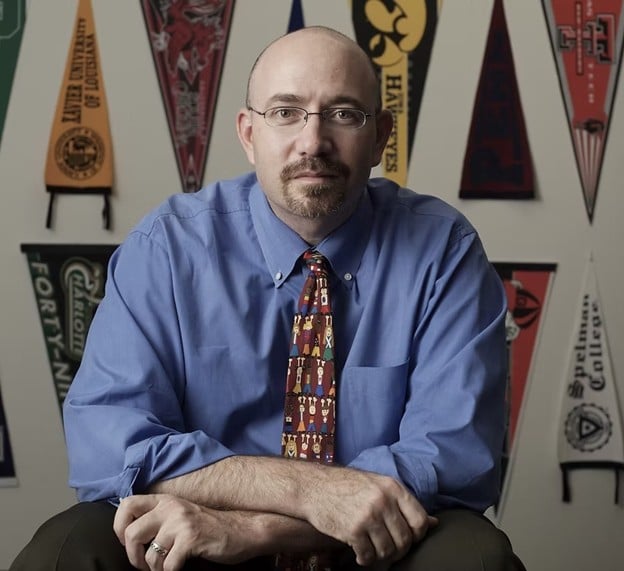
Mike Feinberg arrived in Houston in 1992 as a Teach For America corps member, assigned to teach bilingual fifth grade. He had six weeks of training. He describes his first year in the classroom as a series of mistakes made in front of 32 students, the youngest 9 and the oldest 15, nearly none of whom spoke English and two of whom spoke no Spanish.
He stayed anyway. More than three decades later, Feinberg is still in Houston, still working with the same population, still wrestling with the same core question: what does it actually take for a kid from an underserved neighborhood to build a stable life?
His answer has changed substantially.
“College prep does not need to mean college for all,” Feinberg says. “All of our college counselors could have, should have been career counselors or life counselors, where college is an important pathway but not the only pathway.”

What Mike Feinberg Built, and What the Data Showed Him
Feinberg co-founded KIPP in 1994, starting with a single program at Garcia Elementary on Houston’s north side. What began as a classroom experiment grew into a national network of more than 270 public charter schools, built on the conviction that rigorous academics and high expectations could put low-income students on the path to college.
For most of his time at KIPP, that conviction went largely unexamined. Then the alumni data started coming in.
By around 2016, KIPP Houston had reached a number Feinberg had spent years chasing: more than 50% of its alumni were graduating from four-year colleges, a mark that made it the first high-performing charter region anywhere to hit that threshold, by his accounting. He says he celebrated for about 15 seconds.
“That’s half,” he recalls thinking. “What about the other half?”
The alumni who hadn’t earned degrees weren’t failing. Many had gone into trades, the military, or started their own businesses. They were doing fine. Meanwhile, some graduates who had gone to four-year colleges had taken on six-figure debt for degrees that weren’t producing the returns the college-prep pitch had implied.
“We basically shamed vo-tech out of the high schools, which was a terrible mistake,” Feinberg says. “We told kids and parents that if you want to be successful in this world, you have to go to college. In the ’90s, it was a car loan. Now it’s a home mortgage.”
From KIPP to WorkTexas: Mike Feinberg Tries to Turn the Ship
Feinberg started raising the issue internally at KIPP before he left, pushing to celebrate students who entered trade programs or the military alongside those heading to four-year colleges. He says the resistance was real. The college-prep culture was deeply embedded, and questioning it felt to some like abandoning the mission.
“That was a very strong culture monster we created,” he says. “It was going to take several years to turn that ship.”
He left KIPP around 2018 and co-founded the Texas School Venture Fund, which has since incubated a range of education initiatives including two Houston-area charter schools for pre-K through eighth grade. One of those initiatives became WorkTexas, launched in 2020 alongside businessman Jim “Mattress Mack” McIngvale and Vanessa Ramirez, a former KIPP student of Feinberg’s who now leads the program’s justice-involved youth work.
WorkTexas offers free or low-cost trades training for high school students and adults at two Houston campuses, with curriculum shaped by more than 100 employer partners. Courses run about 11 weeks. Graduates are tracked for at least five years after they complete training.
Feinberg is candid that his generation of education reformers, including KIPP, Teach For America, and Uncommon Schools, collectively pushed too hard in one direction. He doesn’t frame WorkTexas as a repudiation of that work, but as a correction.
“College prep is a good thing,” he says. “We don’t need to get into a soft bigotry of low expectations debate. College prep should be in all schools. But college prep does not need to mean college for all.”
The distinction matters more now than it did in the 1990s. Tuition has climbed steeply, employer attitudes have shifted toward skills-based hiring, and wages in the skilled trades have risen sharply. The argument Feinberg spent years making inside education circles has since become a mainstream conversation, heard in congressional hearings, in the media, and on the shop floors of companies that can’t fill open positions.
He started this work as a two-year adventure. It became something else entirely.
Disclaimer
Artificial Intelligence Disclosure & Legal Disclaimer
AI Content Policy.
To provide our readers with timely and comprehensive coverage, South Florida Reporter uses artificial intelligence (AI) to assist in producing certain articles and visual content.
Articles: AI may be used to assist in research, structural drafting, or data analysis. All AI-assisted text is reviewed and edited by our team to ensure accuracy and adherence to our editorial standards.
Images: Any imagery generated or significantly altered by AI is clearly marked with a disclaimer or watermark to distinguish it from traditional photography or editorial illustrations.
General Disclaimer
The information contained in South Florida Reporter is for general information purposes only.
South Florida Reporter assumes no responsibility for errors or omissions in the contents of the Service. In no event shall South Florida Reporter be liable for any special, direct, indirect, consequential, or incidental damages or any damages whatsoever, whether in an action of contract, negligence or other tort, arising out of or in connection with the use of the Service or the contents of the Service.
The Company reserves the right to make additions, deletions, or modifications to the contents of the Service at any time without prior notice. The Company does not warrant that the Service is free of viruses or other harmful components.