WASHINGTON — The geopolitical standoff in the Persian Gulf reached a fever pitch on Monday as the Trump administration formally responded to a surprise “peace framework” from Tehran. The proposal, delivered via Pakistani intermediaries, offered a conditional reopening of the Strait of Hormuz in exchange for an immediate cessation of the United States’ naval blockade. However, the diplomatic overture was met with a swift “no” from Secretary of State Marco Rubio, leaving the ultimate fate of the global oil supply—and the current fragile ceasefire—resting on the desk of President Donald Trump.
The Iranian proposal, first reported by Axios and later confirmed by administration officials, suggests a two-stage de-escalation plan. In the first stage, Iran would “reopen” the Strait of Hormuz to international shipping and end the current maritime “toll” system. In exchange, the United States would be required to lift the naval blockade that has effectively strangled Iran’s oil exports and crippled its domestic economy since late 2025. Crucially, the proposal seeks to delay any discussions regarding Iran’s nuclear program and highly enriched uranium (HEU) stockpiles to a “later stage,” a condition that has become a non-starter for hardliners in Washington.
The Rubio Doctrine: “That’s Not Opening the Strait”
In a series of blistering remarks on Monday, Secretary of State Marco Rubio dismissed the Iranian offer as a “repackaging of extortion.” Speaking from the State Department, Rubio emphasized that the United States would not accept a “conditional” freedom of navigation in what are recognized under international law as international waterways.
“If what they mean by ‘opening the straits’ is, ‘the straits are open as long as you coordinate with Iran, get our permission, or we will blow you up and you pay us’—that’s not opening the straits,” Rubio told reporters. “Those are international waterways. We cannot tolerate, nor can we normalize, a system in which the Iranians decide who gets to use them.”

Rubio’s stance reflects a broader administration concern that Iran is using its control over the 21-mile-wide choke point to hold the global economy hostage. With 20% of the world’s oil and liquefied natural gas (LNG) normally passing through the Strait, the ongoing closure has driven global energy prices to historic highs, complicating President Trump’s domestic economic agenda ahead of the 2026 midterm elections.
The Situation Room: Trump’s “Call Me” Diplomacy
While Rubio has taken a firm public stance, the White House appears to be engaged in a more complex internal debate. President Trump spent much of Monday afternoon in the Situation Room, briefed by national security aides and intelligence officials on the specifics of the Pakistani-brokered deal.
The President’s public comments have been a study in “Maximum Pressure” mixed with his trademark willingness to talk. Over the weekend, Trump described the latest Iranian proposal as “much better” than previous iterations, yet he stopped short of sending a formal negotiating team to Islamabad.
“I see no point in sending them on an 18-hour flight in the current situation,” Trump remarked on Sunday. “We can do it just as well by telephone. The Iranians can call us if they want. We are not gonna travel just to sit there.”
According to reports from The New York Times and Anadolu Agency, Trump remains “dissatisfied” with the proposal’s omission of the nuclear file. The administration’s core demand remains the total removal of Iran’s stockpile of 60% enriched uranium and a 10-year moratorium on further enrichment. The Iranian proposal, by contrast, seeks to secure economic relief first, banking on the idea that the U.S. will buckle under the pressure of high gas prices before the nuclear issue is resolved.
A Nation on the Brink: Iran’s Collapsing Infrastructure
The urgency of the Iranian proposal may be driven by sheer economic desperation. Treasury Secretary Scott Bessent warned on X (formerly Twitter) on Monday that Iran’s oil industry is on the verge of a “catastrophic collapse.”
Due to the U.S. naval blockade, Iran has been unable to export its crude, leading to a massive backlog that has filled the country’s storage capacity to the brim. Reports suggest that Iran is now storing oil in “disused tanks in poor condition” and makeshift containers in cities like Ahvaz and Asaluyeh.
“Pumping will soon collapse,” Bessent warned. “Gasoline shortages in Iran next.”
Military analysts from the Institute for the Study of War (ISW) suggest that Iran may have as little as three days before its internal pipeline infrastructure suffers permanent damage due to pressure build-ups. This “technical countdown” is believed to be the primary motivator for Foreign Minister Abbas Araghchi’s diplomatic sprint through regional capitals like Doha, Ankara, and Islamabad.
The Naval Front: Enforcing the Blockade
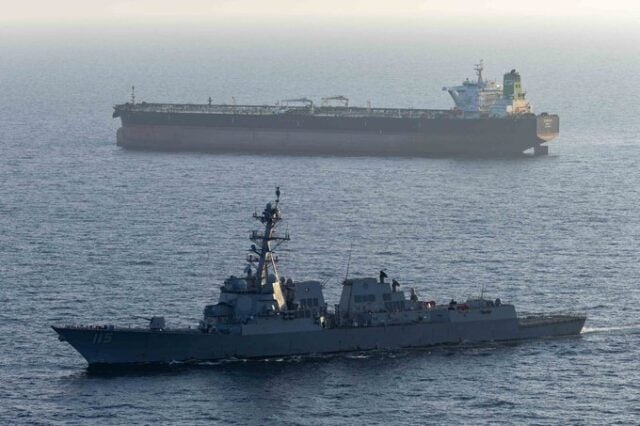
On the water, the situation remains tense but controlled. The U.S. Navy’s 5th Fleet continues to enforce the blockade with a heavy presence of Arleigh Burke-class destroyers and littoral combat ships.
On April 26, the USS Rafael Peralta (DDG 115) intercepted the M/T Stream, a tanker allegedly attempting to smuggle supplies into an Iranian port in violation of the blockade. This enforcement comes on the heels of a “shoot and kill” order issued by the President last week, targeting Iranian small boats caught laying sea mines in the shipping lanes.
Despite the blockade, maritime intelligence from Windward AI indicates that some “shadow fleet” traffic continues to move through Pakistani territorial waters using AIS spoofing techniques. However, these volumes are a fraction of what Iran requires to sustain its national budget, which has been gutted by the combination of sanctions and the direct military costs of the 2026 conflict.
International Pressure and the Macron Factor
While Washington and Tehran trade barbs, international allies are growing restless. French President Emmanuel Macron announced on Monday that he would speak with Iranian leadership in the coming days to press for a “unconditional” reopening of the Strait.
“The international community supports reopening the Strait of Hormuz,” Macron told reporters. “We hope to convince the stakeholders that this waterway is not a bargaining chip.”
The French Foreign Minister, Jean-Noël Barrot, echoed this sentiment at the UN Security Council, stating that while the nuclear program is the ultimate goal, the immediate maritime crisis is holding the global food and fertilizer supply chain at risk.
The Road Ahead: Diplomacy or Escalation?
As of Monday night, the ball remains in Tehran’s court. The Trump administration has signaled that while the door to a “phone call” is open, the current proposal lacks the “major concessions” required to lift the blockade.
Inside Iran, the leadership appears divided. Intelligence reports suggest that while the “reformist” wing under Araghchi is pushing for a deal to save the economy, the IRGC (Islamic Revolutionary Guard Corps) leadership remains committed to using the Strait as a strategic “choke” on the West.
If a breakthrough is not reached within the next 48 to 72 hours, analysts warn that the “ceasefire” established after the February 28 military strikes could collapse. With Iran’s oil industry “trapped like drowning rats,” as Secretary Bessent put it, the regime may feel it has nothing left to lose but to attempt a forceful breakout from the blockade—a move that would almost certainly trigger a full-scale return to kinetic warfare.
For now, the world watches the White House, waiting to see if the 47th President will take the call, or if Secretary Rubio’s “no” stands as the final word in this high-stakes game of maritime chicken.
Sources Used and Links:
- Institute for the Study of War (ISW): Iran Update Special Report, April 27, 2026
- Axios: (Referenced in various reports regarding the “new proposal” framework)
- ANI News: Iran offers “new proposal” via Pakistan to end war, reopen Strait of Hormuz
- Fox News: Iran makes new offer to open Strait of Hormuz, seeks end of US blockade
- The Times of Israel: Rubio rejects new Iranian proposal to reopen Strait of Hormuz
- Ukrainska Pravda: US secretary of state responds to Iran’s proposal on Strait of Hormuz
- Anadolu Agency: Trump unhappy with Iran’s proposal on Strait of Hormuz: Report
- PBS NewsHour: Trump likes a naval blockade. But Iran presents major differences
- Windward AI: April 27, 2026: Iran War Maritime Intelligence Daily
Disclaimer
Artificial Intelligence Disclosure & Legal Disclaimer
AI Content Policy.
To provide our readers with timely and comprehensive coverage, South Florida Reporter uses artificial intelligence (AI) to assist in producing certain articles and visual content.
Articles: AI may be used to assist in research, structural drafting, or data analysis. All AI-assisted text is reviewed and edited by our team to ensure accuracy and adherence to our editorial standards.
Images: Any imagery generated or significantly altered by AI is clearly marked with a disclaimer or watermark to distinguish it from traditional photography or editorial illustrations.
General Disclaimer
The information contained in South Florida Reporter is for general information purposes only.
South Florida Reporter assumes no responsibility for errors or omissions in the contents of the Service. In no event shall South Florida Reporter be liable for any special, direct, indirect, consequential, or incidental damages or any damages whatsoever, whether in an action of contract, negligence or other tort, arising out of or in connection with the use of the Service or the contents of the Service.
The Company reserves the right to make additions, deletions, or modifications to the contents of the Service at any time without prior notice. The Company does not warrant that the Service is free of viruses or other harmful components.