As the second term of President Donald Trump moves into its second year, a wave of new polling data released in April 2026 paints a challenging picture for the administration. Faced with a persistent conflict in the Middle East and a domestic economy struggling under the weight of inflation and high energy costs, the President’s approval ratings have reached some of the lowest points of his presidency. From the boardrooms of Wall Street to the living rooms of middle America, the “honeymoon period” of the 2024 victory has firmly given way to public skepticism and mounting political pressure.
The Approval Rating Crisis
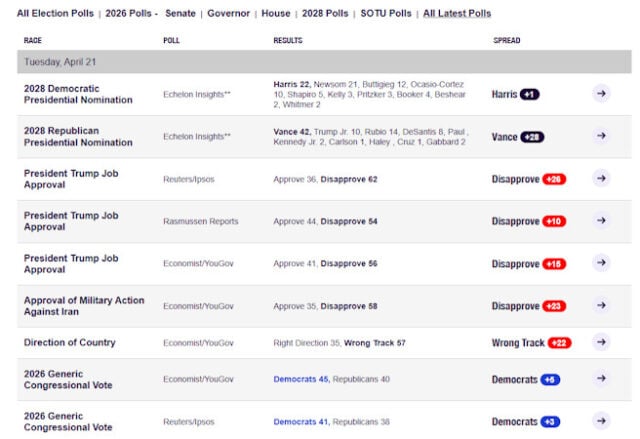
According to the latest data from the AP-NORC Center for Public Affairs Research, President Trump’s overall job approval rating has fallen to 33% in April 2026, a notable decline from the 38% recorded just one month prior. This downward trend is corroborated by other major polling entities. The Yale Youth Poll shows a slightly higher, but still underwater, approval rating of 41% overall, while highlighting a massive 57% disapproval rate among the general electorate.
Comparing these figures to his historic performance, Chatham House notes that Trump entered his second term with an approval rating of approximately 47% on Inauguration Day 2025. The current slump to the mid-30s mirrors the lows seen during his first term in late 2017 and is comparable to the floor of his predecessor, Joe Biden, whose rating dipped to 36% during the peak of 2022 inflation. However, the speed of this decline—a drop of nearly 15 points in 15 months—has raised alarms within the Republican party as the 2026 midterm elections approach.
The Economy: A Domestic Achilles’ Heel
The most significant driver of public dissatisfaction is the economy, specifically the “cost of living.” While the President frequently touts his administration’s “golden age” of economic policy, the lived experience of many Americans tells a different story. The AP-NORC poll found that a staggering 73% of Americans describe the national economy as “poor,” with 72% believing the country is headed in the wrong direction.

Approval of the President’s handling of the economy has slumped to 30%, down from 38% in March. Even more critical is the public’s view on the cost of living; only 23% to 25% of U.S. adults approve of the administration’s efforts to manage daily expenses. Inflation, which stands at 3.3%, remains slightly higher than the levels Trump inherited upon his return to the White House. This persistence has led to what Reuters/Ipsos calls a state of “skepticism,” with only one in four Americans approving of his handling of rising prices.
Gasoline prices have become a visceral symbol of this economic strain. Following military actions in Iran in February 2026, oil prices jumped roughly 35%, settling around $90 a barrel. While the President dismissed the conflict as a “little journey” and suggested he expected prices to hit $200, the public has been less forgiving. YouGov polling indicates that 47% of Americans feel gas prices are “going up a lot,” and this perception is tightly bound to their disapproval of the ongoing war.
Furthermore, Trump’s signature trade policies are facing renewed scrutiny. A Fox News survey cited by Chatham House found that 60% of respondents disapprove of the administration’s imposition of tariffs, with many believing these measures hurt individual family budgets.
Foreign Policy and the Shadow of Iran
Foreign policy has historically been a secondary concern for voters, but the current conflict in the Middle East has moved it to the forefront. Net approval for the President’s foreign policy has hit a record low of -18 according to Economist/YouGov polls. While 36% of Americans approve of his handling of the situation, 54% strongly or somewhat disapprove.
The conflict with Iran, characterized by Trump as a “little journey,” has tested the patience of the electorate. Public sentiment has shifted toward a desire for de-escalation; the majority of Americans now approve of a ceasefire and want the U.S. to make a deal to end the war as quickly as possible. Interestingly, the polling shows that the views of Pope Leo XIV on the Iran war currently enjoy more public support than those of the President.
Beyond the Middle East, the U.S. role in other global conflicts remains a point of contention. Support for military aid to Ukraine currently outpaces support for military aid to Israel, reflecting a complex and shifting landscape of American internationalism. Overall, 52% of Americans believe that the nation’s standing in the world has worsened since the start of the second Trump term.
Demographic Shifts and the Partisan Divide
The polling reveals a deepening chasm between different segments of the American population. The “Make America Great Again” (MAGA) base remains remarkably resilient; approximately 90% of MAGA-identifying Republicans approve of Trump’s job performance. However, this loyalty does not extend to the entire party. Among non-MAGA Republicans, approval has dropped to 44%.
The most dramatic shifts are occurring among younger voters and women. The Yale Youth Poll indicates that 68% of voters aged 18-22 and 75% of those aged 30-34 disapprove of the President. The administration has lost significant ground with women under 35 and men under 30. Furthermore, 82% of Democrats now believe their congressional leaders should “stand up” to the President, even if it causes legislative gridlock.
Independence is also waning. Pew Research reports that backing from self-identified independents has fallen 21 percentage points over the last year. This erosion is particularly dangerous for the GOP as it looks to maintain its House and Senate majorities in the upcoming midterms.
Leadership, Ethics, and Physical Fitness
Public confidence in the President’s personal attributes is also under pressure. Pew Research highlights that only 34% of Americans are “extremely or very confident” in Trump’s leadership skills. Concerns regarding his age and fitness have persisted; an Economist/YouGov poll found that 48% of Americans believe the President is suffering from “modest or significant cognitive decline.”
Ethical concerns remain a prominent issue for the opposition and a growing number of skeptics. Only 21% of Americans express confidence that the President acts ethically in office. This lack of trust extends to his choice of advisors, with only 25% of the public believing he selects high-quality personnel.
Symbolic projects have also met with resistance. A proposal to build a 250-foot “United States Triumphal Arch” in Washington, D.C., has failed to capture the public imagination, with 54% of Americans opposing the project compared to only 26% in favor.
Key Issues for the Electorate
When asked to prioritize the issues that will determine their vote in the 2026 midterms, Americans are focused on domestic stability. The top-tier issues identified across multiple polls include:
- Cost of Living/Affordability: Cited by 84% of voters as a primary concern.
- Healthcare: 75% of voters rank this as a top priority.
- Democracy and Corruption: 75% and 72% respectively.
- Housing: Particularly among voters under 35.
- Immigration and Crime: While still significant, these rank below the immediate economic concerns in recent weeks.
Conversely, issues like the conflict in Ukraine, relations with China, and cultural debates over AI or social acceptance of marginalized groups rank significantly lower on the list of immediate voter priorities.
Conclusion: The Road to the Midterms
As April 2026 comes to a close, the Trump administration finds itself in a defensive posture. The combination of “sticky” inflation, high energy costs, and a controversial foreign war has created a “perfect storm” of polling headwinds. While the President’s core base remains unmoved, the loss of support among independents, women, and young voters suggests a volatile political environment.
The upcoming months will likely see the administration attempting to pivot back to economic growth and perhaps seeking a definitive resolution to the Iran conflict to soothe public anxiety. However, with 47% of Americans already predicting that Trump will be an “unsuccessful” president in the long term, the window to reshape his second-term narrative may be narrowing.
Sources and Links
- AP-NORC: “Trump’s approval on economy falls in AP-NORC poll, showing new warning signs for president” https://apnews.com/article/trump-approval-iran-economy-cost-of-living-poll-fff492898cc8ff34e11df90ec4837a79
- PBS News: “Approval of Trump on economy falls in new AP-NORC poll, as Iran war drives up prices” https://www.pbs.org/newshour/politics/approval-of-trump-on-economy-falls-in-new-ap-norc-poll-as-iran-war-drives-up-prices
- Yale Youth Poll: “Spring 2026 Results” https://youthpoll.yale.edu/spring-2026-results
- Chatham House: “Donald Trump’s poll numbers suggest his popularity is waning” https://www.chathamhouse.org/2026/01/donald-trumps-poll-numbers-suggest-his-popularity-waning
- Pew Research Center: “Confidence in Trump Dips, and Fewer Now Say They Support His Policies and Plans” https://www.pewresearch.org/politics/2026/01/29/confidence-in-trump-dips-and-fewer-now-say-they-support-his-policies-and-plans/
- YouGov: “Iran, Trump’s health, gas prices, and more: April 10 – 13, 2026 Economist/YouGov Poll” https://yougov.com/en-us/articles/54536-iran-gas-prices-donald-trump-health-jd-vance-marijuana-april-10-13-2026-economist-yougov-poll
- YouGov: “The pope, the president, the war with Iran, Ukraine, Israel, and more: April 17 – 20, 2026 Economist/YouGov Poll” https://yougov.com/en-us/articles/54593-pope-leo-president-donald-trump-war-iran-ukraine-israel-april-17-20-2026-economist-yougov-poll
- Ipsos: “Americans remain skeptical of Trump’s handling of inflation” https://www.ipsos.com/en-us/americans-remain-skeptical-trumps-handling-inflation
- AP-NORC Center: “Fewer approve of Trump’s handling of the economy” https://apnorc.org/projects/fewer-approve-of-trumps-handling-of-the-economy/
Disclaimer
Artificial Intelligence Disclosure & Legal Disclaimer
AI Content Policy.
To provide our readers with timely and comprehensive coverage, South Florida Reporter uses artificial intelligence (AI) to assist in producing certain articles and visual content.
Articles: AI may be used to assist in research, structural drafting, or data analysis. All AI-assisted text is reviewed and edited by our team to ensure accuracy and adherence to our editorial standards.
Images: Any imagery generated or significantly altered by AI is clearly marked with a disclaimer or watermark to distinguish it from traditional photography or editorial illustrations.
General Disclaimer
The information contained in South Florida Reporter is for general information purposes only.
South Florida Reporter assumes no responsibility for errors or omissions in the contents of the Service. In no event shall South Florida Reporter be liable for any special, direct, indirect, consequential, or incidental damages or any damages whatsoever, whether in an action of contract, negligence or other tort, arising out of or in connection with the use of the Service or the contents of the Service.
The Company reserves the right to make additions, deletions, or modifications to the contents of the Service at any time without prior notice. The Company does not warrant that the Service is free of viruses or other harmful components.