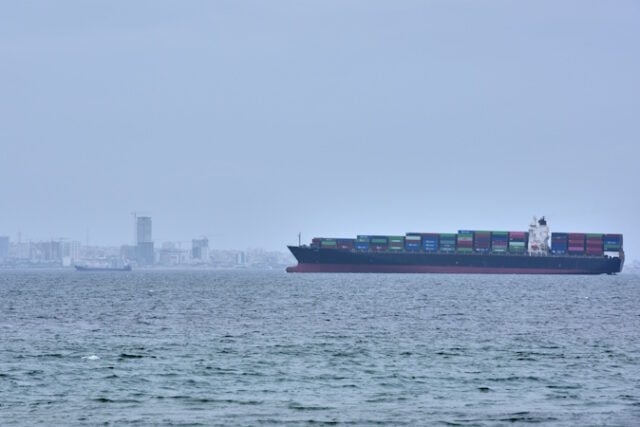
The Mid-Day Shocker: A Ceasefire with Teeth
In a move that sent tremors through the trading floors of Wall Street and the corridors of the United Nations, President Donald J. Trump announced via Truth Social this Tuesday that the United States would grant an “indefinite extension” to the current ceasefire with the Islamic Republic of Iran. The announcement, coming just hours before a critical midnight deadline that many feared would signal the start of a massive aerial campaign, was initially met with a brief sigh of relief from global markets.
However, that relief was short-lived. In the very same breath—and the very same social media thread—the President clarified that the “extension” only applied to kinetic military strikes. The brutal, suffocating naval blockade of Iranian ports and oil terminals will not only remain in place but will be enforced with “new and devastating vigor.”
“Based on the fact that the Government of Iran is seriously fractured… I have directed our Military to continue the Blockade and, in all other respects, remain ready and able, and will therefore extend the Ceasefire until such time as their proposal is submitted,” Trump posted Tuesday morning.
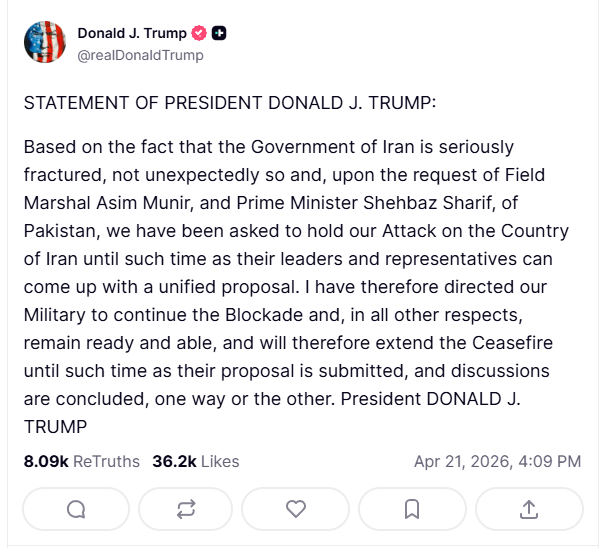 The duality of this policy—offering a diplomatic window while simultaneously tightening a literal noose around the Iranian economy—has left analysts scrambling to define this new phase of “Maximum Pressure 2.0.” It is a ceasefire that stops the bombs but continues the economic strangulation, a strategy that the administration claims is the only way to force a “unified proposal” from a Tehran leadership it describes as “broken.”
Tuesday’s Interdiction: The Seizure of the M/T Tifani
Proving that the blockade is far from a paper tiger, the Pentagon confirmed Tuesday afternoon that U.S. forces successfully boarded and seized the M/T Tifani, a stateless oil tanker, in the Bay of Bengal. The vessel, which has long been on the Treasury Department’s radar as part of Iran’s “shadow fleet,” was reportedly carrying over one million barrels of illicit Iranian crude destined for Asian markets.

This marks the second major maritime interdiction in just three days. On Sunday, the U.S. Navy seized the Iranian-flagged cargo ship Touska after a high-stakes pursuit in which an American destroyer reportedly “blew a hole” in the ship’s engine room to force a stop. The seizure of the Tifani on Tuesday, however, was described by the Pentagon as occurring “without incident,” suggesting that the shadow fleet’s operators are beginning to realize the futility of resisting the U.S. Fifth and Seventh Fleets.
“The United States Navy will continue the blockade of Iranian ports,” Treasury Secretary Scott Bessent warned in a follow-up statement. “Any vessel or intermediary involved in facilitating those flows risks exposure to U.S. sanctions. We are systematically degrading Iran’s ability to generate, move, and repatriate funds.”
Market Chaos: Futures, Volatility, and the Brent-WTI Spread
The reaction in the energy markets has been nothing short of schizophrenic. Immediately following the news of the ceasefire extension, oil futures saw a sharp, algorithmic “flush,” with Brent crude dropping nearly $3 per barrel on hopes of de-escalation. However, as the details of the ongoing blockade and the seizure of the Tifani filtered through, those gains were erased.
As of Tuesday evening, the Brent-WTI spread has widened to a staggering $15 per barrel, a level not seen since the height of the 2011 Arab Spring. This massive gap reflects a bifurcated global market: U.S. domestic supply (WTI) remains relatively stable thanks to record-breaking North American production, but the global benchmark (Brent) is being hammered by the disappearance of Iranian volumes and the risk premium associated with the Strait of Hormuz.
The $4.30 Reality: Gas Prices at the Pump
For the average American, the geopolitical chess match is translating into a painful reality at the gas station. According to the latest Short-Term Energy Outlook from the Energy Information Administration (EIA), the national average for retail gasoline is projected to hit $4.30 per gallon this month.
While the Trump administration has been vocal about “Drill, Baby, Drill,” the sheer scale of the Iranian blockade has removed nearly 2 million barrels of oil per day from the global pool. J.P. Morgan Global Research analysts note that while they expect Brent to eventually stabilize around $60 if a deal is reached, the “geopolitical risk premium” is currently adding at least $10 to $15 per barrel to the price.
- National Gas Average: $4.30/gal (Projected April 2026)
- Diesel Average: $5.80/gal
- Brent Crude: $87/bbl (Spot)
- WTI Crude: $72/bbl (Spot)
The Pakistan Connection: Mediation or Delay?
The catalyst for the sudden extension appears to have come from an unexpected quarter: Islamabad. President Trump credited Pakistan’s Prime Minister Shehbaz Sharif and Chief of Army Staff for requesting the delay to allow for a “unified negotiating proposal” from Tehran.
The Iranian government is currently viewed by Western intelligence as deeply divided between pragmatists, led by Foreign Minister Abbas Araghchi, and hardliners within the IRGC who view the blockade as an act of war that justifies closing the Strait of Hormuz entirely. Vice President JD Vance had been scheduled for a high-stakes trip to Islamabad for a second round of indirect talks, but that trip remains “on hold” until the U.S. sees a concrete offer from the Islamic Republic.
“I’m not sure you can reach a deal with these guys,” Secretary of State Marco Rubio remarked, echoing the skepticism of many in the cabinet. “But we are giving them one last chance to come to the table before the pressure becomes unsustainable.”
The Shadow Fleet and Global Shipping Risks
The seizure of the M/T Tifani highlights a growing “war on the water” that extends far beyond the Persian Gulf. The U.S. is no longer just patrolling the Strait of Hormuz; it is hunting Iranian oil across the Indian Ocean and the Bay of Bengal.
The “shadow fleet”—a collection of aging, often uninsured tankers that use “spoofing” (falsifying AIS location data) and ship-to-ship transfers to hide the origin of their cargo—is now the primary target of U.S. Central Command. By seizing these ships, the U.S. is not only depriving Tehran of cash but also creating a massive insurance liability for any shipping company or nation willing to touch Iranian oil.
For the maritime sector, the impact is immediate and costly. Insurance premiums for “war risk” zones have tripled in the last month, and many major carriers are diverting ships around the Cape of Good Hope rather than risking the uncertainty of the U.S. blockade and potential Iranian retaliation in the Strait.
Conclusion: The Art of the Blockade
As we close the books on this Tuesday, the world remains in a state of “suspended escalation.” President Trump has successfully avoided the political fallout of a major new Middle Eastern war—for now—while maintaining maximum economic pressure.
Whether the Iranian leadership can survive a total blockade of their oil exports long enough to formulate a “unified proposal” remains the multibillion-dollar question. For the markets, the message is clear: expect volatility to be the only constant. Gas prices will remain high, futures will remain erratic, and the U.S. Navy will continue to be the world’s most aggressive “customs agent” on the high seas.
Sources Used and Links:
- gCaptain: Hormuz Shipping Disruptions Show No End as Trump Extends Ceasefire, Maintains Blockade
- Military.com: US Forces Board a Sanctioned Oil Tanker in the Indian Ocean, the Pentagon Says
- Energy Information Administration (EIA): Short-Term Energy Outlook for Petroleum Products – April 2026
- J.P. Morgan Global Research: Oil Price Forecast for 2026 and Geopolitical Risk Analysis
- Wikipedia: 2025–2026 Iran–United States Negotiations History
- Department of Justice: United States Seeks Forfeiture of Oil Tanker and 1.8M Barrels of Crude Oil
- King 5 News (Associated Press): Trump says the US will extend its ceasefire with Iran at Pakistan’s request
- The Guardian: Trump news at a glance: Trump backs off threat to resume bombing Iran and extends ceasefire
- CNBC: Trump says US ‘much more powerful than five weeks ago’ but grants ceasefire window
- Fox News: President Trump vows ‘positive action’ as ceasefire agreement with Iran reached
- Al Jazeera: Iran war: What is happening on day 53 of the US-Israel conflict?
- Washington Post: Trump extends ceasefire indefinitely as Iran says it won’t join talks now
- CBS News: Live Updates: Trump extends ceasefire as uncertainty over U.S.-Iran peace talks remains
- IranWire: U.S. Seizes Second Iranian Ship – M/T Tifani Interdicted
- Energy Information Administration (EIA): Short-Term Energy Outlook for Petroleum Products – April 2026
Disclaimer
Artificial Intelligence Disclosure & Legal Disclaimer
AI Content Policy.
To provide our readers with timely and comprehensive coverage, South Florida Reporter uses artificial intelligence (AI) to assist in producing certain articles and visual content.
Articles: AI may be used to assist in research, structural drafting, or data analysis. All AI-assisted text is reviewed and edited by our team to ensure accuracy and adherence to our editorial standards.
Images: Any imagery generated or significantly altered by AI is clearly marked with a disclaimer or watermark to distinguish it from traditional photography or editorial illustrations.
General Disclaimer
The information contained in South Florida Reporter is for general information purposes only.
South Florida Reporter assumes no responsibility for errors or omissions in the contents of the Service. In no event shall South Florida Reporter be liable for any special, direct, indirect, consequential, or incidental damages or any damages whatsoever, whether in an action of contract, negligence or other tort, arising out of or in connection with the use of the Service or the contents of the Service.
The Company reserves the right to make additions, deletions, or modifications to the contents of the Service at any time without prior notice. The Company does not warrant that the Service is free of viruses or other harmful components.