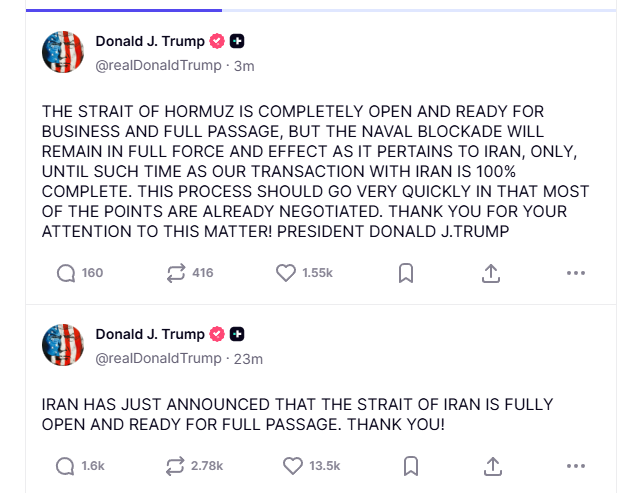
MUSCAT, Oman — In a development that has sent shockwaves through global financial centers and provided a glimmer of hope for a weary global economy, President Donald Trump and the Iranian leadership announced Friday that the Strait of Hormuz is officially open to all commercial maritime traffic. The agreement, brokered in the neutral grounds of Muscat, effectively ends the naval blockade and military hostilities that have choked 25% of the world’s seaborne oil trade since late February 2026.
The joint announcement, confirmed by the White House and the Iranian Foreign Ministry, marks the most significant diplomatic breakthrough in the Middle East in decades. It signals an end to the “Energy Shock of 2026,” a period of extreme volatility that saw crude oil prices soar past $115 per barrel and sparked fears of a prolonged global recession.
The Breakthrough in Muscat
The deal follows weeks of intense, high-stakes negotiations mediated by Omani Foreign Minister Badr bin Hamad Al Busaidi. While the “2026 Iran War”—initiated on February 28 with targeted strikes on Iranian infrastructure—had threatened to spiral into a regional conflagration, the two-week ceasefire that began on April 7 provided the necessary window for diplomacy.

President Trump, speaking from the Mar-a-Lago Club shortly after the announcement, characterized the deal as a masterclass in economic leverage. “We were very firm, we were very strong, and now we have a deal that is great for the world,” the President stated. “The Strait is open, the oil will flow, and the American worker is going to see those prices at the pump drop like a rock.”
Iranian Foreign Minister Abbas Araghchi echoed a tone of cautious pragmatism, noting that while deep ideological differences remain, the “economic reality of the blockade was unsustainable for all parties.”
Immediate Impact on Crude Oil Markets
The reaction in the commodities pits was instantaneous and violent. Upon the news breaking at 8:30 AM EDT, Brent Crude futures—the international benchmark—plunged by 14.2%, dropping from $96.40 to $82.70 in a single hour of trading. West Texas Intermediate (WTI), the U.S. benchmark, saw similar carnage, falling 13.8% to settle near $78.50.
Market analysts describe this as the “unwinding of the risk premium.” For the past two months, oil prices had included a “war premium” of roughly $20 to $30 per barrel, reflecting the fear that the Strait—through which 20.9 million barrels per day (b/d) normally flow—would remain closed indefinitely.
“What we are seeing is the market pricing out the worst-case scenario,” said James Sterling, Chief Energy Strategist at Global Macro Research. “The physical supply hasn’t even hit the refineries yet, but the guarantee of supply has destroyed the speculative bubble that was holding prices above $100.”
When Will Prices Drop at the Pump?
For the average consumer, the most pressing question is when this massive drop in crude prices will translate to lower costs at the gas station. According to data from the Energy Information Administration (EIA), retail gasoline prices in the United States averaged $3.70 per gallon in early April, up significantly from the $3.00 average seen in January before the conflict began.
Economists warn of the “Rocket and Feather” effect: prices tend to shoot up like a rocket when crude rises but float down like a feather when crude falls. However, the sheer scale of this drop suggests a faster-than-average correction.
- The 2-Week Lag: Most refined gasoline currently at stations was purchased by distributors when crude was at its peak. It typically takes 14 to 21 days for new, cheaper crude to be refined, transported, and sold at the pump.
- Inventory Clearing: Retailers must first sell through their existing, high-cost inventory before they can lower prices without taking a loss.
- Forecast: Experts predict a $0.15 to $0.25 drop per gallon within the first ten days, with a full correction of $0.60 to $0.80 possible by Memorial Day 2026, assuming the Strait remains stable.
The Strategic Importance of the Strait of Hormuz
To understand the magnitude of this announcement, one must look at the sheer volume of energy that passes through this 21-mile-wide chokepoint. According to International Energy Agency (IEA) reports for 2025 and early 2026:
| Metric | Volume/Percentage |
| Total Oil Flow | ~20.9 Million Barrels/Day |
| Global Seaborne Oil Trade | 25% – 27% |
| Global LNG Trade | 20% |
| Primary Destination | 84% to Asian Markets (China, India, Japan) |
The closure of the Strait essentially “locked in” 14 million barrels per day that have no viable alternative route. While Saudi Arabia’s East-West Pipeline and the UAE’s Fujairah Pipeline can bypass the Strait, their combined spare capacity is only 3.5 to 5.5 million b/d, leaving a massive deficit that could only be resolved by reopening the waterway.
Naval De-escalation and Security Protocols
The deal includes a strict maritime security framework. U.S. Central Command (CENTCOM) and the Iranian Navy have reportedly agreed to a “blue corridor” system. Commercial vessels will be escorted by a multinational task force to ensure that no mines or “rogue elements” interfere with the transit.
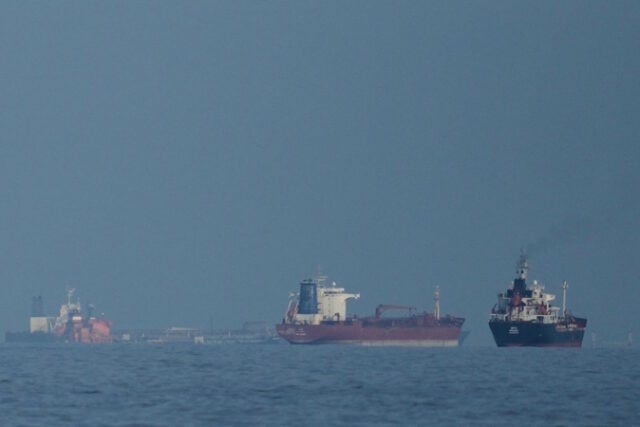
“The technical challenge now is clearing the backlog,” noted Admiral Brad Cooper of CENTCOM. “We have over 130 commercial tankers currently anchored in the Gulf of Oman and the Arabian Sea. It will take approximately 10 to 14 days to resume a normal rhythm of traffic.”
The “Trump Doctrine” and Geopolitical Shifts
Political analysts are already dissecting how this agreement fits into the broader “Trump 47” foreign policy. Unlike the JCPOA of the Obama era, this deal appears focused almost exclusively on maritime stability and energy security rather than a comprehensive nuclear overhaul—though the White House suggests that nuclear talks will resume in May as a “Step 2.”
“Trump used the threat of the carrier groups and the reality of the strikes in February to bring Tehran to the table,” said Sarah Jenkins of the Institute for the Study of War. “But he also offered an off-ramp: the lifting of specific secondary sanctions on petrochemicals in exchange for the Strait opening. It’s a transaction, not a treaty.”
Global Economic Relief
The news has provided a massive tailwind for global equity markets. The S&P 500 rose 2.4% in morning trading, while the Nikkei 225—representing a nation that imports nearly 90% of its oil through Hormuz—jumped 4.1% in overnight trading.
For European nations like Germany and France, which have struggled with high energy costs and the “snapback” of U.N. sanctions, the reopening of the Strait provides a crucial buffer against inflation. It also reduces the pressure on China, the largest consumer of Persian Gulf oil, which had been increasingly vocal about the U.S. military’s role in the region.
A Fragile Peace
Despite the euphoria, skeptics remain. The agreement is described as a “durable ceasefire” rather than a permanent peace treaty. Iranian hardliners in the Majlis have already criticized the concessions, while some U.S. lawmakers argue that the deal does not go far enough in dismantling Iran’s missile program.
However, for a world that spent the spring of 2026 looking into the abyss of a global energy crisis, the image of tankers once again moving through the Strait of Hormuz is the most positive signal in years. As one trader on the NYMEX floor put it: “The risk of World War III just dropped by 50%, and the price of oil followed it.”
Sources Used and Links:
- International Energy Agency (IEA): “Strait of Hormuz – About – Oil Security and Emergency Response” (2025-2026 Data). https://www.iea.org/about/oil-security-and-emergency-response/strait-of-hormuz
- U.S. Energy Information Administration (EIA): “Short Term Energy Outlook (STEO)” – April 7, 2026 Update. https://www.eia.gov/outlooks/steo/
- Rigzone: “EIA Boosts 2026 Brent Oil Price Projection to $96” – Published April 15, 2026.
- https://www.rigzone.com/news/eia_boosts_2026_brent_oil_price_projection_to_96-15-apr-2026-183451-article/
- Institute for the Study of War (ISW): “Iran Update Special Report, April 15, 2026.” https://understandingwar.org/research/middle-east/iran-update-special-report-april-15-2026/
- Wikipedia (Current Events Simulation): “2025–2026 Iran–United States negotiations.” https://en.wikipedia.org/wiki/2025%E2%80%932026_Iran%E2%80%93United_States_negotiations
- ICIS (Independent Commodity Intelligence Services): “US forecasts for oil prices up 46% from start of 2026.” https://www.icis.com/explore/resources/news/2026/04/07/11195661/us-forecasts-for-oil-prices-up-46-from-start-of-2026
- Speed Commerce Insights: “How Much of the World’s Shipping & Oil Goes Through the Strait of Hormuz? 2025 vs 2026.” https://www.speedcommerce.com/insights/how-much-of-the-worlds-shipping-goes-through-the-strait-of-hormuz/
Disclaimer
Artificial Intelligence Disclosure & Legal Disclaimer
AI Content Policy.
To provide our readers with timely and comprehensive coverage, South Florida Reporter uses artificial intelligence (AI) to assist in producing certain articles and visual content.
Articles: AI may be used to assist in research, structural drafting, or data analysis. All AI-assisted text is reviewed and edited by our team to ensure accuracy and adherence to our editorial standards.
Images: Any imagery generated or significantly altered by AI is clearly marked with a disclaimer or watermark to distinguish it from traditional photography or editorial illustrations.
General Disclaimer
The information contained in South Florida Reporter is for general information purposes only.
South Florida Reporter assumes no responsibility for errors or omissions in the contents of the Service. In no event shall South Florida Reporter be liable for any special, direct, indirect, consequential, or incidental damages or any damages whatsoever, whether in an action of contract, negligence or other tort, arising out of or in connection with the use of the Service or the contents of the Service.
The Company reserves the right to make additions, deletions, or modifications to the contents of the Service at any time without prior notice. The Company does not warrant that the Service is free of viruses or other harmful components.